

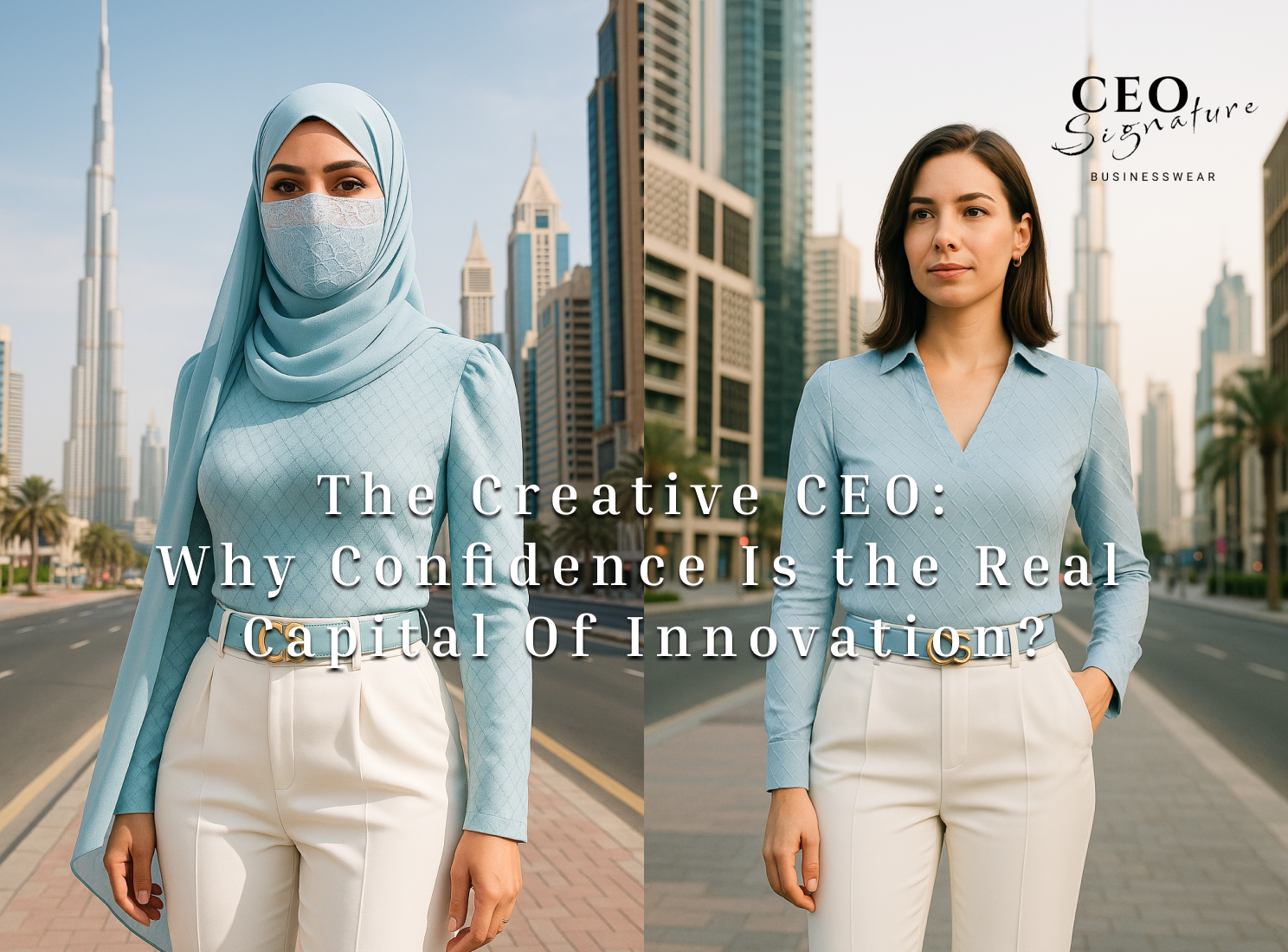
Impostor Syndrome, Creativity & Leadership in the Lives of Christian and Arab Women Leaders.
In every boardroom where blueprints for the future are drawn, in every studio where fashion lines are sketched into existence, in every digital startup assembled between coffee rituals and whispered prayers, one currency moves more powerfully than money, more decisively than connections, and more enduringly than trend: Confidence.
It’s not confidence as bravado, nor performative assurance or polished bravura. But the deep, unwavering knowing of identity - the internal conviction that allows a woman to speak vision before the world believes it, to create what has never yet been affirmed, and to lead long before applause arrives. At Martin’s, we call this the real capital of innovation. Without confidence, creativity becomes timid - without creativity, leadership becomes mechanical, and without leadership, vision dies unborn. At the intersection of these three forces - Impostor Syndrome, Creativity, and Leadership - stands the modern Creative CEO: A woman of intellect and faith, strategy and spirit, elegance and endurance. She builds empires within environments that often misunderstand, silence or underestimate her ambition. Even when the world recognises her, she battles a private adversary within herself: Impostor syndrome.
The Silent Enemy of Creative Leadership.
Impostor syndrome does not appear to be a threat. It arrives disguised as humility. It sounds like prudence. It mimics realism. It whispers: You are not enough. You are not qualified. You were lucky to arrive - you will be exposed soon. This internal voice does more damage to women CEOs than any discriminatory ceiling or financial barrier because it turns the mind into a battleground. Impostor thinking can be particularly corrosive for creative leaders, especially women, who generate culture rather than merely managing it. Creativity requires courage. Leadership requires daring. Impostor Syndrome steals both.
Creativity: The CEO’s Most Vital Skill.
Contrary to outdated business doctrine, the most essential skill of the 21st-century CEO is not accounting prowess or strategic modelling - it is creativity. Creativity is the capacity to:
- See the possibility before profit exists
- Design solutions before infrastructure forms
- Imagine cultural movements, not just products
- Hold vision steady during early instability
Creative CEOs do not wait for permission to create - they authorise themselves, and yet, impostor syndrome convinces even the most capable leaders that:
“I don’t deserve to imagine boldly. I should stay conservative.”
But conservatism is death to innovation. Those who move industries forward do so through daring expression, visionary thought, revolutionary design, and courageous leadership - all sustained by authentic confidence.
The Creative CEO’s Crisis.
Across cultures, faith traditions, and entrepreneurial spheres, women CEOs face a convergence of pressures:
- Cultural expectations about femininity
- Leadership stereotypes that equate authority with aggression
- Economic inequities
- Faith-based tensions around visibility
- Internalized perfectionism
Together, these pressures ferment fertile ground for impostor syndrome. But the shape of the struggle differs across women’s lived experiences - particularly among Christian CEOs navigating faith expression in Western business frameworks, and Arab or Muslim women leaders balancing spiritual devotion with public leadership in patriarchal or conservative contexts.

1- Christian Female CEO’s.
Leadership Under the Gaze of Visibility.
Christian businesswomen often build within environments that celebrate ambition outwardly but quietly discourage overt spiritual grounding. These women face a unique tension:
“Be powerful - but don’t be visibly faith-driven.”
Public leadership rewards boldness - but faith encourages humility. Christian CEOs wrestle inwardly with questions such as:
- How do I lead without appearing prideful?
- Is ambition aligned with spiritual humility?
- Will visible faith reduce professional credibility?
This produces a spiritualized impostor syndrome - a fear that leadership aspiration contradicts piety. Some Christian CEOs dull their creative voice out of subconscious guilt:
- Playing small to avoid appearing arrogant
- Hesitating to claim authority
- Overworking to “earn” space rather than occupying it naturally
The psychological result is exhaustion disguised as virtue.
The Inner Conflict.
Christian creative leaders often overspiritualize sacrifice:
- They romanticise burnout.
- They confuse invisibility with humility.
- They believe diminishing presence equals spiritual purity.
Suddenly, the lie whispers:
“True leaders stay unseen.”
But history disproves this. From Lydia to Esther, Deborah to Priscilla - faith-led women throughout Scripture were visible leaders whose divine authority was unmistakable. Leadership does not negate spirituality - it manifests it.

Arab and Muslim Female CEO’s.
Leadership Within Cultural and Religious Constraints.
Arab women CEOs encounter a distinctly different labyrinth of challenges:
- Cultural modesty expectations
- Patriarchal leadership environments
- Global stereotypes about female agency
- Misrepresentation within Western media
These women must master the dance of: Visibility without violating values, power without erasing modesty, and success without compromising spirituality. Their impostor syndrome is shaped by:
- Limited representation of empowered Arab women leaders
- External scrutiny amplified by identity politics
- Pressure to represent entire cultures rather than individual capability
Some internalise doubt not over competence - but over legitimacy:
“Do I have permission to lead this visibly?”
The Armour of Modesty.
Where Christian leaders struggle to integrate faith and ambition, Arab women must integrate faith and visibility. Their battle is not merely internal - it’s societal. Yet their creative power is exceptional:
- They operate with cultural sensitivity
- They possess emotional intelligence honed by constraint
- Their fashion becomes symbolic - every garment negotiating aesthetic authority
Modesty becomes a leadership language rather than submission - flowing lines conveying dignity; covered silhouettes expressing sovereignty. But impostor syndrome lurks even here:
- Am I respected or tolerated?
- Am I authentic or assimilated?
Confidence: The Only True Innovation Capital.
Finance scales ideas, but confidence births them. Innovation does not emerge from certainty - it arises from conviction. Before markets validate vision, confidence authorises it. This principle stands central to Martin’s philosophy:
Confidence is not personality - it is capital.
It is the asset no investor can fund - but without which no investment survives. Confidence fuels:
- Creative resilience
- Leadership clarity
- Visibility courage
- Cultural originality
When women CEOs possess confidence anchored in identity - not validation - they stop performing leadership and start embodying authority.
Comments ()