

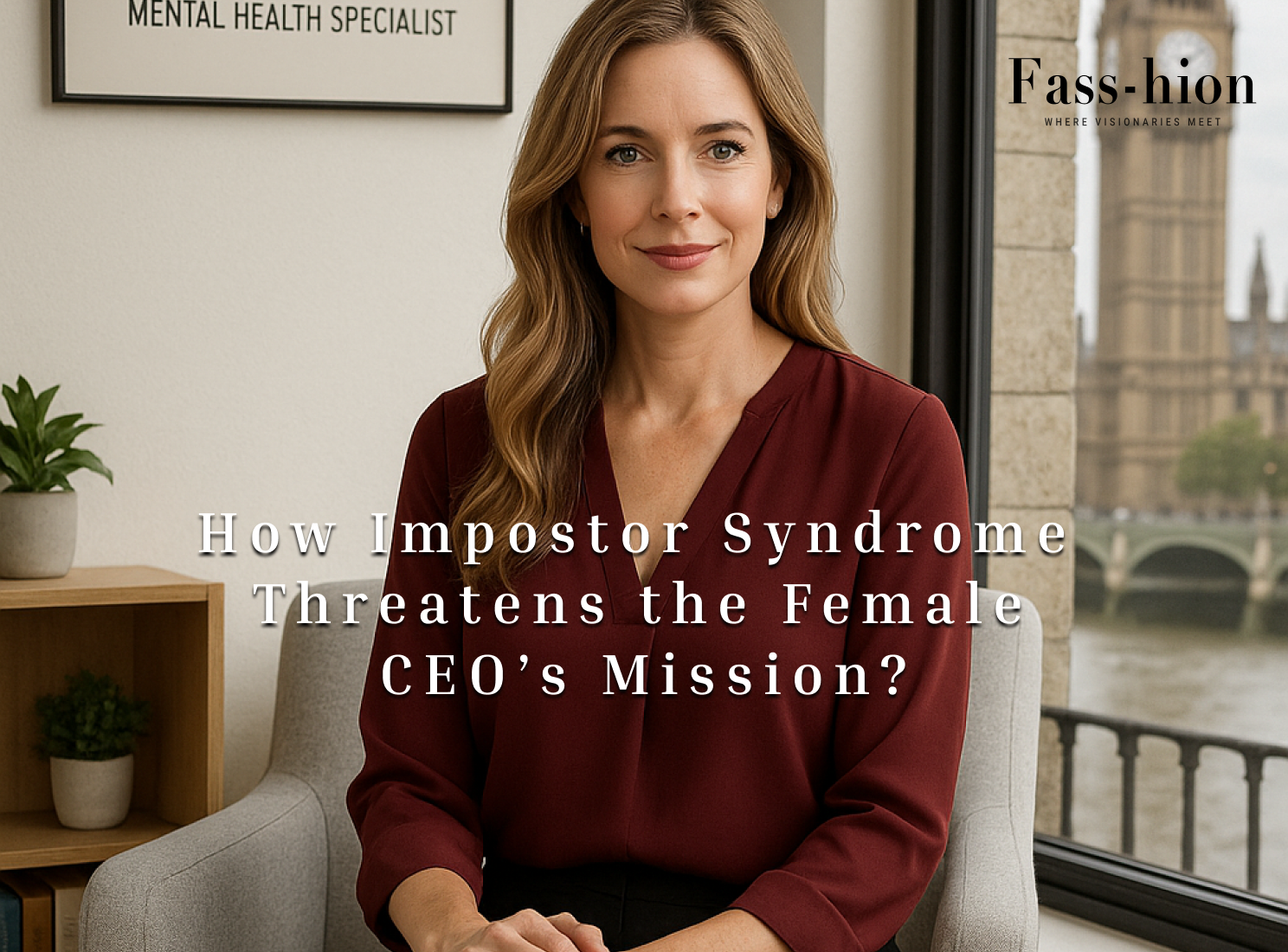
An Exclusive FASS-HION Interview With Dr Pamela Kofner, Mental Health Specialist.
In the shimmering world of ambition - where women build global brands from kitchen tables, transform intuition into innovation, and carry purpose into profit - an unspoken adversary is stalking the corridors of power. She shatters confidence at the moment of celebration, questions authority when leadership is established, and corrodes belief when destiny begins to unfold. Her name is Impostor Syndrome.
It is a psychological shadow that follows even the most accomplished women - especially female CEOs and entrepreneurs driven by creativity, mission, and legacy. Behind closed doors, many of these women silently wrestle with the belief that their success is tenuous, undeserved, or temporary. The irony is piercing:
The women most affected by Impostor Syndrome are often the most gifted.
Creativity - the most vital CEO skill - cannot flourish in the face of constant doubt. Vision weakens without belief. An entrepreneurial mission cannot expand when the leader herself feels unworthy of the call. In this exclusive editorial conversation, FASS-HION sits down with Dr Pamela Kofner, internationally respected mental-health specialist, executive therapist, and trauma-informed mentor to visionary leaders, to unpack the real impact of Impostor Syndrome on female entrepreneurs - and what must be done to defeat it. This is not merely an interview - this is a liberation manifesto for women ready to reclaim their authority.
What Is Impostor Syndrome?
FASS-HION: Dr Kofner, how do you define Impostor Syndrome?
Dr Pamela Kofner: “Impostor Syndrome is the persistent belief that your success is fraudulent - that eventually you’ll be discovered as incompetent or undeserving, regardless of credentials, results, or achievements. It is not a clinical diagnosis but a psychological pattern rooted in fear, perfectionism, and identity distortion.”
She continues: “It often manifests as chronic self-doubt, minimisation of accomplishments, fear of exposure, creative paralysis, overworking, or avoiding leadership opportunities.”
Women, she explains, experience the syndrome more intensely because of historic marginalisation, limited representation in power structures, social perfection conditioning, and the emotional burden of visibility.
“When women step into leadership,” Kofner says, “They are not merely building businesses - they are breaking generational ceilings. The subconscious pressure of that responsibility fuels the syndrome.”
1- Why Female CEOs Are Particularly Vulnerable.
Female entrepreneurs carry pressures beyond profit margins:
- They must perform to an excellent standard while dispelling stereotypes.
- They often lead without adequate mentorship.
- Their success invites harsher scrutiny than their male counterparts.
“The psychological load placed on women founders is disproportionate,” Dr Kofner notes. “They are expected to be visionary, flawless, emotionally caring, and endlessly resilient.” This creates fertile ground for impostor thoughts:
- “I don’t belong here.”
- “Someone else could run this better.”
- “This success is temporary.”
The consequences extend far beyond emotional discomfort - they strike directly at the entrepreneurial mission.
2- Creativity: The CEO’s Most Powerful Skill.
Creativity is not an accessory to leadership - it is leadership’s backbone. A CEO’s creativity fuels:
- Brand differentiation
- Product innovation
- Strategic problem-solving
- Cultural influence
Yet impostor syndrome suffocates creativity. “When doubt occupies mental space,” Dr Kofner explains, “innovation retreats.” This results in:
- Risk avoidance
- Hesitation toward expansion
- Vision dilution
- Safe, uninspired decision-making
True leadership is bold, and Impostor Syndrome breeds restraint. What is the result? Businesses plateau - not from lack of talent, but absence of belief.
3- When Doubt Masquerades as Laziness.
One of the most destructive manifestations of Impostor Syndrome is how it disguises itself as delay or “laziness.” Not because the CEO is unmotivated - but because fear convinces her that effort may be pointless. Why fully promote your brand if you don’t feel worthy of success? Why finish a project if you believe it won’t matter? Dr Kofner is direct: “Impostor Syndrome doesn’t rob women of ambition, it undermines their permission to pursue it.” Procrastination, hesitation, and inconsistent execution are not laziness. They are symptoms of fear-induced paralysis.
4- The Lie of Luck.
Another deadly impostor narrative: “I just got lucky.” Dr Kofner firmly dismantles this myth: “No amount of luck reproduces discipline, insight, stamina, or courage. What women call luck is their excellence refusing to be acknowledged.” Every revenue milestone achieved… Every team member hired… Every product launched… These are not accidents. They are evidence of competence.
5- You Are Unrepeatable.
Impostor Syndrome convinces women to blend into industries where dominance requires distinctiveness. But business prizes uniqueness. Your creativity, perspective, leadership energy, and personal brand. “There is no replacement for originality,” Dr Kofner emphasises. “No one else leads exactly as you do.” Your edge in business is not conformity - it is authentic expression.
6- The Loneliness of Command.
Leadership is often isolating. CEOs shoulder:
- Final responsibility
- Visionary solitude
- Emotional containment
This isolation breeds internal doubt: “If it’s lonely, maybe I don’t belong here.” Dr Kofner reframes: “Leadership isolation is not rejection - it is ascension. You’re alone because you’re ahead.”
7- Impostor Syndrome: A Battlefield of the Mind.
Impostor Syndrome doesn’t shout. It whispers. “I’ll fail.” “People are more capable than I am.” “I don’t deserve this role.” Belief precedes behaviour, and if lies shape thought, they shape destiny.

Where “Martin’s” Enters the Narrative.
While therapy addresses cognitive healing, women CEOs also need something that goes deeper - a re-anchoring of identity, purpose, and vision. This is where Martin’s emerges as transformational support. Martin’s is not a branding company. It is an identity restoration house for visionaries.
Built to serve women of faith, creativity, leadership, and entrepreneurial purpose, Martin’s specialises in rebuilding the inner lives of female CEOs affected by Impostor Syndrome, thereby simultaneously reinforcing their public leadership narratives. “Martin’s” understands a central truth:
You do not rebuild businesses by fixing strategies alone, you rebuild businesses by first restoring the woman behind them.
How Martin’s Rebuilds Female CEOs?
Martin’s supports women facing Impostor Syndrome through a three-pillar approach:
1- Identity Reclamation.
Impostor Syndrome fractures identity:
- Women forget who they are.
- They shrink from their calling.
- They minimise accomplishments.
Martin reclaims its identity by:
- Purpose-clarity coaching
- Prophetic storytelling
- Brand narrative alignment
Each CEO is guided to own her story boldly, using creative writing, vision articulation, and brand positioning to realign personal belief with real-world leadership. “You cannot lead what you refuse to embody,” Martin’s philosophy teaches. Women learn: I am not lucky. I am called. I am capable.
Comments ()