

You hit publish. You feel good about it. Maybe you share it in your stories, drop it in a group chat, or pin it at the top of your profile. For a few hours — maybe a day — it gets some traction. A few likes. A few saves. A comment or two.
Then nothing.
It's gone. Not just from the algorithm. It's gone from you. You move on to the next idea, start the cycle again, and weeks later you realize: nothing you've posted in the last three months is building on anything else. Each piece lives and dies alone. The audience isn't growing. The brand isn't strengthening. It feels like running on a treadmill at full speed and staying exactly in place.
This isn't bad luck. It isn't the algorithm conspiring against you. It's a structural problem — and it has a structural solution.
The real reason content disappears
Most creators diagnose this wrong. They think the problem is the content itself — the hook wasn't strong enough, the thumbnail was off, they posted at the wrong time. So they chase better content.
But better content doesn't fix a broken system. It just gives you more material to watch disappear.
The real problem is that most creators operate in what I call the Isolation Loop.
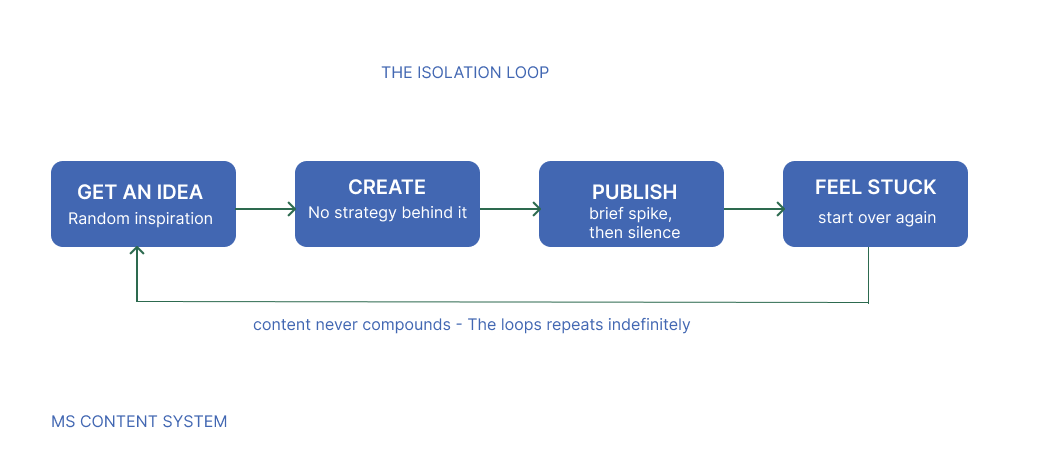
Every piece of content enters this loop independently. It doesn't connect to anything you made last week. It doesn't set up what you'll make next week. There's no thread running through your work. And because there's no thread, nothing compounds — each post starts at zero and ends at zero, and the only thing left is the vague sense that you're working very hard for very little.
What "compounding content" actually means
In finance, compounding means your interest earns interest. Each cycle doesn't start from scratch — it starts from a larger base than before.
Content works the same way, but only when it's designed to. A piece of content can compound when it reinforces an existing idea in your body of work, points the audience toward something else you've made, signals your brand's consistent point of view, and builds on trust that previous content already established.
That last point is the key. Trust is the compound interest of content. Each piece you publish either deposits into or withdraws from a trust account your audience has with you. Random, disconnected content makes tiny withdrawals every time — it signals inconsistency, confusion, and lack of direction. Structured, intentional content makes consistent deposits.
The chart below shows the actual growth curve difference between random posting and system-driven compounding over time.
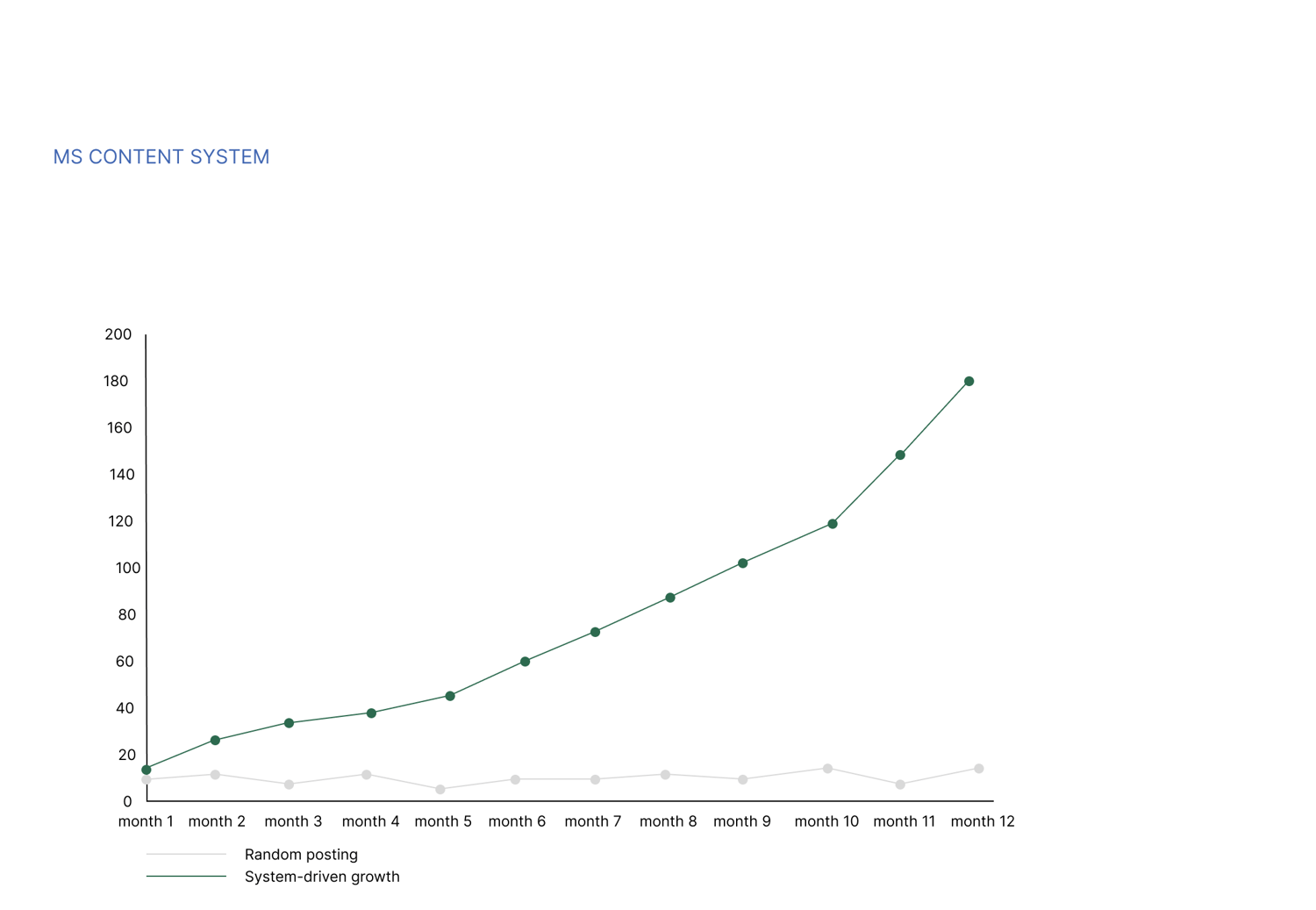
The random poster isn't lazy. They're not even inconsistent in effort — they're working just as hard month after month. But because each post is isolated, the audience can never build a complete picture of what you stand for. There's nothing to follow. Nothing to return to.
The system-driven creator starts slow too. Months 1 and 2 look almost identical. But by month 6, something is clearly happening. Content begins to reinforce itself. Old posts send traffic to new ones. New posts deepen what old ones established. The audience grows in quality and loyalty, not just size.
The anatomy of a content system
A content system isn't a complicated thing. It's any repeatable structure that connects your ideas to your output in a predictable way. It has five core phases.
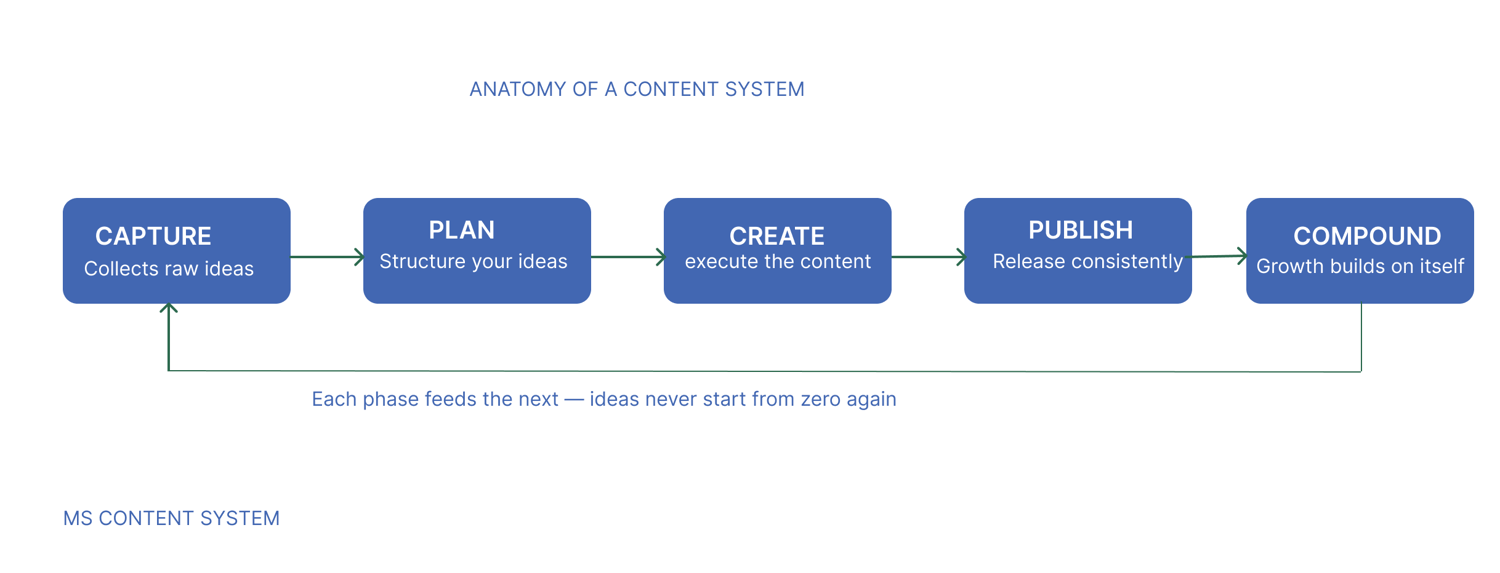
Notice the return arrow at the bottom. That's not a mistake. In a real content system, the Compound phase feeds back into Capture — audience signals, comments, and traction from older posts become the raw material for new ideas. The system is self-referential. It learns.
Let's walk through each phase briefly.
Capture is where most creators make their first mistake. They rely on memory. An idea surfaces, feels great in the moment, and vanishes by tomorrow. A real capture system means having one place — a Notion database, a quick-add inbox — where every idea lands immediately, regardless of quality. You filter later. You capture always.
Plan is where ideas become intentions. You're not asking "what should I post today?" You're asking "which of my captured ideas fits my content pillars this week?" Planning is a weekly practice, not a daily scramble. It eliminates decision fatigue and keeps your content strategically aligned.
Create is where most productivity advice focuses — and it's actually the least complicated phase once the first two are working. When you know exactly what you're creating and why, execution becomes mechanical. You're not fighting the blank page. You're filling in a template.
Publish is more than hitting the button. A real publishing workflow includes a checklist: is the hook right? Are the visuals ready? Is the CTA aligned with this week's goal? Is it cross-posted in the right places? Systematizing this removes the final decision points that cause delays.
Compound is what happens when the other four phases work consistently for long enough. Old content starts driving traffic to new content. A post from three months ago becomes relevant again because a new post references it. Your audience builds a complete picture of your expertise and starts to trust you before you say anything.
What breaks the system (and it's not what you think)
Here's something counterintuitive: the biggest threat to a content system isn't inconsistency. It's tool-switching.
Most creators who decide to "get organized" spend the first two weeks optimizing their system. They build an elaborate Notion dashboard. They move platforms. They rename all their folders. They watch three YouTube tutorials on PKM systems.
Then they post once, feel good, and never open the dashboard again.
This happens because the system was built for admiration, not operation. A good content system is boring on the inside. It doesn't need to be beautiful — it needs to be reliable.
The second major break point is skipping the Plan phase. Creators who capture ideas and then create directly — skipping planning — end up with the same problem they started with: random content. Capturing without planning is just a more organized version of chaos.
The third break point is treating the system like a cage instead of a track. A system doesn't tell you what to create. It tells you how to make sure that what you create actually builds toward something. You still have full creative freedom. You just have a direction.
The before / after: what changes when a system is running
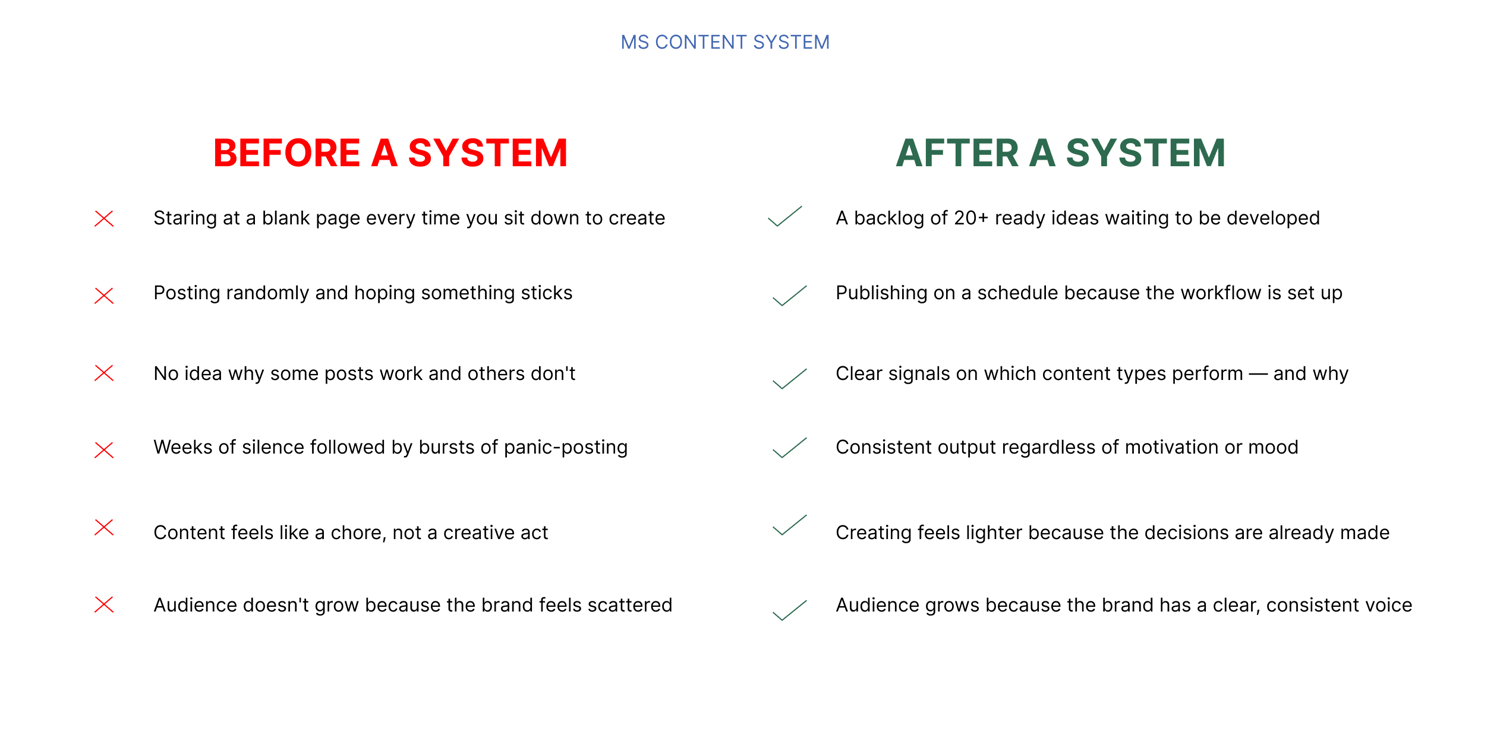
The shift isn't dramatic overnight. It's incremental — but it's directional. With a system, you're always moving forward. Without one, you're always starting over.
How to start building your system today
You don't need a perfect system. You need a functional one. Here's the minimum viable version:
Start with a single capture inbox. A Notion page titled "Raw Ideas" with one property: the idea itself. Nothing else. Every time a thought surfaces — in the shower, on a walk, while scrolling — it goes in there immediately. No filtering, no organizing. Just capture.
Once a week, spend 15 minutes in your inbox. Sort the ideas by content pillar. Pick two or three to develop this week. Archive the rest.
Build a simple creation doc for each piece. The format: a one-line hook, three body points, a CTA. That's your template. Use it every time.
Run a five-point publishing checklist before every post. Hook written. Visual ready. CTA clear. Platform format correct. Scheduled or posted.
Then — and this is the part most people skip — log each piece after publishing. What format was it? What platform? What was the engagement? This log becomes your system's intelligence. Over time, patterns emerge. You stop guessing.
That's the whole system. It fits in one Notion workspace. It takes one weekly session to maintain. And over time, it builds the compounding engine that isolated, random posting never can.
The bottom line
Your content doesn't disappear because it's bad. It disappears because it has nowhere to go. No context to land in. No thread to pull the audience forward.
A system gives your content a place in a larger story — one that your audience can follow, trust, and return to. It's not about posting more. It's about making every post matter to every post that came before it.
That's how content stops disappearing. And that's how you stop starting over.
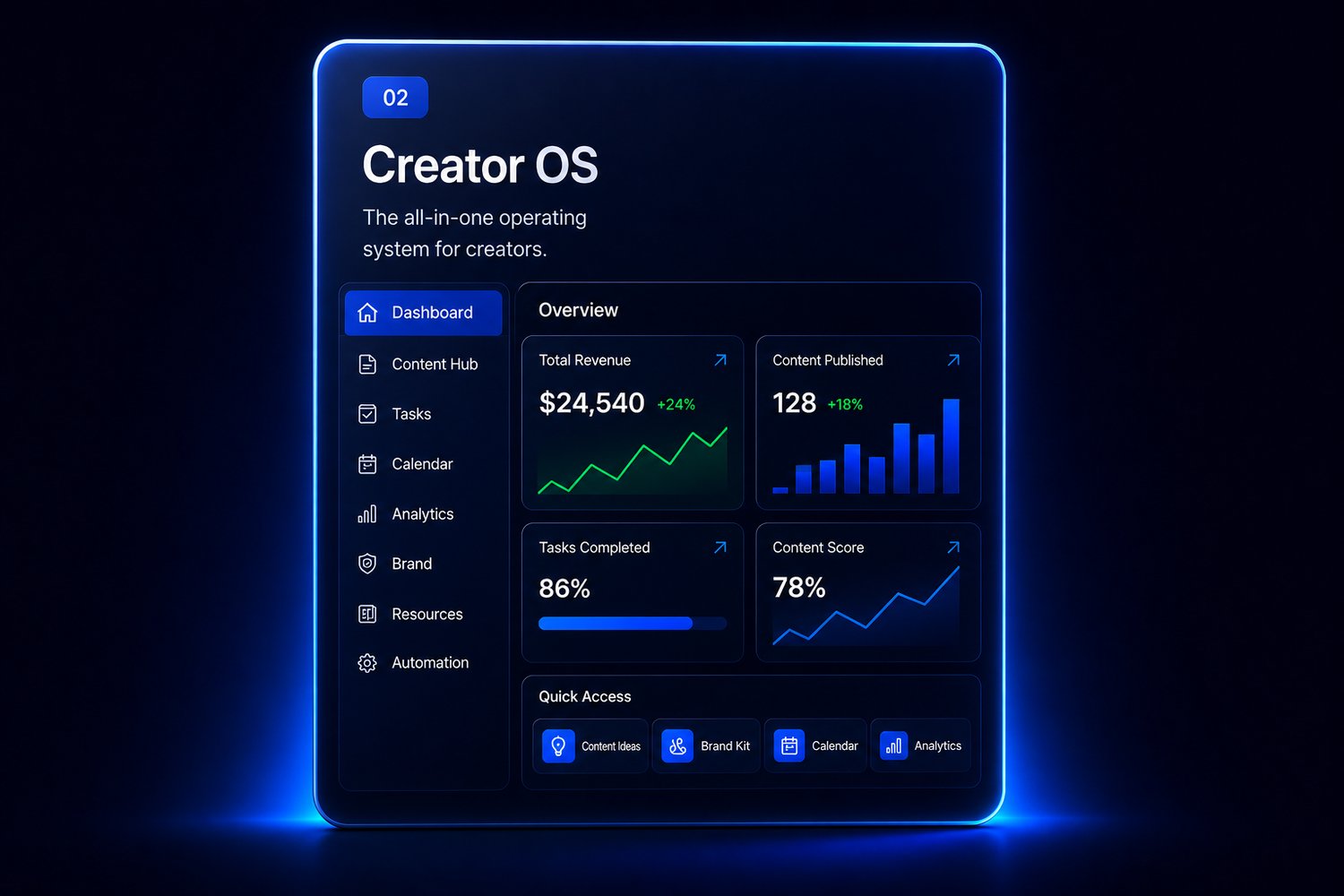
The MS Content System is built around this exact five-phase workflow — structured in Notion, designed for solo creators who want to grow without burning out.
→Start with the Creator Core — the most complete version of the system.
Comments ()