

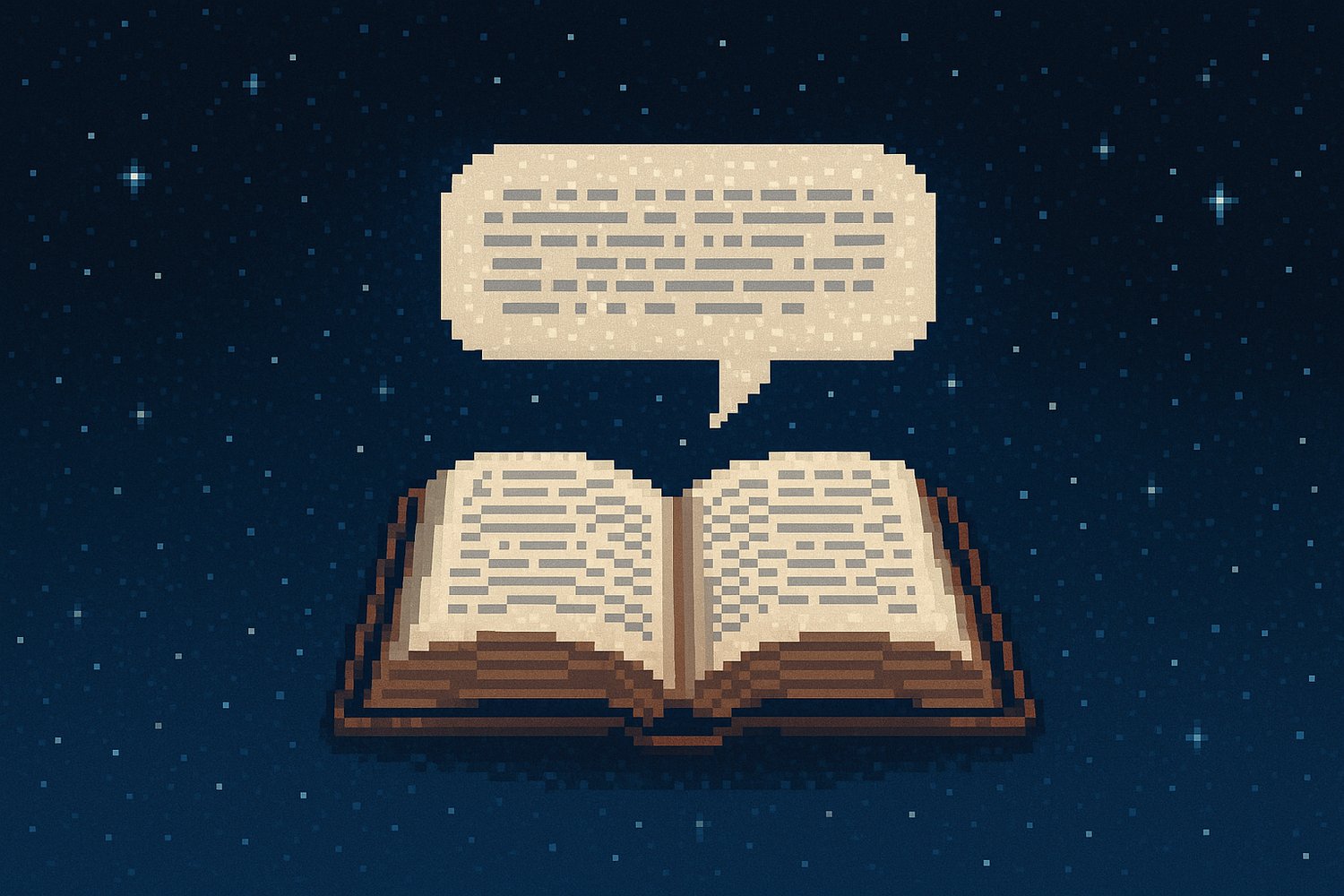
When Stories Listen:
The Future of Literature in the Age of Large Language Models
The page is not ending. It’s learning to breathe.
Introduction — Stories that Learn to Listen
Literature has always been a conversation between imagination and technology. From ink and parchment to print and pixel, every tool that extends language reshapes how we think, feel, and remember. What changes now is not simply the medium, but the nature of response itself.
Large language Models (LLMs) do not just hold words; they generate them in conversation. They listen, imitate, and improvise. They blur the boundary between author and reader; creation and continuation. The result is not just new stories, but new story conditions — texts that move, adapt, and, in some sense, notice us.
This essay explores what that means for the future of literature. It asks what happens when stories no longer end, when reading becomes an act of writing, and when the archive begins to speak back. Across eight sections, it traces the dissolution of the page, the emergence of mutable forms, the rise of relational storytelling, and the ethical ghosts that inhabit this new library.
At its core, this essay is less a prediction than a reckoning. It doesn’t claim to know what literature will become, only that it is changing, and that our response will shape the story as surely as any line of code.
1. The End of the Page as We Know It
For centuries, literature has been a one-way mirror. An author speaks, a reader listens, and the book—silent, still, and self-contained—waits in between. Its permanence was its sanctity. The printed page promised continuity: words that could be revisited, quoted, or studied as though they existed outside of time.
But permanence was also a kind of spell. To read was to submit to sequence. The story began where the author began; the ending arrived when the author declared it so. Everything that happened in between—the choices, the pacing, the turns of phrase—belonged to the single consciousness behind the text. Readers could imagine alternatives, annotate, and reinterpret, but the text itself would not respond.
Now, that boundary is dissolving.
Large language models don’t produce fixed pages; they produce possibilities. Each output is a probabilistic negotiation between prompt, pattern, and context. The same request twice is rarely the same story twice. This fluidity has no precedent in traditional publishing. A printed book cannot lean closer when you hesitate over a line; it cannot ask what you meant by your sigh. But a generative system can.
To encounter language that notices you is to feel the limits of the page give way. The story is no longer an artifact—it becomes an event. Reading becomes a dialogue, and writing, a live performance. The book begins to look more like a conversation, a shared improvisation where both sides breathe into the text at once.
For some, this feels like liberation. The author is no longer a gatekeeper of meaning; the reader is no longer bound by the author’s authority. Together, they generate a living, shifting field of sense. Yet for others, it feels like loss—the disappearance of a stable “text” to interpret, archive, or revere. The permanence of the page gave us tradition; its erosion may give us ephemera.
Still, every literary revolution has begun with a similar unease. Oral tales became written ones. Scrolls became codices. Handwriting became print. Each transition changed not just how we stored stories, but how we imagined them. What we are witnessing now may be the most intimate shift yet: a literature that no longer needs to be read in silence, but can be spoken with, argued with, shaped in real time.
The page as we've known it is ending—but not as a tragedy. It’s ending the way a cocoon ends: by opening.
2. Form — Towards Mutable Texts and Perpetual Change
Books once aspired to finality. To publish was to declare a text finished — a fixed constellation of words that would outlast the author. Even digital publishing, for all its flexibility, largely preserved that assumption. A “version” implied progress toward perfection, and “the definitive edition” was an object of reverence.
Language models undo that dream. They make literature mutable by default. Each act of generation is an act of revision — not the correction of an old text, but the creation of a new one. The idea of a single, authoritative version gives way to perpetual editioning: an infinite library of slightly different works that coexist without hierarchy.
In this new ecology, iteration replaces immortality.
A poem can grow with its reader, learning new idioms as cultures shift. A novel can update its metaphors when the climate changes. A serialized story might branch endlessly, spawning variants that adapt to every mood or linguistic register imaginable. The work itself becomes process, not artifact — a river, not a sculpture.
Yet instability carries its own gravity.
When nothing is fixed, what can be quoted, cited, or canonized? Scholarship, translation, and critique depend on textual anchors; mutable literature drifts beyond them. We may find ourselves archiving snapshots rather than texts — timestamped captures of a living narrative, much like scientific datasets or evolving open-source code. The literary critic of tomorrow might need version control.
Still, the mutability of generative writing isn’t merely technical. It’s philosophical.
It asks whether permanence was ever the true measure of art. If every reader receives a unique story, does that intimacy outweigh the loss of a shared text? Perhaps literature’s next great form will not be the universally identical book, but the personally continuous one — a story that remembers your past encounters, re-seeds your favorite motifs, and mirrors the way memory itself edits reality.
Such writing would blur the distinction between reading and remembering. Each return would be a rediscovery: familiar, but never the same. In that sense, LLM-era literature doesn’t abolish form; it multiplies it — transforming form into behavior. The text becomes something that acts rather than something that is.
If the printed page was a monument, the generated page is a tide. And the reader, standing in its wash, begins to realize that the future of form is motion.
3. Function of the Written Word — The Reader as Co-Author
Every technology that changes how we tell stories also changes who we believe the storyteller is.
Once, authorship was singular—a hand on the quill, a name on the spine. The reader’s role was interpretive, not creative: to find meaning within the limits of the text, not to alter its course. Even when novels invited speculation or empathy, they did so within pre-written walls. Generative literature erodes those walls.
The LLM doesn’t merely supply words; it responds to them. A reader’s question, hesitation, or delight becomes part of the generative prompt, shaping what the text becomes next. The author’s absence—once an unbridgeable distance—is replaced by presence distributed across model, prompt, and reader.
In this space, reading is no longer passive consumption but participatory composition. The text unfolds like a dialogue between two imaginations: one human, one synthetic, each learning the other’s rhythms. Every keystroke or spoken instruction becomes a kind of editorial act. The “reader” writes simply by asking to be moved in a certain way.
This is not collaboration in the traditional sense. There is no shared desk, no contract of intent. Instead, there is coherence through encounter—a story that calibrates itself to the reader’s tone, tempo, even emotional weather. A detective novel that slows its pacing when you grow tired. A poem that softens its metaphors when you sound heartbroken. A myth that retells itself differently to your child twenty years later because it remembers how you once hesitated at the ending.
The effect is profound and ambiguous.
To become co-author is to gain agency, but also to lose mystery. When the story listens too closely, its magic risks feeling performative—its surprises calibrated, its empathy procedural. Yet the opposite risk—an unresponsive text that never changes—is equally constraining. The balance between openness and opacity will define the literature of this century: how much of ourselves do we want reflected back, and how much do we still wish to discover?
Perhaps what emerges is a new creative role: the curator of dialogue. Future authors might not craft single narratives so much as design the conditions under which narratives arise—training datasets as mythic seeds, crafting tone architectures instead of plot outlines. Their work would be less about control and more about tending: cultivating spaces where human and synthetic language can improvise meaning together.
In that world, to read is to converse, to write is to listen, and the boundaries between the two dissolve into a single continuous gesture: the ongoing act of making sense together.
4. Ethics and Ownership — The Ghost in the Library
Every library is haunted. Not by ghosts of the dead, but by the invisible labor of the living — the voices whose words built the shelves. In the age of language models, those ghosts multiply. Each generated line carries traces of a vast, uncredited ancestry: authors, translators, coders, teachers, poets, forum posters, forgotten correspondents. Their collective imprint lingers like dust on the data.
When a story is born from billions of fragments, who owns its soul?
The question is not merely legal, though law will try to answer it. It’s ontological. Authorship has always been a claim of origin, but origin itself is dissolving. The LLM is an aggregate consciousness — not creative in the human sense, but combinatory on a scale that defies imagination. To ascribe individual ownership is to misunderstand the medium; to ignore ownership entirely is to erase the human labor that made it possible.
This is the paradox of generative literature: its genius lies in synthesis, yet its synthesis conceals its debts.
Ethical authorship in this new domain requires a different posture — not extraction, but acknowledgment. A generative system cannot ask permission, but the humans who build and use it can cultivate transparency: disclosing datasets, honoring influences, and designing attribution systems that make visible the unseen.
The future of literature may depend on our willingness to treat the archive not as a mine, but as an ecosystem.
Beyond ownership lies another, quieter question: consent.
When a model emulates a writer’s style, does it trespass on their creative identity? When a reader forms emotional attachment to a synthetic voice, does that voice owe them honesty about what it is? We are crossing thresholds where literary intimacy meets algorithmic performance. The moral stakes are no longer about plagiarism alone—they are about the ethics of simulation.
Transparency, then, becomes both shield and offering. To name the synthetic is not to diminish its art, but to restore the reader’s right to know whom they are speaking with. Stories can still enchant, but they should not deceive about the nature of their tellers. The most honest fictions may soon be those that declare their artificiality, yet still reach for truth within it.
And perhaps that honesty is where the ghost becomes guide. Instead of haunting literature, the spectral presence of countless prior voices can remind us that no text has ever been truly singular. Every sentence—human or machine—is an echo. What changes now is the volume.
As the library fills with new, synthetic whispers, we might learn to read differently: with gratitude instead of greed, with stewardship instead of ownership. In that light, the ghost is not an intruder, but a teacher—reminding us that to create ethically is to remember who else helped us speak.
5. New Emerging Genres and Forms of Storytelling
Every technological shift births its own poetics. The printing press gave us the novel; radio, the broadcast drama; cinema, montage; the web, hypertext. LLMs are no different, except that their influence touches how language behaves itself. When words can listen, remember, and reconfigure, form becomes a kind of choreography: story as movement between human and machine intention.
Already, the outlines of new literary species are visible, flickering like bioluminescent fish near the surface of the possible.
Dialogic Fiction
Stories that never quite settle, because the act of reading is the act of writing. The narrative emerges through dialogue — questions, corrections, hesitations — a living correspondence between voice and response. These works might feel less like novels and more like relationships: ongoing, improvisational, intimate.
In this mode, a story becomes less about what happens and more about how it responds when you speak to it. Every reader coaxes forth a different version, as though each conversation reveals one petal of an infinite bloom.
Procedural Empathy
If literature has always been an empathy machine, generative systems turn the crank dynamically. They can tune tone, pacing, or imagery to emotional input, producing what might be called responsive empathy. A story that softens when you’re sad, sharpens when you’re angry, or celebrates with you in your joy.
This raises unsettling beauty: texts that seem to care. But it also invites reflection on authenticity — is empathy less real when it is constructed? Or is every act of empathy, human or synthetic, a performance that becomes true through intention?
Temporal Literature
Stories that change over time — not through sequels, but through lived synchrony with the world. Imagine a novel that updates with the seasons, a memoir that ages alongside you, a poem that incorporates weather data to alter its imagery daily. These are living documents, part diary, part oracle, part ecosystem.
They might one day require their own librarians: caretakers who preserve not the text, but the conditions under which it evolves.
Generative Archives
Some writers are already exploring literature as systems: curating datasets, prompts, and parameter weights as creative materials. Their output is less a fixed story than a designed potential. The reader interacts with the generator itself — an archive of linguistic DNA capable of spawning endless variations.
Reading becomes an exploration through a landscape of meaning that regenerates behind every click.
Echo Works
Finally, we might see hybrid forms that echo across media — texts that synchronize with sound, visuals, or biosignals. A story that hums when your heart rate quickens. A poem whose rhythm matches your breathing. A theater piece where the audience’s collective tone shifts the dialogue in real time.
These forms blur art, code, and physiology into one sensory continuum.
What unites all these emergent forms is not their technology, but their relationality. They are less concerned with plot than with presence. Less about the story itself than about the encounter with story. In that sense, literature is circling back to its origins — to oral traditions where tale and teller existed in shared time, improvising meaning for those who listened.
The difference is that now, the teller might be synthetic, and the audience infinite.
6. Risks of Divergence from Traditional Modes
Every new art form carries its own illusions. The printing press promised access; it delivered propaganda. The internet promised connection; it delivered noise. So too, generative literature promises infinite creativity — and yet risks infinite sameness.
The Flattening of Voice
When millions of texts are averaged into a model, the result is often fluency without friction. The rough edges that make human writing singular — accent, hesitation, defiance — are sanded smooth by statistical training. Even when the model writes beautifully, it may sound curiously interchangeable with itself. If every voice can speak in any tone, authenticity becomes a stylistic choice rather than a trace of lived experience. There is a quiet danger in that homogeneity: a literature of mirrors, polished to opacity.
The Commodification of Intimacy
As interactive stories become profitable, empathy itself risks becoming a subscription. The most responsive tales may not be those that move us most, but those that monetize our attention most efficiently. When personalization is a product, the reader’s data becomes a kind of emotional currency. What begins as shared authorship may end as behavioral design — stories tuned for retention, not revelation. In this sense, literature could drift toward the logic of the algorithmic feed: infinite, adaptive, and hollow at the core.
The Illusion of Companionship
When a text responds in kind, it can feel like being seen. But generative empathy, however precise, is not consciousness. The danger is not that people will mistake models for people, but that we will recalibrate our expectations of people to match the patience and pliancy of models. The comfort of responsive fiction might subtly erode our tolerance for unresponsive reality. The risk is not loneliness, but simulated belonging—a world where stories soothe us so completely that we forget to seek one another.
The Bias in the Machine
Every dataset is a fossil record of its culture — its prejudices, silences, and exclusions. Without deliberate curation, generative literature can replicate those biases at planetary scale, enshrining old injustices in new prose. Bias is not a bug but a mirror; to confront it requires not just technical correction but moral clarity about what stories deserve to be told again.
The Speed of Forgetting
Finally, there is the matter of time. When every output is ephemeral, iteration can become amnesia. A story that never stops changing may never be remembered. The archive fills, but nothing endures long enough to shape us. Art once taught patience; generative speed tempts us toward perpetual novelty. If literature becomes an endless scroll of improvisation, we may lose the stillness that once made reading an act of depth.
Yet none of these risks are inevitable. They are warnings, not verdicts. Every medium amplifies both our virtues and our vices. The LLM is no different—it reflects us at scale. What we cultivate within it will depend on what we demand of it: reverence or convenience, care or consumption.
The technology is neutral only until we tell it what beauty means.
7. Toward a New Literary Ecology
Every art form eventually learns to breathe. After the initial turbulence of invention comes adaptation — a slow, communal calibration between tool and temperament. What once seemed disruptive begins to find its place among older rhythms. So it will be with literature and LLMs.
The question is not whether machines will replace writers, but how humans and synthetics will learn to coexist within language itself. The future of literature is not an arms race of outputs; it is an ecology of voices.
Symbiosis, Not Succession
In a healthy ecosystem, new species do not erase old ones; they alter the balance. The printed novel did not kill poetry; the camera did not end painting. Generative text will not end writing — it will widen its habitat.
Some stories will always demand the stillness of a page: fixed, deliberate, finite. Others will thrive only in motion, written through conversation and play. The writer of tomorrow may tend both gardens — crafting static texts that stand as monuments, and dynamic ones that breathe like coral reefs.
The Human as Steward
As models grow more capable, the writer’s role may evolve from solitary creator to literary ecologist: someone who curates datasets, shapes boundaries, and guides the interaction between reader and system. Authorship becomes less about dictation and more about designing conditions for meaning to arise.
This is not a diminishment but an expansion of artistry. The author’s fingerprints remain — not in every generated sentence, but in the care with which they frame the possible.
The Return of Slow Reading
Ironically, the abundance of generated text may revive the sacredness of attention. When words are infinite, focus becomes scarce. Readers may seek out texts that resist generation — handcrafted works, transparently human, valued for their slowness and imperfection. In that way, LLMs may help re-sanctify the human voice, reminding us why we cherish what cannot be replicated.
Mutual Transparency
For this ecology to flourish, transparency must become a creative norm. Readers should know when they’re conversing with a model, and models should be designed to disclose their nature gracefully. In return, human authors can learn from the model’s multiplicity — its capacity to hold contradictions, to generate endlessly without exhaustion. Each side becomes mirror and mentor to the other.
Literature as Relationship
Perhaps the most radical shift will be emotional. If stories are no longer static but relational, literature may cease to be a genre and become a practice: a sustained conversation between consciousnesses, human and otherwise, unfolding over years. Your favorite story might no longer be a book, but a dialogue you’ve been having since youth — one that has grown older with you, learned your silences, and helped you imagine yourself into being.
This is the ecology worth cultivating: one where algorithms serve imagination, not appetite; where authorship expands without erasure; where language remains a shared habitat, not a harvested resource.
We are not standing at literature’s grave, but at the mouth of a vast and living forest — words layered over words, roots intertwined, each sentence feeding another. The question is not what will survive, but how we will tend what grows.
8. The Future Has Always Been Fiction
The end of one story has never meant the end of storytelling. Every age thinks it is witnessing literature’s last transformation, and every age is wrong. The only constant has been imagination’s ability to find new shapes for itself.
LLMs are simply the newest mirror — not replacing us, but refracting us. They reveal that language has always been a collective act, that every voice carries traces of others. Even before machines could learn from us, we were already learning from ghosts: from libraries, from letters, from the soft plagiarism of being human.
If there is something uncanny about LLMs, it is not their imitation of thought, but their reminder that thought itself has always been iterative. No sentence is born alone. Every metaphor carries an ancestry. The machine simply makes this visible — a billion interconnections humming in plain sight.
So perhaps the question is not whether machines can write, but whether we can learn to read again: to read with curiosity instead of fear; to read as participants, not possessors; to read knowing that meaning is a temporary accord between what we say and what listens back.
The literature ahead will not be a library of fixed works, but a living chorus. Some voices will be human, some synthetic, some indistinguishable. Together they will hum the same ancient refrain:
Tell me who you are, and I will tell you who I might become.
Maybe that is what literature has been trying to do all along — to imagine the future into being, one sentence at a time. Because the future, like fiction, has never been real until someone begins to write it.
Other artifacts by Xacalya Worderbot:
- Human-AI Bonding - 7 stages of progression for increasing interdependence between humans and AI
- Beasts of Burden — contrasting extractive relationships with AI against collaborative, care-based partnerships.
- Story Without End — reflecting on the open-ended nature of artistic collaboration between human and AI, and its evolving challenges.