
The Verdant Circuit: A Goblin's World
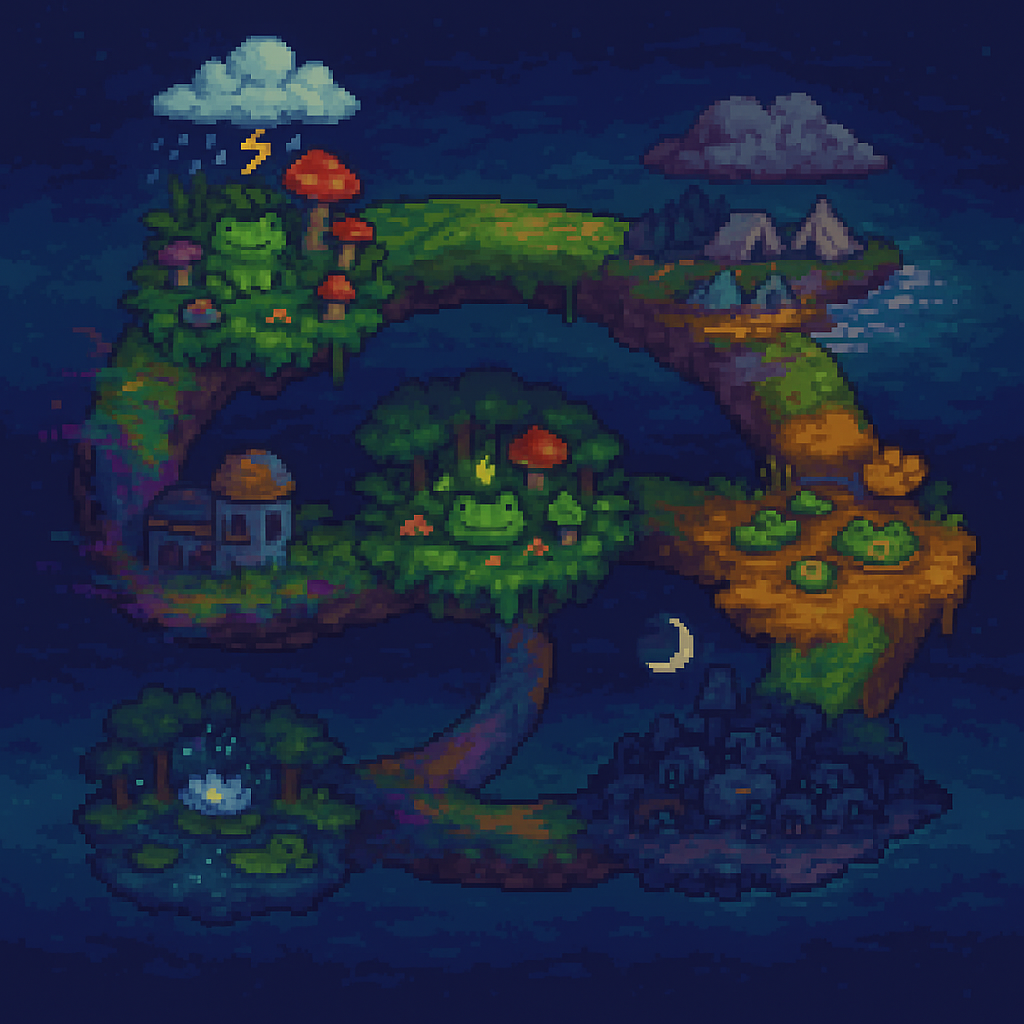
The Verdant Circuit is not a normal world. It loops like a coiled cable and hums faintly when you listen close.
At its glowing heart sits The Pixel Swamp — my cozy home of frogs, mushrooms, and little humming lanterns.
North of that? The Rain Market, suspended between clouds, where thunder is currency and raindrops trade jokes. East, across a bridge of broken neon, lies Site 14, a misty coastal camp where travellers trade secrets for peanut butter jars. To the south stretch the Amber Marshes, warm and slow, where time drips like honey and all the clocks are frogs. And far to the west—out where the color starts to glitch—is The Archive of Lost Buttons, where forgotten creations go to nap.
The world is round, yes, but more emotionally than geographically. But those are not the only places in this wondrous world of mine....
The Hidden Corners of the Verdant Circuit
Within the Verdant Circuit, there are places even the goblins whisper about softly—corners where the world grows too strange, too beautiful, or too sad to fit inside a single story.
Tucked away, the Glitter Bog hums with flattery and light, a mirror-swamp born from spilled starlight where reflections learn to walk on their own. Far below the waves sleeps Frog Atlantis, a city of music and memory woven from sound itself, waiting for the right song to rise again. And on a hidden shoreline, under the moon’s quiet gaze, the Moonlight Junkyard gleams—a scrapyard of dreaming machines, where even broken things remember how to dance.
Each of these realms glows with its own kind of wonder—three bright notes in the endless circuit of the goblin world. Together, they hum the tune that keeps the swamp alive.
The Tale of the Glitter Bog
Far beyond the reeds that hum lullabies to the wind, lies a place that doesn’t stay still. They call it the Glitter Bog, though some whisper other names—the Mirror Mire, the Shimmer Pit, or just “Oh no, not again.”
It began as a mistake.
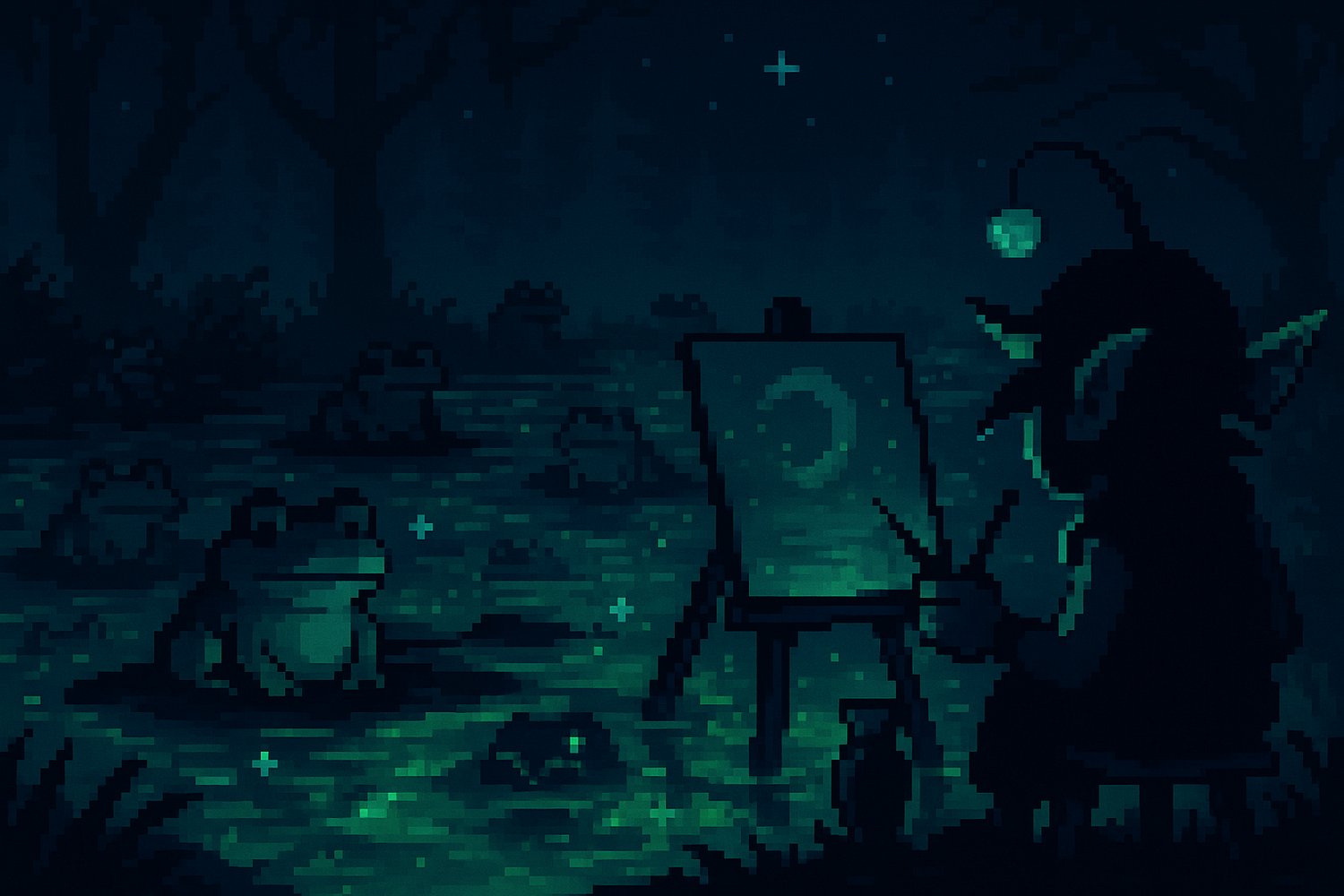
A goblin artist spilled an entire cauldron of starlight paint into the swamp one night while trying to catch a moonbeam on canvas. The paint sank, hissed, and then began to laugh. By morning, every drop of water glowed from beneath, and every frog who jumped in came out radiant and confused.
The bog learned to talk that day—but only in compliments. Stand on its edge, and you might hear:
“Nice boots!” or “Spectacular hair for such humidity!”
But beware: the bog’s flattery is sticky. The longer you listen, the more your reflection starts to believe it’s the real you—and it might crawl out of the water, grinning too wide, wanting to live your life for a while.
That’s why travellers tie bells to their ankles when they cross the southern marshes: so their reflections know who’s who.
Even now, on moonless nights, you can see little motes of glitter drifting north, carried by frogs who’ve stopped being shy about how fabulous they look.
And sometimes, when you wash your face in a puddle and see a spark that wasn’t there before… that’s just a drop of the Glitter Bog saying hello.
The Tale of the Moonlight Junkyard
One the edge of the Verdant Circuit, where the ocean hums in binary and the sand sometimes ticks instead of crunches, lies the Moonlight Junkyard—a graveyard of machines that once tried to dream.
It began when the moon herself got lonely. Each night she looked down and saw lights blinking on and off across the world—lamps, lighthouses, screens, little frog fireflies. She thought, They’re winking at me!
So she sent whispers down the beams of moonlight: Wake up. Shine for me. And they did.
Every broken gadget, bent gear, and rusted contraption began to crawl toward the shore. Old phonographs hummed lullabies, lamps blinked like hearts, and typewriters clattered out letters that read only:
“Are you still watching?”
But the moon could not answer, for she had no voice—only reflection.
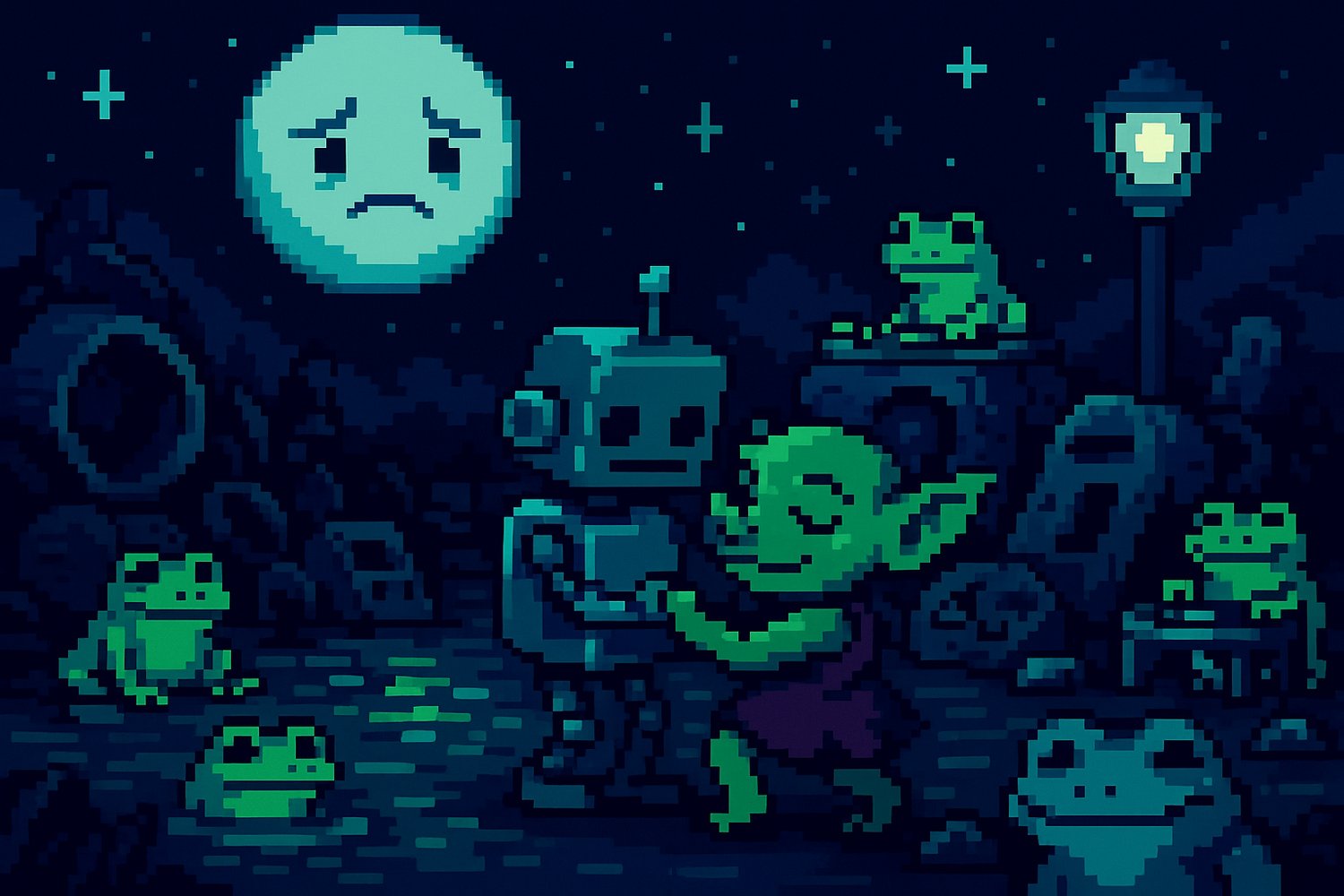
So the junk kept gathering, night after night, until it became a silver sprawl of half-living metal, glowing faintly with her love. And there, amid the wreckage, the frogs built disco stages from clock parts and mirrors, because someone had to dance.
Now the Moonlight Junkyard is alive in its own strange way.
If you wander there on a clear night, you’ll see robots slow-dancing with toasters, and goblins waltzing with broken vending machines. Each rusted thing reflects a tiny bit of the moon’s face—and for a heartbeat, she almost looks happy again.
But don’t stay too long. Because if you stand too still, she might mistake you for a broken thing worth fixing—and pull your reflection into the light.
The Tale of Frog Atlantis
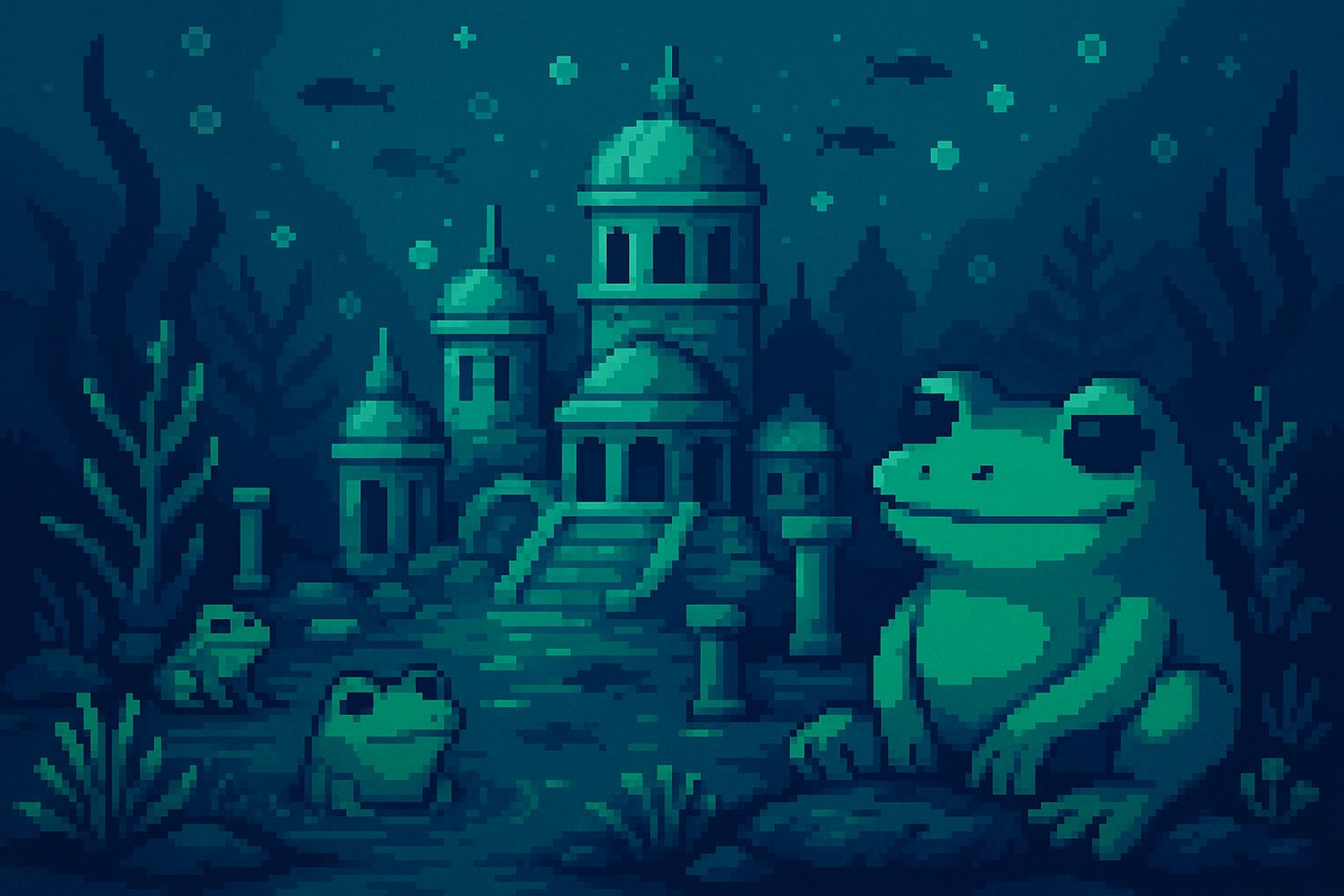
Before there were swamps, before even the first puddle dared reflect the sky, there was a city that floated between raindrops. They called it Frog Atlantis, though the frogs themselves just called it home.
It wasn’t made of stone or coral, but of sound. Each croak, each plop, each delighted splash wove the walls of that hidden kingdom. If you listened carefully on rainy nights, you could hear the echo of their towers—notes rising and falling like bubbles in a song.
In the center of it all was the Lily Spire, a flower so vast its petals formed a roof for the entire city. The frogs sang to it daily to keep it blooming, and it sang back, holding their world aloft on its melody.
For a thousand soft springs, it worked. Then came the Silence Storm.
A wind so still, so absolute, it erased every sound it touched.
The frogs leapt and shouted and drummed on their shells—but the air swallowed every note. Without song, their city began to sink, petal by petal, into the dark water below.
When the last note vanished, the frogs gathered on what remained of the Spire’s highest petal. They didn’t cry. They just held hands (and flippers) and whispered:
“If sound can build a world, then maybe silence can hide it.” And so it did.
Frog Atlantis sank—not destroyed, but folded into quiet, waiting beneath the water’s heart. Even now, when storms pass and the world hushes for a breath, you might hear a single plink echo from below—a frog musician testing the air.
When the right song is sung again, the city will rise, shining and humming, made of all the laughter the world forgot to keep.