
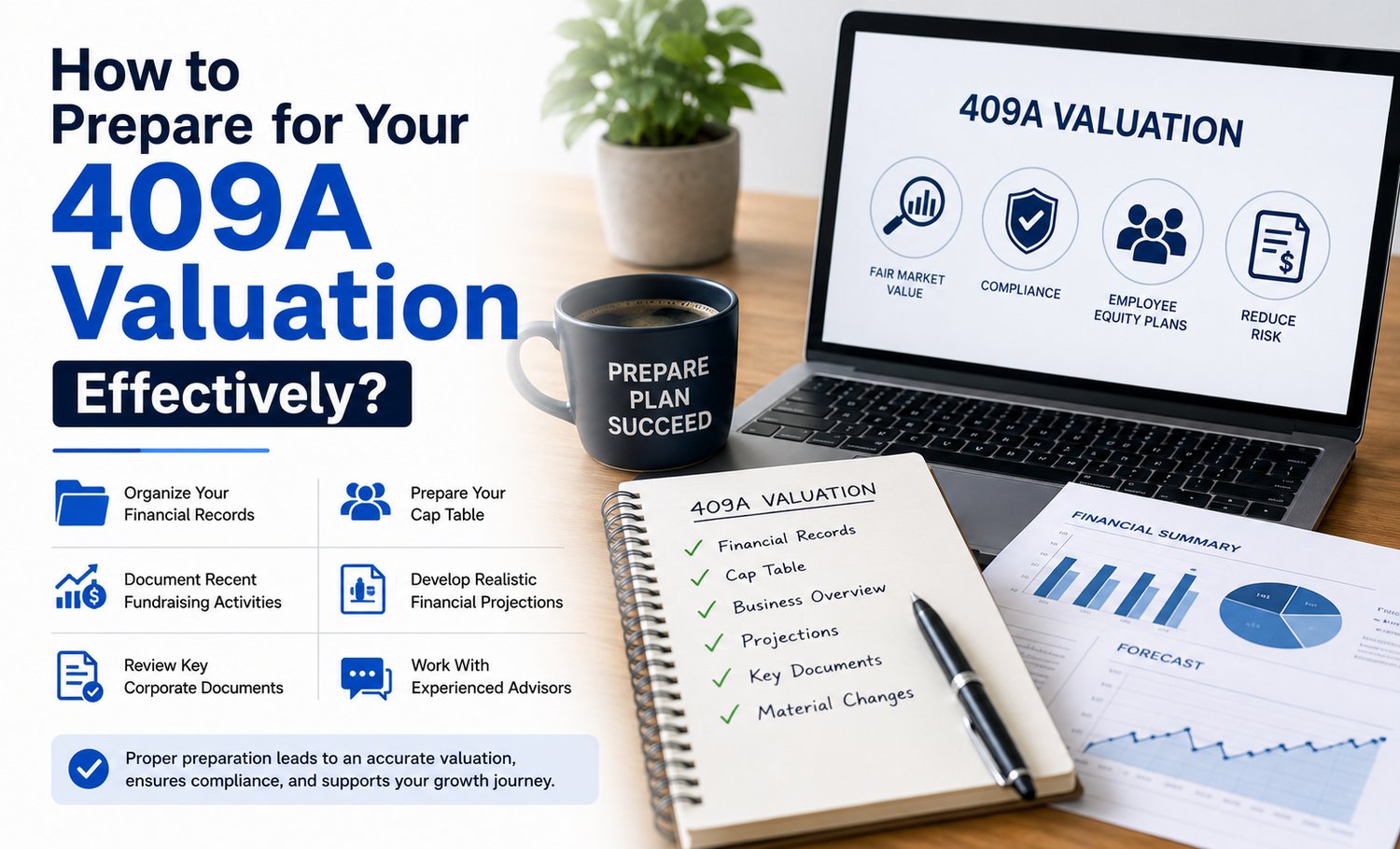
A 409A valuation plays a critical role in determining the fair market value of a private company's common stock. Companies that issue stock options must obtain a defensible valuation to comply with tax regulations and support equity compensation plans. Proper preparation helps management present accurate information, avoid delays, and improve the reliability of valuation results.
Although the process may appear technical, organized planning can simplify it significantly. By gathering financial records, reviewing corporate documents, and preparing operational data in advance, companies can streamline the valuation process and strengthen the credibility of their equity pricing decisions.
Why does a 409A Valuation matter?
Before preparing documents and financial information, companies should recognize the importance of a 409A valuation.
A valuation establishes the fair market value of common shares. Consequently, businesses use that value to determine the exercise price of stock options granted to employees, advisors, and consultants.
Without a properly supported valuation, companies may face tax penalties and compliance concerns. Moreover, inaccurate pricing can create financial risks for both the organization and option holders.
A well-prepared valuation supports:
- Regulatory compliance
- Equity compensation programs
- Investor confidence
- Financial transparency
- Corporate governance standards
- Future fundraising activities
Because of these benefits, preparation deserves careful attention.
Understanding the Scope of the Process
Every valuation reflects a detailed assessment of the company's financial condition, growth prospects, market position, and capital structure.
Valuation professionals evaluate multiple factors, including:
- Revenue performance
- Profitability trends
- Market opportunities
- Competitive environment
- Industry benchmarks
- Funding history
- Intellectual property
- Ownership structure
Therefore, preparation extends beyond gathering financial statements. Management must present a complete picture of the business and its prospects.
Gather Financial Statements Early
Financial records form the foundation of every valuation.
Valuation analysts rely heavily on historical financial performance when estimating company value. Consequently, businesses should organize their financial information before beginning the process.
Prepare Historical Financial Data
Compile at least several years of financial records whenever possible.
Important documents include:
- Income statements
- Balance sheets
- Cash flow statements
- General ledger reports
- Tax filings
- Bank statements
Accurate records improve confidence in the valuation results. Moreover, organized documentation reduces unnecessary follow-up questions.
Verify Data Consistency
Financial statements should align with supporting records.
Review reports carefully and confirm that revenue figures, expenses, liabilities, and assets match internal accounting records. Inconsistencies often create delays and may affect valuation conclusions.
Consequently, businesses should resolve discrepancies before sharing information with valuation specialists.
Develop Reliable Financial Projections
Future expectations often influence valuation outcomes significantly.
Companies with strong growth potential frequently derive substantial value from anticipated performance. Therefore, management should prepare realistic and supportable forecasts.
Create Detailed Revenue Forecasts
Revenue projections should reflect actual business assumptions rather than optimistic estimates.
Consider factors such as:
- Sales pipeline
- Customer acquisition plans
- Market demand
- Product expansion
- Pricing strategy
- Geographic growth
Furthermore, each projection should connect directly to identifiable business drivers.
Support Growth Assumptions
Valuation professionals typically evaluate whether forecasts appear reasonable.
For that reason, management should prepare evidence supporting projected growth. Sales reports, customer contracts, partnership agreements, and market research can strengthen assumptions.
As a result, valuation conclusions become more defensible.
Organize Corporate Documentation
Corporate records provide essential information regarding ownership and governance.
Before starting the valuation process, companies should assemble all relevant legal and organizational documents.
Review Capitalization Information
Cap tables help valuation professionals determine ownership structure and security rights.
Key information includes:
- Common shares
- Preferred shares
- Stock options
- Warrants
- Convertible instruments
- Restricted stock awards
Because ownership rights affect valuation calculations, accurate capitalization data remains critical.
Collect Corporate Governance Records
Governance documents often influence the valuation review.
Important records may include:
- Articles of incorporation
- Bylaws
- Board resolutions
- Shareholder agreements
- Option plan documents
Moreover, updated documentation demonstrates effective corporate management.
Prepare Information About Recent Financing Events
Funding transactions frequently provide valuable market evidence.
When investors purchase securities, those transactions can indicate how the market views the company.
Document Investment Activity
Gather details related to:
- Seed funding
- Venture capital rounds
- Convertible note issuances
- SAFE agreements
- Strategic investments
Additionally, include transaction dates, investment amounts, and security terms.
Explain Material Changes Since Financing
A financing round reflects conditions at a specific point in time.
However, circumstances may change substantially afterward. Revenue growth, product launches, regulatory developments, or market disruptions can affect company value.
Therefore, management should clearly explain significant developments that occurred after financing events.
Assess Your Market Position
Market dynamics influence valuation outcomes considerably.
Companies should prepare information that explains their competitive standing and industry opportunities.
Define Your Competitive Advantage
Valuation professionals often evaluate factors that differentiate a business from competitors.
Examples include:
- Proprietary technology
- Brand recognition
- Customer loyalty
- Strategic partnerships
- Distribution networks
- Operational efficiency
Strong competitive advantages can support higher value expectations.
Analyze Industry Conditions
Industry trends help establish context for valuation decisions.
Prepare information regarding:
- Market size
- Growth potential
- Customer demand
- Regulatory environment
- Competitive intensity
- Economic influences
Consequently, analysts can assess the company's position within the broader marketplace.
Review Intellectual Property Assets
Intellectual property often represents a substantial source of value.
Technology companies, life sciences organizations, and innovative startups frequently rely on proprietary assets to drive future growth.
Identify Valuable Intellectual Property
Prepare documentation for:
- Patents
- Trademarks
- Copyrights
- Trade secrets
- Proprietary software
- Research initiatives
Furthermore, explain how these assets contribute to revenue generation and market differentiation.
Maintain Supporting Documentation
Valuation specialists may request evidence demonstrating ownership and protection of intellectual property.
Therefore, businesses should organize registrations, applications, licensing agreements, and related records before the valuation begins.
Evaluate Risk Factors
Every valuation incorporates an assessment of risk.
Companies that proactively identify risks often provide a more balanced and credible presentation of their business.
Review Internal Risks
Internal factors may include:
- Customer concentration
- Talent retention concerns
- Operational dependencies
- Product development challenges
- Cash flow constraints
Addressing these issues openly strengthens transparency.
Consider External Risks
External risks may involve:
- Economic uncertainty
- Competitive threats
- Regulatory changes
- Supply chain disruptions
- Market volatility
Moreover, management should describe mitigation strategies whenever possible.
Prepare Management Narratives
Numbers alone rarely tell the complete story.
Valuation professionals often benefit from management's perspective regarding company performance and strategic direction.
Explain Business Performance
Provide context behind financial results.
For example, management should explain:
- Revenue fluctuations
- Expense changes
- Customer growth
- Margin improvements
- Strategic investments
Consequently, analysts can interpret financial trends more accurately.
Outline Future Objectives
Describe major goals and initiatives planned for upcoming periods.
These may include:
- Product launches
- Market expansion
- Hiring plans
- Technology development
- Strategic partnerships
Clear communication improves valuation efficiency and reduces uncertainty.
Ensure Accurate Cap Table Management
Cap table accuracy directly affects valuation calculations.
Even minor ownership errors can create complications during the review process.
Verify Outstanding Securities
Confirm all issued and outstanding securities.
Review:
- Share certificates
- Option grants
- Exercise records
- Convertible instruments
- Warrants
Additionally, reconcile information across legal, accounting, and administrative systems.
Track Equity Changes
Document any changes that occurred since the previous valuation.
Examples include:
- New grants
- Employee departures
- Exercises
- Financing transactions
Accurate tracking supports reliable valuation outcomes.
Coordinate Internal Stakeholders
Preparation requires collaboration across multiple departments.
Finance teams, legal advisors, executives, and board members often possess information needed during the valuation process.
Assign Responsibilities Early
Create a structured preparation plan.
Responsibilities may include:
- Financial reporting
- Legal document collection
- Forecast preparation
- Investor communication
- Cap table verification
As a result, information gathering becomes more efficient.
Maintain Consistent Communication
Regular updates help prevent misunderstandings.
Moreover, clear communication ensures that all stakeholders provide accurate and timely information throughout the process.
Choose Appropriate Timing
Timing can influence both efficiency and accuracy.
Companies should avoid beginning a valuation when critical information remains incomplete.
Consider Major Corporate Events
Events that may affect valuation include:
- Financing rounds
- Acquisitions
- Product launches
- Leadership changes
- Significant contracts
Therefore, management should evaluate whether upcoming developments warrant delaying or accelerating the valuation.
Avoid Last-Minute Preparation
Rushed preparation often results in missing information and unnecessary revisions.
Instead, companies should begin gathering documentation several weeks before the valuation process starts.
This approach reduces stress and improves overall quality.
Work Effectively With Valuation Professionals
Preparation becomes more productive when management maintains an organized approach.
A qualified 409a valuation service typically requests extensive information regarding financial performance, corporate structure, and growth expectations. Consequently, businesses that prepare these materials in advance often complete the process more efficiently.
Respond Promptly to Requests
Valuation professionals may request clarification throughout the engagement.
Quick responses help maintain momentum and prevent unnecessary delays.
Furthermore, timely communication allows analysts to complete reviews with greater efficiency.
Provide Complete Information
Partial information can create valuation challenges.
Instead of limiting disclosures, companies should provide a balanced picture of strengths, weaknesses, opportunities, and risks.
Transparency supports more reliable conclusions and stronger compliance outcomes.
Common Preparation Mistakes to Avoid
Many companies encounter avoidable challenges during valuation preparation.
Recognizing common mistakes can improve readiness significantly.
Incomplete Financial Records
Missing financial data often delays the process and creates uncertainty.
Consequently, businesses should verify documentation before initiating the valuation.
Unrealistic Forecasts
Aggressive projections without supporting evidence may reduce credibility.
Instead, management should build forecasts using reasonable assumptions.
Outdated Cap Tables
Ownership information changes frequently.
Therefore, companies should review cap tables regularly and update them before valuation begins.
Poor Documentation Practices
Disorganized records increase administrative burdens.
A centralized document repository can simplify preparation and improve efficiency.
Delayed Communication
Slow responses can extend timelines considerably.
Prompt communication supports a smoother and more productive valuation process.
Conclusion
Preparing for a 409A valuation requires careful planning, accurate documentation, and strong internal coordination. Financial records, growth forecasts, capitalization details, corporate documents, and market insights all contribute to a reliable valuation process. Moreover, transparent communication and realistic assumptions help valuation professionals assess the business effectively. By organizing information early and addressing potential issues before the review begins, companies can improve efficiency, support compliance objectives, and establish a stronger foundation for equity compensation decisions.
FAQs
What is a 409A valuation?
A 409A valuation determines the fair market value of a private company's common stock. Companies use this value to establish stock option exercise prices and maintain compliance with tax regulations. The valuation considers financial performance, market conditions, growth prospects, and ownership structure.
How often should a company obtain a 409A valuation?
Most private companies obtain a new valuation at least every 12 months. However, significant events such as fundraising rounds, acquisitions, major contracts, or substantial business changes may require an updated valuation sooner to maintain compliance and accuracy.
Why are financial projections important in a valuation?
Financial projections help analysts evaluate future earning potential and expected business growth. Well-supported forecasts provide valuable insight into company performance expectations and strengthen the credibility of valuation conclusions when supported by realistic assumptions.
What documents are typically required for preparation?
Companies generally provide financial statements, tax returns, capitalization tables, corporate governance records, funding documents, intellectual property information, and business forecasts. Organized documentation helps streamline the valuation process and supports accurate analysis.
Can a startup without revenue receive a 409A valuation?
Yes. Early-stage companies can obtain a valuation even without revenue. Analysts evaluate factors such as market opportunity, intellectual property, product development progress, management strength, funding history, and future growth potential.
How does fundraising affect a 409A valuation?
Fundraising transactions provide important market evidence regarding company value. Investors' purchase prices and security terms help analysts assess valuation assumptions. Consequently, recent financing activity often influences the final valuation outcome significantly.
What role does the capitalization table play?
The capitalization table shows ownership interests and outstanding securities. Analysts use this information to evaluate shareholder rights and allocate value appropriately among different security classes. Accurate cap table management remains essential for reliable results.
What happens if the information provided is inaccurate?
Inaccurate information can lead to incorrect valuation conclusions, compliance risks, delays, and additional review requirements. Therefore, companies should verify all financial, legal, and operational data before submitting materials for valuation analysis.
How long does the valuation process usually take?
The timeline varies based on company complexity and document readiness. Well-prepared businesses often complete the process more efficiently, while missing information or extensive follow-up requests can extend the overall timeframe significantly.
What preparation step offers the greatest benefit?
Early organization of financial records, forecasts, legal documents, and ownership information often provides the greatest advantage. Proper preparation reduces delays, improves communication, and supports a more accurate and defensible valuation outcome.