
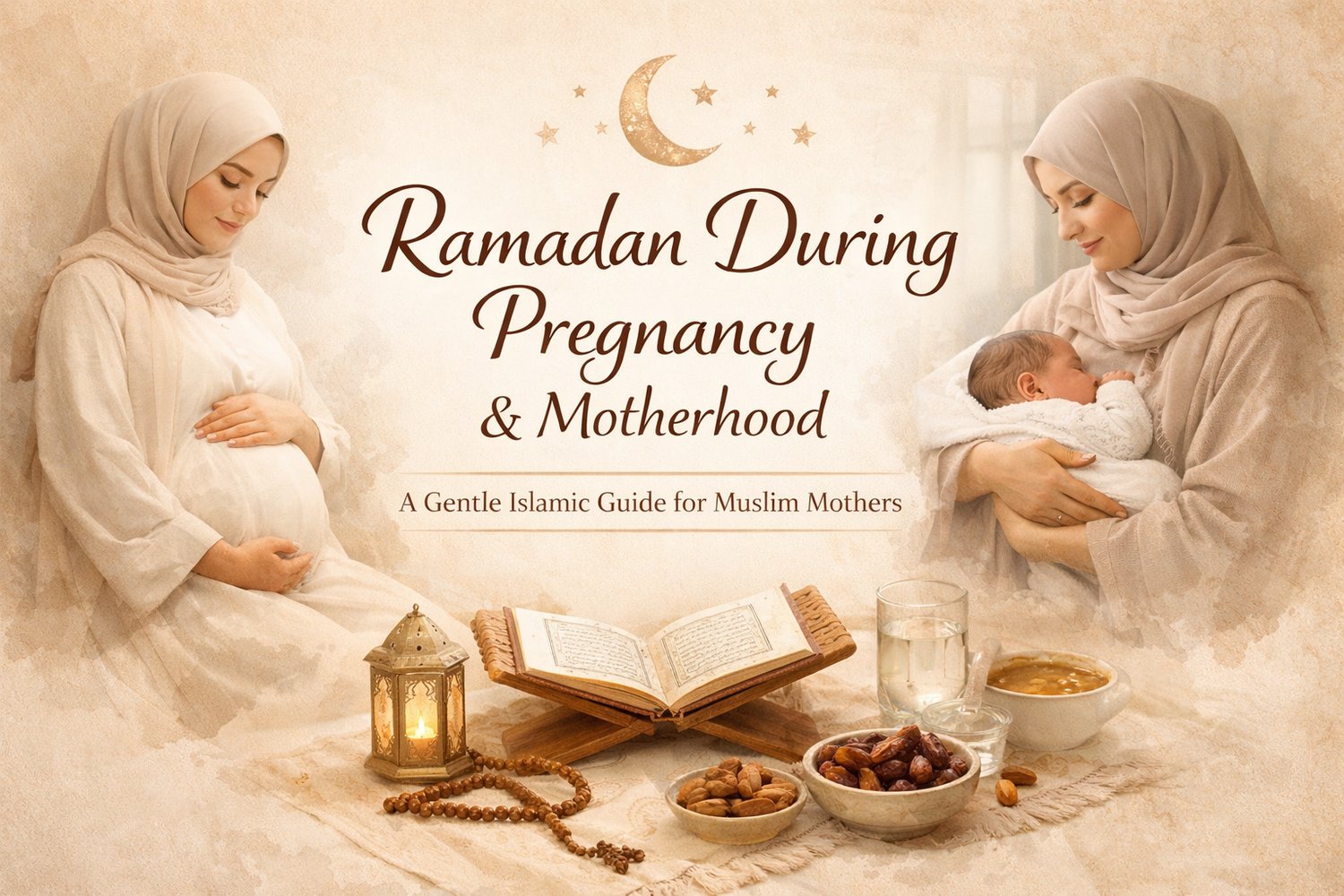
Ramadan Has a Way of Changing Us — Some Seasons More Than Others
Ramadan has a way of changing us every year.
But some seasons change us more deeply than others.
If you’re pregnant…
If you’re breastfeeding…
If you’re navigating postpartum recovery or caring for young children…
Ramadan may not look the way it used to.
And let’s name this gently, but clearly:
That does not mean you are falling short.
It means your amanah has shifted.
“Allah does not burden a soul beyond what it can bear.”
(Qur’an 2:286)
This verse is not meant to comfort guilt after it appears.
It is meant to guide how we live Ramadan in seasons of limitation.
Ramadan Looks Different During Pregnancy — And That’s Still Barakah
When Ramadan Doesn’t Look Like It Used To
Many Muslim mothers carry these thoughts quietly:
“I used to fast every day.”
“I used to finish the Qur’an.”
“I used to attend tarāwīḥ every night.”
Now, you may be:
- Managing nausea, reflux, pelvic pain, or contractions
- Feeding a baby every 2–3 hours
- Recovering from birth while hormones recalibrate
- Running on broken sleep while holding emotional space for others
Ramadan looks… different.
And often, that difference brings guilt.
But here is a reframe we rarely offer mothers:
Ramadan is not diminished by physical limitation.
It is refined by intention.
Pillar 1: Spiritual Grounding — Returning to Niyyah
Before fasting plans.
Before meal prep.
Before “how much Qur’an should I read?”
We return to niyyah.
The Prophet ﷺ said:
“Actions are judged by intentions.”
(Bukhārī & Muslim)
For a pregnant or breastfeeding mother, niyyah may sound like:
“Ya Allah, I intend to honour this body You entrusted to me.”
“Ya Allah, I intend to nourish life for Your sake.”
“Ya Allah, I choose ease where You have allowed it.”
That intention alone carries weight with Allah.
Understanding Niyyah in Pregnancy & Motherhood
Pillar 2: Emotional & Mental Wellbeing — Releasing Comparison
One of the heaviest burdens mothers carry in Ramadan is comparison.
Scrolling social media.
Hearing others’ worship goals.
Comparing yourself to who you were before this season.
But comparison ignores one crucial truth:
Islam recognises seasons of concession (rukhsah).
Pregnancy and breastfeeding are not spiritual loopholes.
They are divinely recognised states.
“Allah intends for you ease and does not intend for you hardship.”
(Qur’an 2:185)
If fasting compromises your health or your baby’s wellbeing:
The reward is not erased
It is deferred with mercy
Feeling Guilty About Ramadan While Pregnant? Read This
Fasting rules during breastfeeding and pregnancy
Preparing for Ramadan Starts Before the Moon Is Sighted
Preparation is not pressure.
It is responsibility.
Before grocery lists.
Before fasting decisions.
Start with intention.
📝 Reflection :
What would a merciful Ramadan look like for me this year?(coming soon)
Can I Fast? A Gentle, Honest Assessment
Islam does not ask you to gamble with health.
Scholars agree:
If fasting causes harm or significant difficulty → you may break or not observe the fast
You may make up fasts later or offer fidyah, depending on your situation
Jābir (رضي الله عنه) narrated that during a journey, a man was injured and later experienced a state requiring ghusl. When he asked whether he could perform tayammum due to his condition, he was wrongly told that water was still obligatory. He performed ghusl, and it led to his death.
When the Messenger of Allah ﷺ was informed, he said:
“They killed him—may Allah deal with them. Why did they not ask when they did not know? The cure for ignorance is to ask. It would have been sufficient for him to perform tayammum, tend to his wound, and wash the rest of his body.”
(Reported by Abū Dāwūd and Ibn Mājah)
This hadith is not merely a historical account.
It is a serious warning.
It reminds us that religious rulings given without knowledge—or without mercy—can cause real harm, even when intentions seem sincere.
And this principle matters deeply when we speak about fasting during pregnancy or breastfeeding.
Clearing a Common Misconception
Our intention is not to pressure women who are genuinely unwell, nutritionally depleted, or medically advised not to fast.
Islam does not glorify hardship for its own sake.
At the same time, we must also be honest and balanced:
Fasting in Ramaḍān is an obligation.
Pregnancy and breastfeeding are not automatic exemptions.
The Sharīʿah allows rukhsah (concessions) when there is real harm or high likelihood of harm—not based on fear alone.
This is why blanket statements such as “you shouldn’t even try” can be just as harmful as forcing someone to fast when they truly cannot.
The Prophet ﷺ taught us to:
- remove harm,
- ask when unsure, and
- apply rulings with wisdom and context.
Where Science & Sharīʿah Meet
From both an Islamic and scientific standpoint:
Many healthy pregnancies can tolerate fasting with proper preparation, hydration, and nourishment.
Many breastfeeding mothers can fast safely depending on milk supply, infant age, maternal nutrition, and overall health.
This does not mean everyone must fast.
It means the minimum requirement is to assess, prepare, and try, rather than assume incapacity by default.
Islam asks us to act with responsibility, not fear.
The Spirit Behind This Guidance
Our hope in presenting this discussion is not judgment—
it is care.
It is rooted in the prophetic ethic:
“None of you truly believes until he loves for his brother what he loves for himself.”
(Ṣaḥīḥ al-Bukhārī & Muslim)
We want for our sisters what we want for ourselves:
- clarity,
- safety,
- spiritual dignity, and
worship rooted in knowledge—not guilt or pressure.
May Allah grant us wisdom to know when to hold firm and when to ease,
and the humility to say “I don’t know—let me ask.”
For a deeper discussion on discernment, accountability, and amanah in recognising bodily limits, see:
Listening to Your Body in Pregnancy (coming soon)
So in a nutshell..
Assess fasting day by day, not emotionally:
- Dizziness, fainting, worsening nausea
- Reduced milk supply
- Dehydration, uterine irritability
- Inability to care for yourself or your children
Always seek guidance from:
- Your doctor or midwife
- A trusted local scholar
- Your country Islamic council rulings
Pillar 3: Physical Nourishment — Caring for the Body as an Amanah
Your body is not an obstacle to worship.
It is a means of worship.
During Ramadan, the nutritional margin for error becomes smaller — especially for:
- Pregnant mums
- Breastfeeding mums
- Nutrient-depleted postpartum mums
Key Priorities
1. Hydration (Non-Negotiable)
- Aim for 2.5–3L between ifṭār and suḥūr:
- Water
- Soups/broths
- Milk
Pregnancy-safe herbal infusions
💡 Dehydration increases:
- Fatigue & headaches
- Braxton Hicks
- Milk supply dips
📌 Pinterest Pin: Hydration checklist
2. Protein at Every Eating Window
Supports:
- Baby’s growth
- Blood sugar stability
- Milk production
Aim: 20–30g protein per main meal
Sources:
Eggs
Chicken
Fish (low-mercury)
Lentils, chickpeas
Greek yoghurt
WHO Maternal Nutrition Guidelines
3. Iron & Blood-Building Foods
Especially important if you:
Have low Hb
Feel dizzy or breathless
Include:
- Red meat (if tolerated)
- Dates
- Spinach
- Lentils
Pair with vitamin C for absorption.
📌 Pinterest Pin: Iron-rich ifṭār plate
Suḥūr: Your Protective Meal
Think of suḥūr as: Fuel + Hydration + Mercy
A balanced suḥūr includes:
Slow carbs (oats, whole grains)
Protein
Healthy fats
Fluids
Avoid:
Excess caffeine
Very salty foods
📌 Pinterest Pin: Pregnancy-safe suḥūr ideas
Ifṭār: Gentle, Not Heavy
Break fast slowly:
- Dates
- Water
- Soup
Pause.
Let your body catch up.
Overloading the stomach:
- Worsens reflux
- Triggers nausea
- Disrupts sleep
✨ Sunnah wisdom meets physiology here.
Pillar 4: Simplified Worship — Depth Over Volume
“The most beloved deeds to Allah are those that are consistent, even if small.”
(Bukhārī)
Gentle worship examples for mothers:
- Dhikr while nursing
- Duʿā’ between feeds
- Listening to Qur’an when reading feels heavy
- One meaningful sujood
Gentle Worship Routines for Tired Mothers – coming soon
📌 Pinterest Pin: Small worship still counts
Pillar 5: Family Rhythms — Worship Inside the Home
Ramadan is lived in homes long before mosques.
For mothers, worship often looks like:
- Preparing suḥūr while exhausted
- Regulating children’s emotions
- Creating calm bedtime rhythms
The Prophet ﷺ said:
“The best of you are the best to their families.”
(Tirmidhī)
Your patience is worship.
Your presence is worship.
Creating a Calm Ramadan Rhythm at Home – Future blog
If You’re Not Fasting This Ramadan
Let this be said clearly:
Not fasting ≠ not worshipping
Not fasting ≠ missing Ramadan
Not fasting ≠ spiritual failure
It means your worship has shifted form.
And Allah sees what others don’t.
📌 Pinterest Pin (End of Blog)
Title: Not Fasting This Ramadan? Your Worship Still Counts
A Quiet Reminder for Your Heart
Ramadan is not a performance.
It is a return.
Some years we return through fasting.
Some years through patience.
Some years through surrender.
And some years — through motherhood.
And that… is still barakah.
Gentle Support for Mothers This Ramadan 🌙
If you’d like calm, grounded support:
📘 Duʿā’ Book for Pregnancy, Birth & Postpartum
🧺 Pregnancy Starter Kit( Coming Soon)
Only if and when you’re ready 🤍