
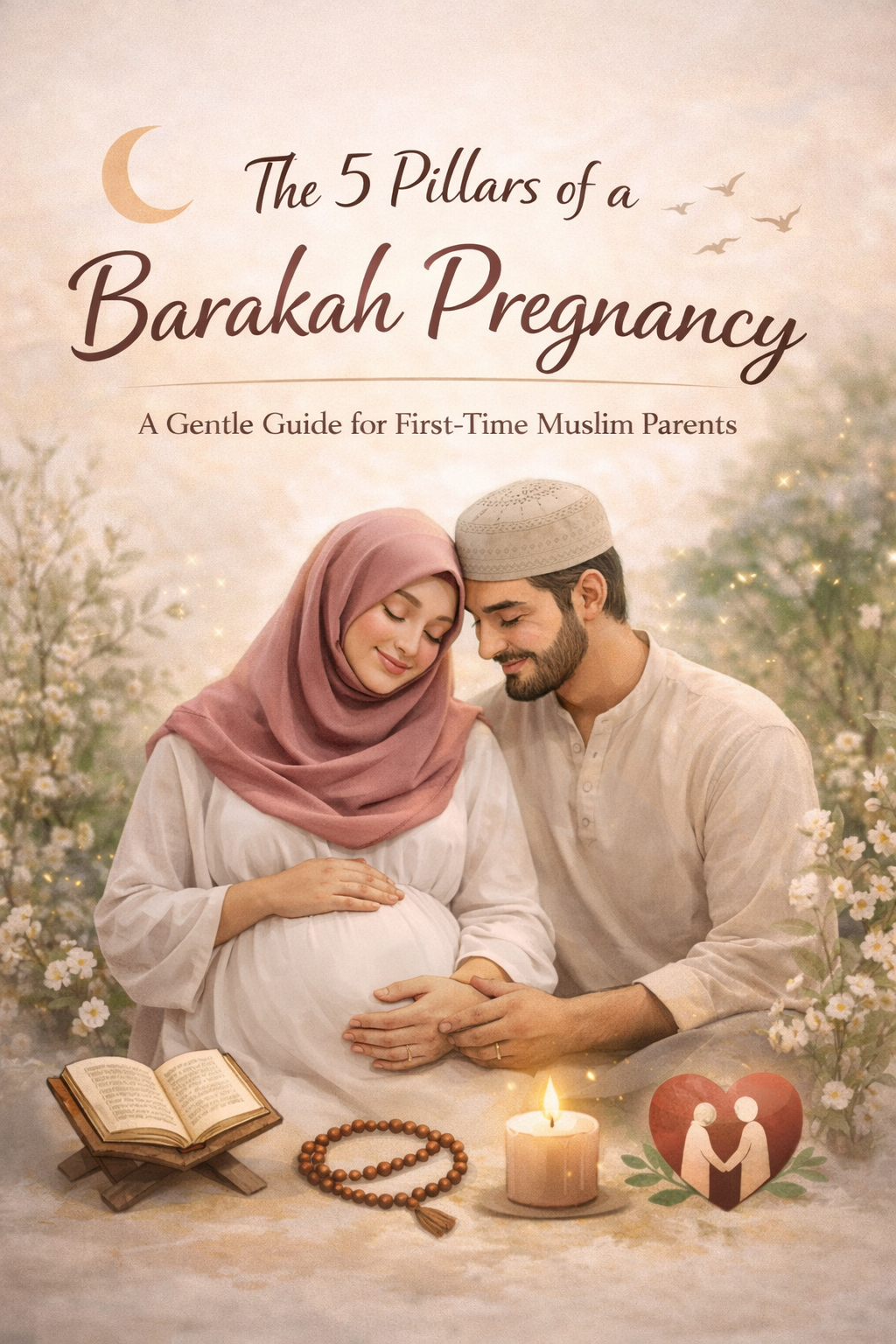
What “Barakah” Really Means — Beyond Supplements, Scans & Checklists
There is a lot of talk about Barakah Pregnancy.
You’ll see it in captions.
Hear it in duʿā’.
Read it in passing reminders.
But what does barakah in pregnancy actually mean?
Is it:
- a complication-free pregnancy?
- a calm birth?
- a healthy baby?
Those outcomes are beautiful — but barakah is deeper than outcomes.
Barakah is not control.
It is alignment.
A barakah pregnancy is one where the heart, body, intentions, and actions are gently aligned with Allah — even when things feel uncertain. This post shares the 5 foundational pillars that support a pregnancy filled with barakah — spiritually, emotionally, and practically — especially for Muslim parents navigating modern life in Singapore, Malaysia and beyond.
Pillar 1: Niyyah & Barakah Mindset
Beginning With Intention, Not Fear
Every act in Islam begins with niyyah.
Pregnancy is no different.
A barakah pregnancy starts when you consciously shift from:
“I hope nothing goes wrong” to “Ya Allah, I entrust this journey to You”
This does not mean ignoring medical care or preparation.
It means placing reliance before control.
Allah reminds us:
“And whoever relies upon Allah — then He is sufficient for him.”
Qur’an 65:3
When niyyah is clear:
- decisions feel lighter
- comparison softens
- anxiety loses its grip
Reflection:
“What am I placing my trust in most right now — outcomes or Allah?”
Barakah in pregnancy is not about controlling outcomes — it is about aligning the heart, body, and intentions with Allah throughout the journey.
Pillar 2: Physical Care With Amanah
Treating the Body as a Trust, Not a Machine
Islam honours the body as an amanah.
Caring for your body during pregnancy is not vanity — it is worship when done with intention.
This includes:
- nourishment
- hydration
- rest
- appropriate movement
- seeking medical care when needed
Science supports this balance.
Pregnancy increases nutritional, metabolic, and neurological demands and ignoring the body often increases emotional strain.
Barakah does not mean “doing everything perfectly”.
It means responding wisely.
Caring for the body during pregnancy is part of honouring the amanah — through nourishment, rest, hydration, gentle movement, and seeking appropriate medical care when needed.
Pillar 3: Emotional & Couple Awareness
Pregnancy Is a Family Transition — Not a Solo One
Pregnancy affects more than the womb.
It shifts:
- emotions
- roles
- expectations
- communication
Many marital tensions during pregnancy and postpartum are not caused by lack of love — but by lack of emotional preparation.
Allah describes marriage as sakan — tranquility.
“…that you may find tranquility in them…”
Qur’an 30:21
This tranquility is built through:
- gentleness during emotional shifts
- reassurance instead of fixing
- shared duʿā’ during uncertainty
Preparing emotionally together is a pillar of barakah.
Pregnancy is not only a physical transition for a mother — it is an emotional and relational transition for a couple.
Pillar 4: Emotional & Spiritual Regulation
Understanding That Emotional Shifts Are Not Weak Iman
One of the most misunderstood parts of pregnancy is emotional change.
Sudden tears.
Unexpected fear.
Feeling unlike yourself.
Science explains this clearly:
- hormonal changes affect emotional regulation
- the nervous system becomes more sensitive
- the brain prepares for caregiving
Islam meets this reality with raḥmah, not judgment.
Emotional distress during pregnancy is not a sign of weak faith.
It is a sign of transition.
Allah says:
“Allah does not burden a soul beyond what it can bear.”
Qur’an 2:286
A barakah pregnancy includes:
- emotional awareness
- gentle self-talk
- grounding through duʿā’ and dhikr
Preparing the heart — emotionally and spiritually — is just as important as preparing the body during pregnancy. Many of the emotional shifts that surface in this season are part of a deeper transition the heart is undergoing.
Pillar 5: Preparing for Birth & Beyond
Barakah Is Sustained — Not Rushed
A barakah pregnancy does not end at birth.
How you prepare for:
- labour
- postpartum recovery
- emotional support
- expectations after delivery matters deeply.
Many postpartum struggles begin because pregnancy preparation focused only on the birth day , not the weeks after. Islam teaches foresight with gentleness.
Preparation is not fear-based.
It is trust-based planning.
Preparing for birth and beyond is part of sustaining barakah — not rushing it.
(A future post will explore this in more depth.)
What a Barakah Pregnancy Is — And Is Not
A barakah pregnancy is not:
- a perfect pregnancy
- a fear-free journey
- a checklist completed flawlessly
A barakah pregnancy is:
- a heart anchored in trust
- a body cared for with compassion
- emotions met with understanding
- a couple growing together
- preparation that honours both dunya and akhirah
A Gentle Next Step
If you’re at the beginning of this journey, or finding your footing again, you may find these supports helpful:
- Free Trimester 1 checklist
- Free: Dua for Pregnancy & Birth
- Barakah Birth Online series
- Barakah Pregnancy Starter Kit — a calm, faith-anchored guide covering mindset, emotional preparation, physical care, and couple alignment (Look out for it in Feb)
Take what serves your season.
Barakah does not mean certainty.
It means being held — even when the path unfolds slowly.
May your pregnancy be filled with:
- gentleness where there is fear
- clarity where there is confusion
- and barakah in every step, bi idhnillah.