
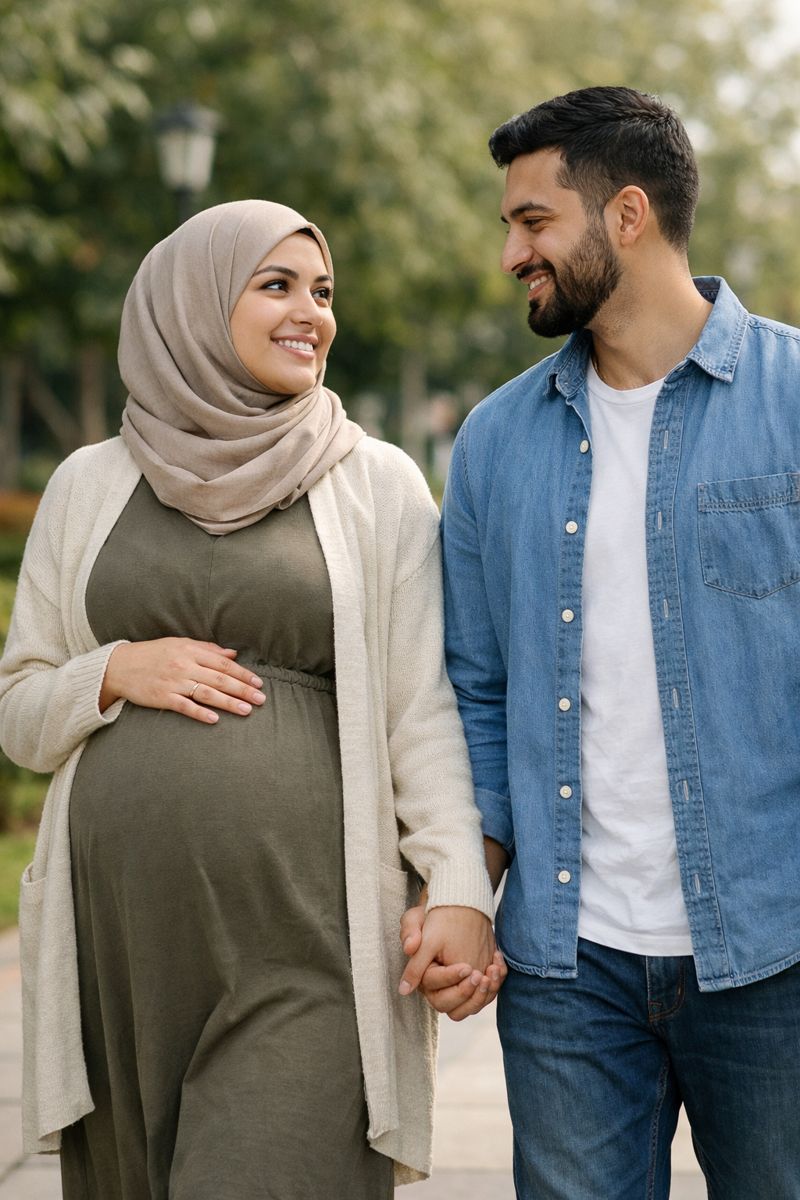
Journey Meant for Two Hearts
Pregnancy is often spoken about as " her " journey.”
But in Islam, it is their journey.
Allah gave the mother the honour of carrying the child ,but He gave the father the honour of carrying the home, the emotional climate, and the leadership that allows the mother to thrive.
This blog post explores the Islamic framework of shared pregnancy, and why the husband’s presence is a source of mercy, stability, and barakah.
The Qur’anic Foundation of Shared Parenthood
Islam honours mothers, yes , but it also honours the father’s role through responsibility, leadership, and protection.
Allah says:
“Men are protectors and maintainers of women.”
(Qur’an 4:34)
Protector of what?
Not just finances.
But:
- her emotional wellbeing
- her sense of safety
- her spiritual state
- her comfort
- her dignity during pregnancy and birth
This ayah calls husbands into active presence, not distance.
The Emotional Weight of Pregnancy
For many Muslim women, pregnancy is:
- emotionally unpredictable
- physically draining
- spiritually awakening
- mentally overwhelming
This is where the husband becomes her anchor.
His presence can regulate her hormones.
Oxytocin rises when she feels loved and supported.
Stress hormones decrease with gentle words and compassion.
His tone becomes her atmosphere.
A calm husband → calm household.
A stressed husband → stressed mother → stressed baby.
His du’a becomes her emotional shield.
When he recites:
“Ya Allah, ease her path and protect her and our child.”
her heart softens.
Why Husbands Matter More Than They Realise
1. The father shapes the mother’s mental health
A supported mother is:
- more confident
- less anxious
- more emotionally stable
- more spiritually grounded
This directly benefits the baby.
2. The father influences the baby’s emotional development
Babies sense:
- the mother’s heart
- her calmness
- her stress
- her safety
When the husband supports the mother, the baby feels safer through her.
3. The father’s du’a carries barakah into the home
Angels respond to sincere du’a.
Imagine a father reciting:
“Ya Rabb, make me a source of mercy for my wife and child.”
This fills the home with tranquility.
4. The Prophet ﷺ modeled gentle fatherhood
He carried children.
He kissed them.
He played with them.
He taught us that fatherhood is mercy, not distance.
Husband & Wife: A Team in Pregnancy
Here’s what shared pregnancy looks like:
1. Learning together
Attend birth classes
Understand stages of labour
Read about emotional changes
Discuss expectations
When husbands learn, they stop feeling helpless.
2. Clear emotional support
Support means:
listening, not fixing
holding, not pressuring
comforting, not criticizing
Sometimes the mother needs a loving, steady companion—not solutions.
3. Practical help
helping with chores
attending appointments
researching options
preparing the home
ensuring she rests
These actions replace stress with calmness.
4. Spiritual bonding
Pregnancy is the perfect time to:
pray together
recite Qur’an
make du’a for the baby
reflect on Allah’s Names
reconnect as a couple
This becomes the spiritual foundation of parenthood.
Pregnancy Through the Lens of Mercy
The Prophet ﷺ described marriage as:
“Tranquility, mercy, and affection.”
Pregnancy multiplies the need for these three qualities.
Mercy
When she cries easily.
When her back hurts.
When she is overwhelmed.
Affection
Small gestures.
Gentle hugs.
Soft tones.
Tranquility
Protecting her from unnecessary stress.
If you're expecting and want to walk this journey together, with purpose, intention, and barakah:
Check out our Barakah Pregnancy Blueprint Ecourse.
The gentle, couple-led guide for every Muslim family.