
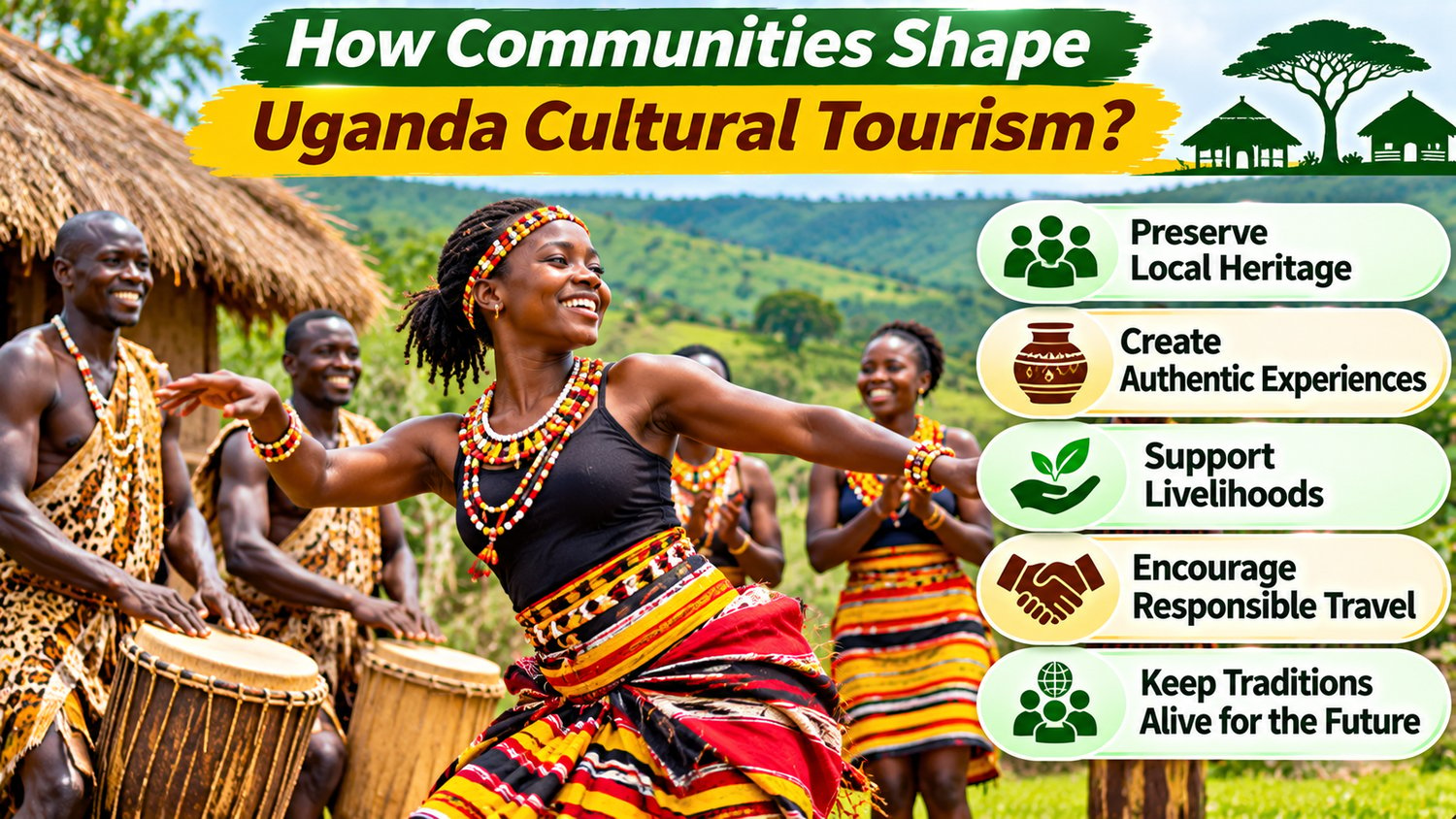
Local communities shape cultural tourism in Uganda by organising visits, interpreting heritage, sharing everyday skills and managing small enterprises. Performers, cooks, artisans, storytellers and hosts contribute different forms of knowledge, while community associations may negotiate with tour operators and decide how activities operate. Participation also raises questions about who controls cultural representation and receives tourism income. Meaningful experiences respect those decisions rather than treating residents as attractions.
Communities Plan and Deliver Cultural Experiences
Cultural tourism involves considerably more than inviting visitors to watch a performance. Local organisers may select activities, agree on prices, arrange meeting places and decide which traditions they wish to present. Some groups run their own programmes; others supply services through lodges, travel companies or cultural institutions.
Before inviting visitors, organisers may consult elders, ask which households wish to participate and establish group sizes. Venues can accommodate activities that might intrude on private homes. Agreements about access and timing distinguish an invitation from assumed permission.
A community association might coordinate hosts and rotate opportunities among members. Meanwhile, an individual craftsperson may welcome customers independently. Neither model automatically ensures fair outcomes. What matters is whether participants can negotiate payment, set boundaries and influence decisions.
Participation Versus Decision-Making Power
An enterprise can employ local performers without allowing them to choose the programme or retain a reasonable share of its revenue. By contrast, community-led ventures can give members a voice in scheduling, storytelling, visitor numbers and acceptable photography. Transparent records and agreed responsibilities help prevent disputes, particularly when several households contribute to one visit.
For travellers considering uganda cultural tours, asking who designed an experience reveals more than promotional claims about authenticity.
Music, Dance and Storytelling Carry Cultural Meaning
Uganda includes many communities with distinct languages, histories and performance traditions. Groups may present music, dance or drama to explain celebrations, social relationships or regional artistic forms. Instruments, rhythms, costumes and movement vary considerably; no single performance represents the country as a whole.
A visitor presentation also differs from a ceremony within community life. Organisers may shorten a performance, explain unfamiliar references or create a programme specifically for guests. Such adaptations need not diminish its value when performers clearly describe what they are presenting.
Elders and Cultural Practitioners as Interpreters
Elders and knowledgeable practitioners may discuss oral histories, farming customs, language, land relationships or inherited skills. Younger interpreters sometimes translate or explain these accounts for visitors, linking generations through shared work.
However, communities do not owe strangers unrestricted access to private beliefs or sacred stories. Hosts should decide which knowledge they share, and visitors should request consent before recording interviews, performances or ceremonial spaces. Different members may also interpret the same history differently.
Craft Workshops Turn Skills Into Livelihoods
Craft production offers a practical point of contact between visitors and makers. Artisans may demonstrate basket weaving, pottery, beadwork, textile techniques or wood carving, depending on local specialisms and available materials. A workshop can show the time and judgement behind an object that a souvenir stall cannot easily communicate.
Participants may earn through several channels:
- Demonstration fees for teaching particular techniques.
- Direct sales of finished pieces or made-to-order work.
- Paid workshops where guests practise under an artisan's supervision.
- Orders from local accommodation providers or tourism retailers.
Direct purchasing can improve an artisan's return, although materials, transport, commissions and shared enterprise costs still affect earnings. Visitors should ask prices respectfully rather than assuming handmade work costs little. Producers, not tourists, should determine whether a design carries private cultural meaning.
Craft skills can also travel between generations when younger makers join workshops. Yet commercial demand may favour quick, standardised items over slower techniques, so economic incentives and cultural continuity do not always align neatly.
Food and Hospitality Connect Visitors With Local Life
Community cooks and hosts may organise meals, market visits or demonstrations that explain how ingredients reach the table. Such encounters can involve growers, small traders, food preparers and families who provide a suitable setting for guests.
For example, matooke, a preparation of cooking bananas, features prominently in parts of Uganda. In Buganda, luwombo involves steaming food in banana leaves. Presenters can explain regional preferences, preparation methods and dining customs without suggesting that every Ugandan household eats identical meals.
Food experiences work best when hosts control timing, hygiene arrangements, dietary discussions and participation. Guests should respect household privacy, communicate allergies beforehand and avoid treating ordinary domestic responsibilities as a permanent public performance.
Heritage Visits Depend on Community Authority
Cultural heritage includes places, memories, skills and relationships with particular landscapes. Communities may organise walking visits, interpret historic locations or explain how environmental knowledge connects with livelihoods. These activities require careful attention to local ownership and access.
Near Bwindi Impenetrable National Park and Mgahinga Gorilla National Park, Batwa cultural experiences provide examples of forest knowledge and heritage interpretation. Batwa participants may discuss traditional gathering practices, songs and their communities' relationships with forest landscapes. Visitors must also consider their involvement alongside the history of displacement associated with protected areas.
Such visits should never portray Batwa people as living exhibits or suggest that historical lifestyles describe every person's circumstances now. Community members should determine what they present and how visitors engage with it.
Other regions offer different contexts. In Karamoja, locally arranged encounters may address pastoral livelihoods and regional traditions, but organisers should avoid presenting Karamojong identity as uniform or unchanged. Appropriate interpretation leaves room for contemporary aspirations and individual differences.
Women and Young People Contribute Beyond Performances
Women may manage craft groups, food enterprises, guest services, bookings and financial records. Young people can participate as interpreters, performers, organisers or digital promoters. These activities may build business skills and create work near home, particularly where tourism organisations provide fair access to training.
However, participation does not necessarily translate into authority. An enterprise could rely on women's labour while others control prices and revenue. Likewise, young workers may lack influence over schedules or working conditions.
Fairer arrangements may include:
- Clear payment agreements and accessible income records.
- Opportunities to participate in management decisions.
- Skills training linked to actual paid responsibilities.
- Scheduling that respects education, caring duties and community obligations.
Benefits depend on who gains access, how organisers distribute work and whether members can raise concerns without losing opportunities.
Tourism Earnings Spread Through Local Enterprises
Cultural visits may generate direct payments for hosts, interpreters, performers and artisans. Secondary spending can reach transport providers, farmers, shops and accommodation businesses. Some associations direct a portion of earnings towards shared priorities, although arrangements differ between projects.
A hosted meal may involve growers, cooks and interpreters, but an inclusive price can obscure how earnings reach them. Travellers can ask about payment principles without demanding private accounts. Transparent organisers explain their approach while respecting members’ privacy.
Revenue alone cannot establish community benefit. Operators must cover legitimate costs, while intermediaries may retain a substantial share of the visitor's payment. Seasonal demand also makes earnings uncertain. A village that receives visitors regularly during one period may have little tourism income during another.
Visitors can ask whether fees reach the people delivering the activity and whether organisers explain charges before booking. Local ownership often improves opportunities for decision-making, but fair contracts and transparent distribution matter just as much.
Cultural Preservation Requires Choice, Not Performance
Tourism can provide an audience and income for skills that communities value. A paid storytelling session may encourage documentation, while craft workshops can create reasons for experienced makers to mentor younger people. Performances may also bring attention to local languages and artistic practice.
Nevertheless, cultural change belongs to communities themselves. Tourism becomes problematic when outsiders demand supposedly ancient customs, disregard contemporary lifestyles or pressure hosts to reveal restricted knowledge. Recording material without permission can also remove control over how others circulate it.
Cultural preservation therefore involves more than repeating performances. It includes recognising community choices about what to maintain, adapt, share privately or leave outside commercial tourism.
Challenges and Responsible Choices for Travellers
Limited transport, inconsistent demand and weak marketing access can restrict community enterprises. Disagreements over payments or representation may create further pressures. Partnerships work better when organisers communicate expectations clearly and community members can revise agreements.
Travellers can support respectful arrangements through straightforward checks:
- Ask whether residents organise the activity or merely appear in it.
- Confirm fees, payment arrangements and any additional craft costs.
- Seek permission before photographing people, homes or religious spaces.
- Honour agreed schedules and avoid intrusive personal questions.
- Choose activities that explain cultural context without claiming to represent everyone.
Responsible cultural tourism should respect communities as partners with their own priorities, rather than treating visits as charitable interventions.
Conclusion
Ugandan communities participate in cultural tourism as organisers, interpreters, business owners, artisans and hosts. Their activities can create income and strengthen opportunities to share heritage, but outcomes depend on consent, fair compensation and genuine decision-making power. Visitors contribute most constructively when they ask how an experience operates, respect cultural boundaries and pay for people's work on agreed terms. Community participation matters not simply because residents appear in a tourism programme, but because they retain a meaningful voice in shaping it.