

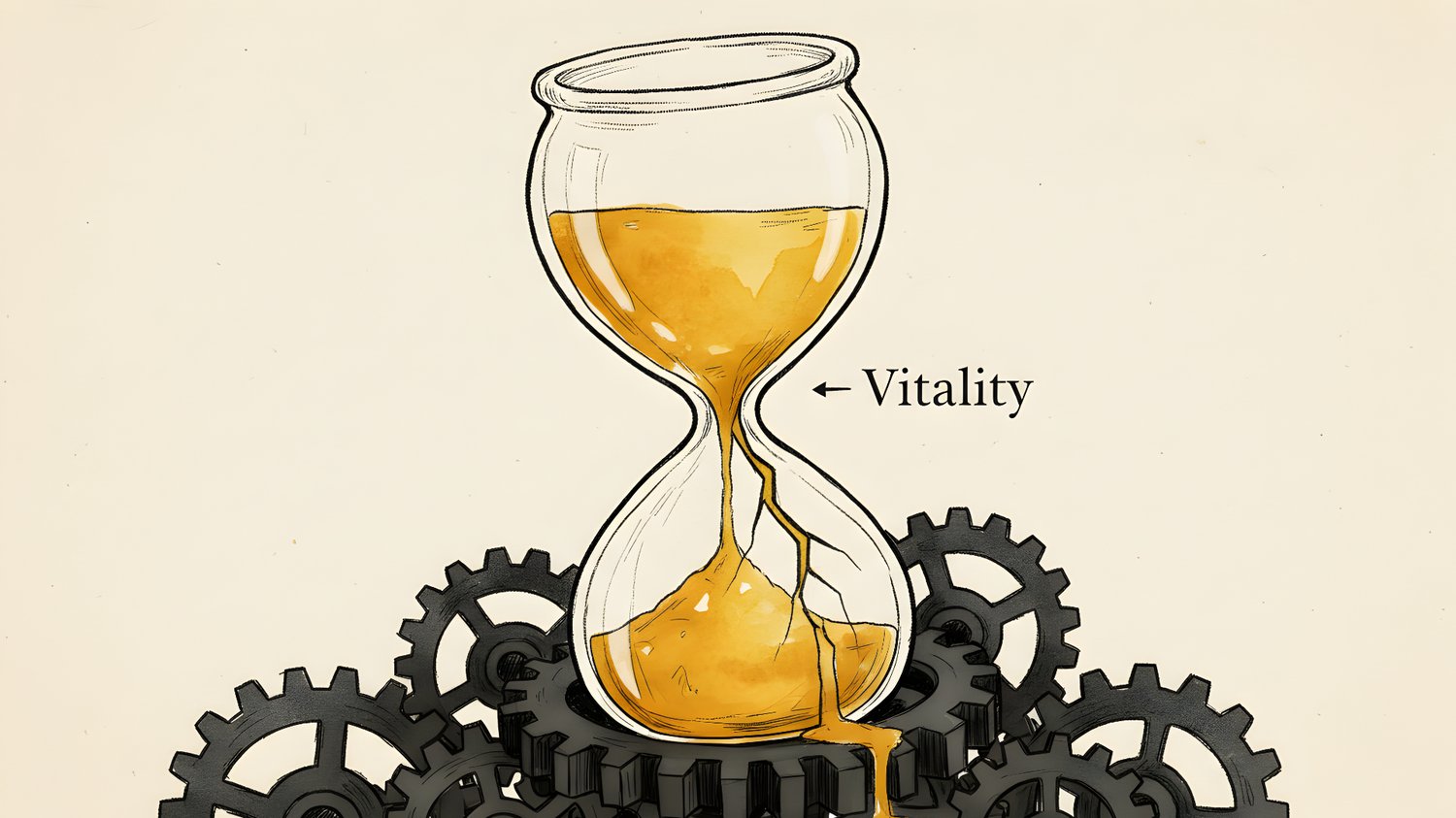
Fulfillment Beyond Achievement
At some point, the job became the person. The title became the identity. The output became the measure of worth.
According to a 2023 Pew Research study, 73% of employed Americans say their job is at least somewhat important to their overall identity. Among postgraduate workers, 53% describe it as central to who they are. And yet only 29% of those same workers report feeling genuinely fulfilled.
That gap is where the depletion lives.
Wholeness is not a destination that arrives with the next promotion, or when the business finally scales, or when the audience grows large enough. Modern psychology, existentialism, Stoicism, and spiritual philosophy point to the same conclusion: wellbeing is a state of action. A multi-dimensional practice that integrates biology, psychology, philosophy, and presence.
This article is on what that practice actually looks like.
The Body Has to Catch Up First
Before any meaningful psychological shift becomes possible, the body needs to come along for the ride.
In 2025, 66% of American workers are experiencing some form of burnout. 82% are considered at risk. Burnout costs businesses $322 billion annually in lost productivity alone. These are the predictable outcomes of a workforce that has learned to manage stressors while never completing the stress cycle itself.
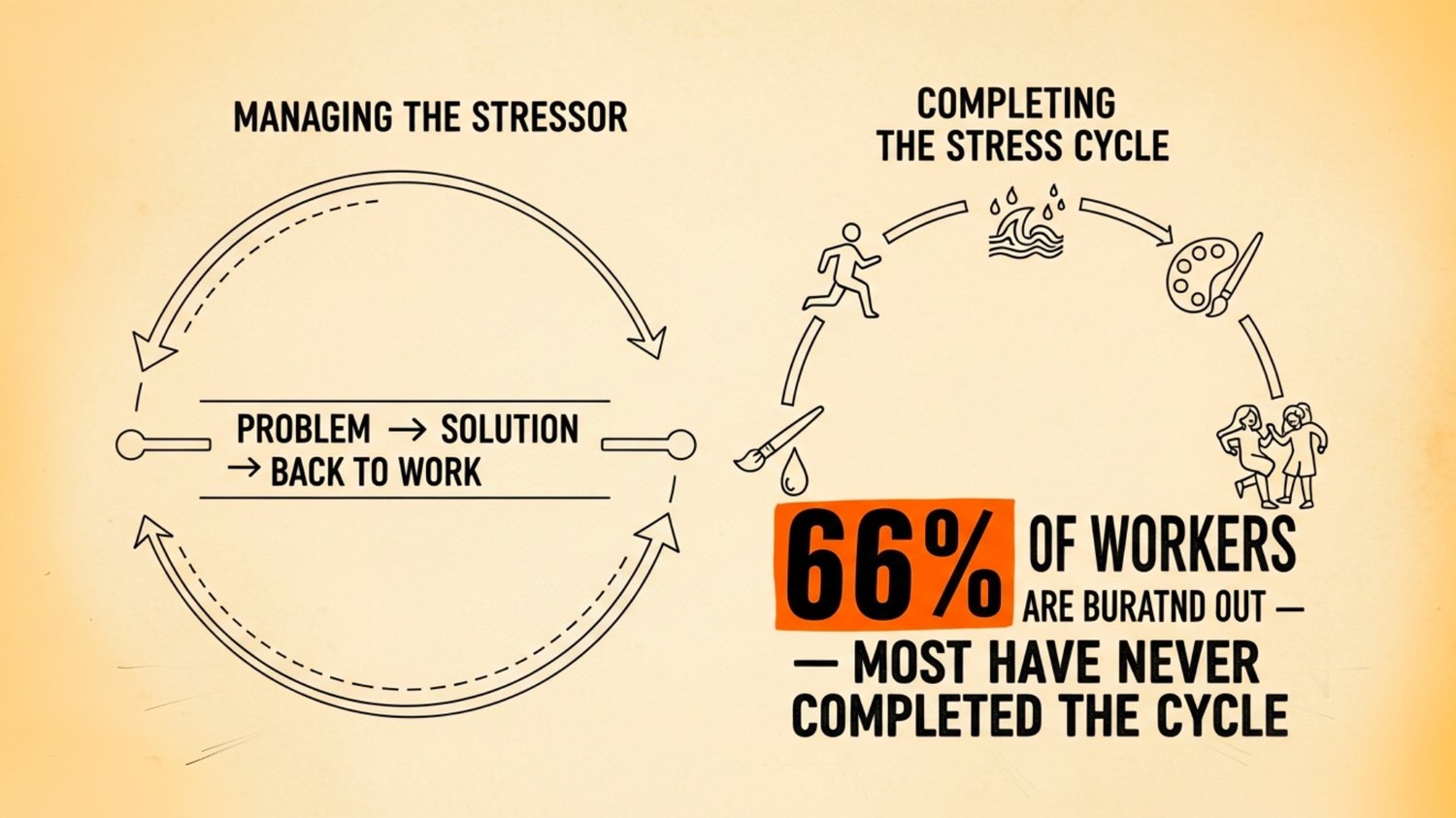
Human biology draws a sharp distinction between the two. Dealing with a stressful situation and dealing with the physical stress response inside the body are entirely separate processes. Even when the problem is resolved, the body remains flooded with adrenaline and cortisol until it receives an active signal that the threat has passed. Ignoring that signal, repeatedly, is exactly where chronic burnout begins.
"The body will not be lied to." - Caroline Myss
The most efficient way to complete the biological stress cycle is physical movement, which metabolizes stress hormones and resets the brain. Deep breathing, creative expression, a genuine cry, or twenty seconds of sustained physical affection (long enough for the brain to register safety) are also reliable methods. These are physiological requirements, not lifestyle indulgences.
Neuroscientist Stephen Porges' Polyvagal Theory maps three states the nervous system moves through: the dorsal vagal state of helpless shutdown, the sympathetic state of fight or flight, and the ventral vagal state of calm connection and safety. Research confirms that mindfulness practices targeting the ventral vagal complex are directly linked to improved resilience and long-term stress reduction. Fulfillment requires anchoring in that third state. And the body has to get there before the mind can follow.
The False Self Is Exhausting to Maintain
77% of workers experienced work-related stress in the past month. Among them, 31% reported emotional exhaustion as the primary symptom. Much of that exhaustion has a specific and underexamined cause: the sustained performance of a version of yourself that is not entirely real.

Trauma and early conditioning often drive people toward a "please and appease" response. Behavior shapes itself around the expectations of others. Survival begins to depend on keeping the peace. Somewhere inside that dynamic, the authentic self goes quiet.
A False Self forms in its place, built to be palatable, functional, and approved of.
In professional settings, this becomes emotional labor: the ongoing management of feelings to satisfy organizational expectations.

Research confirms that chronic surface acting (performing emotions you do not feel) correlates significantly with depression, burnout, emotional dissonance, and cardiovascular strain. It is the experience many describe simply as feeling like a fraud, or wondering who they actually are outside of their role.
Jean-Paul Sartre called this "bad faith," the self-deception of believing your identity is entirely defined by your job title or social role. His argument was direct: humans are, in his words, "condemned to be free," meaning identity is never fixed, and the responsibility for creating meaning always belongs to the individual. Reclaiming wholeness requires the courage to dismantle the idealized social self and take genuine ownership of who you are beneath it.
"We are our choices." - Jean-Paul Sartre
The Philosophical Triage That Changes Everything
Worry has a particularly cruel relationship with output. It spends enormous energy on problems that were never within our control to begin with.
The Stoics identified this as the root of most human unhappiness: insatiability combined with a fixation on outcomes we cannot dictate. Epictetus formalized the antidote as the Dichotomy of Control. Every element of your life falls into one of two categories: what you have complete control over (your goals, your character, your values, your responses) and what you have no control over (external events, the opinions of others, the past).
The practical shift is significant. A goal of "winning the deal" or "going viral" depends entirely on factors outside your control.
The Stoic reframe: make the goal to perform at your absolute best. That goal remains invincible regardless of external outcomes and it keeps self-worth intact even when the results disappoint.
Stoics also practiced negative visualization: a brief, deliberate contemplation of loss.
Imagine the platform gone. The income gone. The relationship ended. This exercise directly counters hedonic adaptation, the phenomenon through which we rapidly return to a baseline satisfaction level no matter what we achieve.
Research on present-moment awareness echoes this principle: people with higher present-moment awareness navigate stress through their core values more reliably, and that effect persists into the following day.
"You have power over your mind, not outside events. Realize this, and you will find strength." - Marcus Aurelius
The Meaning Question That Cannot Be Skipped
A life without meaning generates a particular kind of suffering.
Purpose in life is a more robust predictor of long-term mortality outcomes than life satisfaction alone.
Meaning is not a soft concept but directly measurable and it matters deeply.
Albert Camus observed that life is fundamentally absurd, the result of friction between our human desire for order and the universe's indifference. His prescription was to face that absurdity directly and find meaning in the struggle itself. Like Sisyphus pushing his boulder, perpetually and without resolution, the engagement is the point. Camus concluded we must imagine Sisyphus happy.
Jordan Peterson sharpens this: meaning is found through voluntary sacrifice. Giving up immediate gratification in service of something larger. Taking on the heaviest burden of responsibility you can bear. This is the deliberate inverse of comfort-seeking, and it is, by Peterson's account, the most reliable path to a life that feels genuinely significant.
"The purpose of life is a life of purpose." - Robert Byrne
There is also the matter of honesty. Paulo Coelho described this as pursuing your "Personal Legend," the unique purpose that belongs to you alone.
A study involving 1,267 participants found that higher mindfulness was associated with significantly greater happiness, and that this relationship was explained in part by a stronger sense of purpose in life. The data reflects what the philosophers have argued for centuries: living in alignment with your truth is not optional to wholeness. It is the structure of it.
The Present Moment Is the Only Address
All of the above converges in one location: now.
Research from Harvard found that people are significantly happier when their attention is fully present in the current moment.
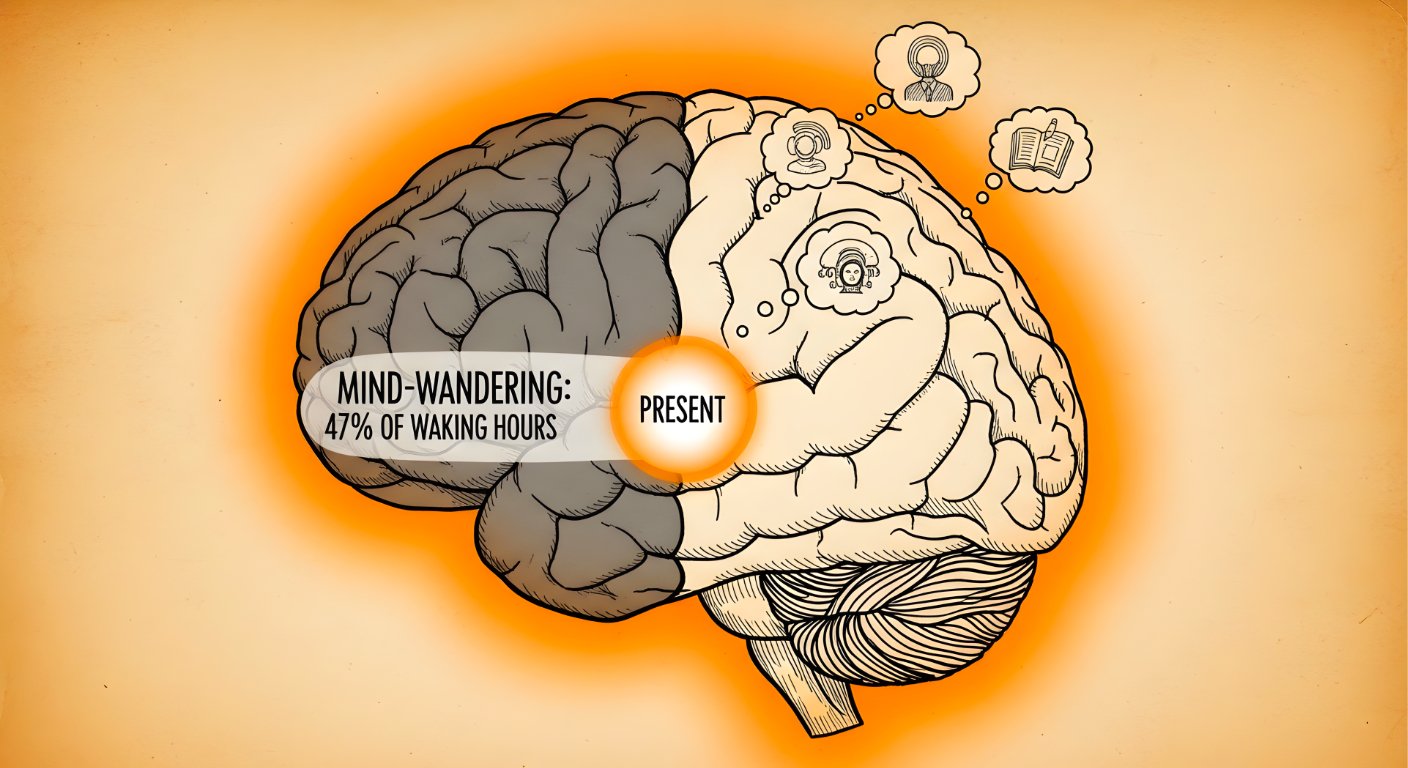
Mind-wandering, which occupies nearly 47% of waking hours, is consistently associated with unhappiness regardless of the activity being performed. The quality of presence predicts the quality of experience more reliably than the activity itself.
Dan Millman, in Way of the Peaceful Warrior, distilled this into something that sounds deceptively simple: the secret to happiness is found not in seeking more, but in developing the capacity to enjoy less. Satori, a concept from Zen Buddhism, describes the realization that what you were searching for was present all along. Full, unencumbered attention to the arising moment, without the weight of past regrets or future anxieties.
"Realize deeply that the present moment is all you ever have." - Eckhart Tolle
This is where the work of reclaiming self-worth ultimately lands. When the nervous system is regulated, when the False Self is set aside, when the philosophical tools are in place, and when meaning is actively pursued, the present moment becomes livable again. More than livable.
Wholeness is never built all at once. But it is built, one regulated breath, one honest choice, one present moment at a time.
Ready to Move From Insight Into Action?
Understanding the framework is one thing.
Actually walking through it, on your own terms, in a single focused day, is another.
Action is a 1-day blueprint we created and are sharing for $0+, built for exactly this moment. Designed for professionals who recognize themselves in this article, online creators building something real, and anyone who is done waiting to feel whole again. In one day, you will move through the five dimensions covered in this report and walk away with a personal, actionable map back to your own self-worth.
Comments ()