


Executive Function can be defined as a set of cognitive and self-regulatory processes that work together to aid actions towards achieving goals.
There are three (3) foundational components to executive function: working memory, self-control, and cognitive flexibility. Within these three components are eight (8) skills (Flowers, n.d.):
- Response inhibition (the capacity to think before acting)
- Working memory (ability to retain information while performing tasks)
- Emotional control (ability to manage emotions in actions)
- Flexibility (ability to revise plans to adapt to changes in the environment)
- Sustained attention (the capacity to pay attention to a task for appropriate lengths of time)
- Task initiation (the ability to begin projects in a timely manner without procrastination)
- Planning & Organization (the ability to create and maintain a plan or system to keep track of information)
- Time Management (the capacity to estimate time available, allocation of time towards tasks, and complete tasks efficiently)
The Center on the Developing Child at Harvard University (n.d.) attributes executive function to an air traffic control system in the brain, managing information, making decisions, and planning ahead.
Attention Deficit Hyperactivity Disorder (ADHD) is a neurodevelopmental disorder that impacts all skills categorized under executive function. The National Institute of Mental Health (n.d.) characterizes ADHD as inattention, hyperactivity, and impulsivity.
The name of the disorder is confusing (in addition to the societal understanding of the condition) because it causes people to think that this is simply about difficulties sustaining attention and having appropriate levels of physical activity. In reality, as a condition that impacts the brain and the development (hence, "neurodevelopmental") of executive functioning skills, a plethora of challenges in day to day life occur.
Here is the kicker: Most of those challenges are invisible.
Think of it this way: Your brain tells your body what to do. An overactive mind can lead to an overactive body. Sometimes, an overactive mind doesn't lead to an overactive body, which I refer to as invisible hyperactivity.
Rapid thoughts can be just as debilitating as physical hyperactivity. Commonly, individuals who have "invisible ADHD," or otherwise unnoticeable traits of the condition, are diagnosed with an anxiety disorder and are left to manage their executive functioning challenges without treatment. Unfortunately, treating anxiety that is caused by ADHD without treating ADHD is ineffective. The rapid thoughts, worries, and disorganization continue.
Using the information from various resources, including peer-reviewed articles, continuing education presentations, my professional experience working with individuals with ADHD, and personal experience with the disorder, I've created a table to help paint a better understanding of ADHD and how it impacts day to day life by correlating the related executive function skills.
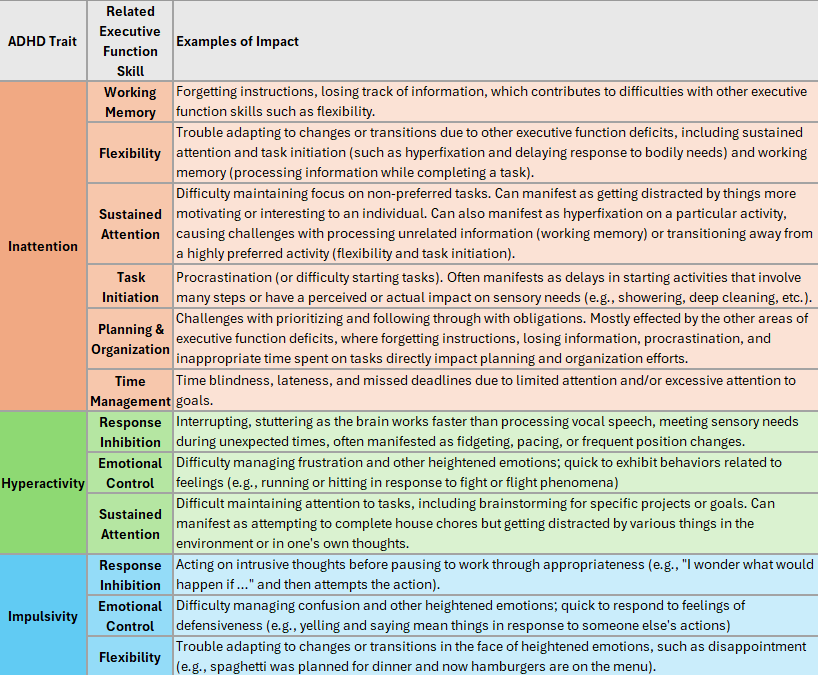
The invisible impact of ADHD becomes easier to understand when correlating ADHD traits to the eight (8) critical executive functioning skills. The obvious, or visible, behaviors of ADHD are often perceived as carelessness, inconsideration, and dramatic but are often the result of genuine neurological differences that affect information processing, organization, memory, regulation, and actions.
It is no wonder that many individuals with ADHD spend years feeling misunderstood. Their intentions are often good-natured and plans well-intentioned, but the deficits in their executive functioning plays a prominent role in how their behaviors impact others.
A missed deadline, interruptions, and emotional reactions are the tip of the iceberg for the air traffic control system, where immense amounts of mental effort is required to manage rapid thoughts, competing priorities, shifting attention, regulation, and endless other demands that require executive functioning throughout each day.
Recognizing ADHD as an executive function disorder rather than simply a problem of attention or hyperactivity helps shift the conversation from judgment to understanding. Instead of asking, "Why are they like this?" we can begin asking, "What support might help them be more successful?" This change in perspective can make a profound difference in schools, workplaces, healthcare settings, and personal relationships.
Most importantly, understanding the connection between ADHD and executive functioning reminds us that struggles do not reflect intelligence, capability, or character. Individuals with ADHD often possess remarkable creativity, problem-solving abilities, passion, resilience, and innovation. The challenge is not a lack of potential, but rather navigating a world that frequently assumes executive functioning skills develop and operate the same way for everyone.
Our understanding of ADHD will continue to grow as research and practice evolves. Our willingness to recognize the invisible challenges individuals face every day should coincide with this growth. Let's create opportunities for effective support, appropriate accommodations, and meaningful success for those whose brains simply work differently.
Advancing Behavioral Solutions is committed to practical, ethical, and compassionate behavior change rooted in evidence‑based practice and respect for individual experience.
References
Center on the Developing Child at Harvard University. (n.d.). A guide to executive function: What is it, and
how is it developed? Harvard University. https://developingchild.harvard.edu/resource-guides/guide-executive-function/
Cleveland Clinic. (2024, March 15). Executive function: What it is, how to improve & types. Cleveland
Clinic. https://my.clevelandclinic.org/health/articles/executive-function
Diamond, A. (2013). Executive functions. Annual Review of Psychology, 64, 135-168.
https://doi.org/10.1146/annurev-psych-113011-143750
Flowers, J. (n.d.). Addressing executive functioning skills with applied behavior analysis [Asynchronous
continuing education course].
National Institute of Mental Health. (n.d.). Attention-deficit/hyperactivity disorder (ADHD). U.S. Department
of Health and Human Services. https://www.nimh.nih.gov/health/topics/attention-deficit-hyperactivity-disorder-adhd
Psychology Today. (2026, June 2). Executive function. Psychology Today.
https://www.psychologytoday.com/us/basics/executive-function
Comments ()