

China isn’t just a place to visit — it’s a market, a supply chain, and a workplace reality across industries like advanced manufacturing, EVs and batteries, renewable energy, humanoid robotics, logistics, and global trade. Learning Mandarin is the foundation for real engagement with China — and a serious career advantage.
Even basic Mandarin makes you more independent — you can follow what’s really being said, communicate without always relying on a translator, negotiate better deals, spot opportunities earlier, and build stronger, long-term relationships based on trust and clarity.
Today we’re tackling the absolute essentials: ten workplace Mandarin questions you’ll genuinely use in China—probably before lunch. Skip the awkward office small talk and learn how to exchange WeChat contacts, order coffee, request a PDF, and sort out lunch plans like a pro.
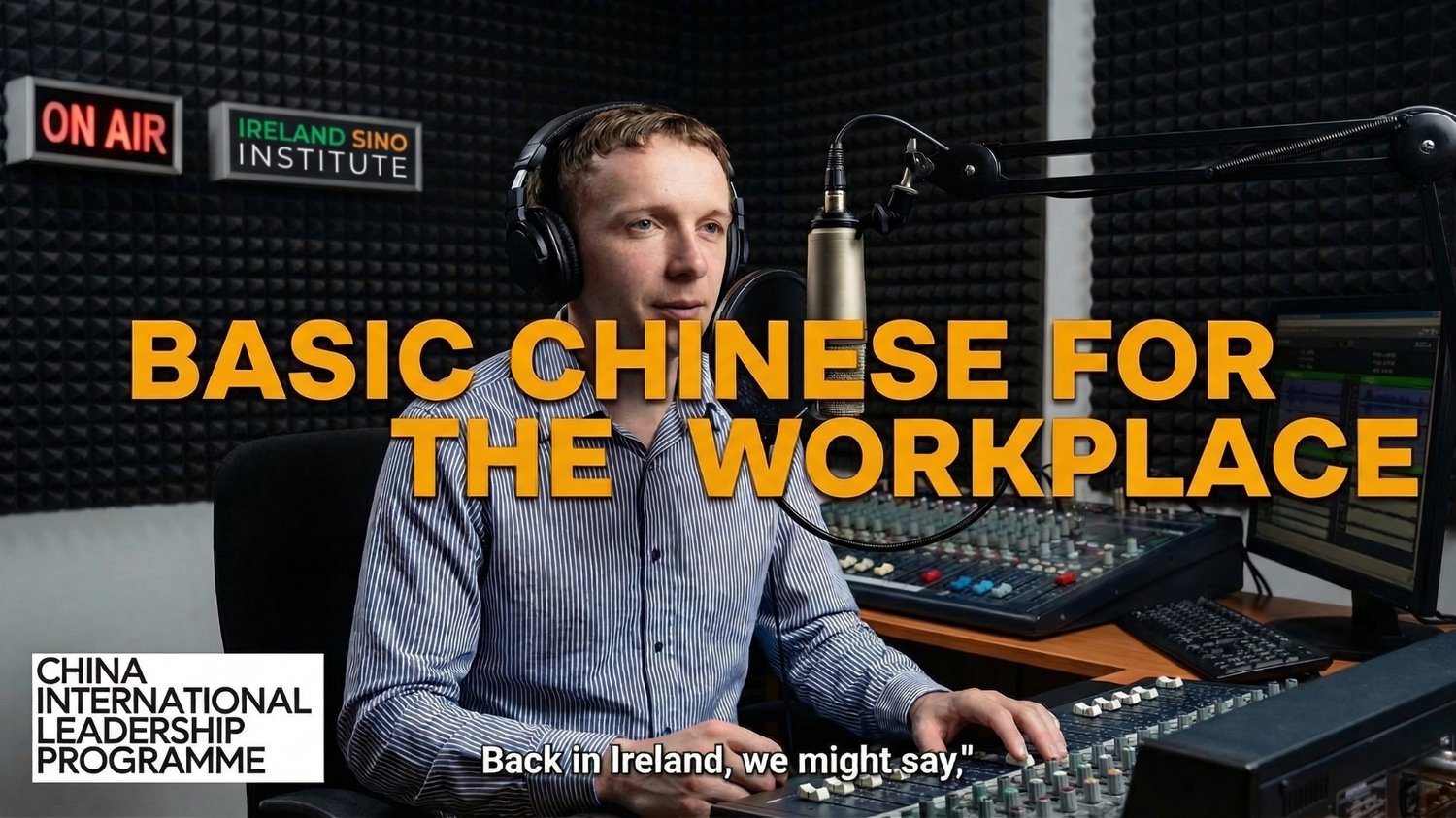
This blog post features the full script from the video, prepared by Pat McCarthy and Jane Wang of the Ireland Sino Institute. Together, the video and script make up the lesson Basic Chinese for the Workplace, part of Module 3 of the China International Leadership Programme: Essential Chinese for Everyday Living.
After the script, you’ll find a Lesson Vocabulary & Phrases section for quick review and practice.
Basic Chinese for the Workplace: (Full Dialogue)
Jane Wang
Welcome to Basic Chinese for the Workplace. I'm Jane Wang, and today we are tackling the absolute essentials: ten workplace Mandarin questions that you will genuinely use in China—probably before lunch.
Pat McCarthy
And I'm Pat McCarthy, your brave volunteer. I'm ready to attempt these lines in public… which is, as we all know, the highest form of courage.
Jane Wang
Or the highest form of learning! This is Module 3: Essential Chinese for Everyday Living; the China International Leadership Programme. We are focusing on the phrases that stop awkward silences by the water cooler.
Pat McCarthy
And the promise is: no fancy ancient poetry. Just the stuff that stops awkward silences in the workplace.
Jane Wang
Exactly. Pat, your job is to say the Chinese. My job is to explain the grammar, make it sound natural, and tell you when to actually use it.
Pat McCarthy
So basically you’re the teacher and I’m… the linguistic crash-test dummy.
Jane Wang
Perfect analogy. Let’s start. Number one: Email. You meet a colleague, and you want to follow up. Let’s ask: "What is your email address?"
Pat McCarthy
Slow pace: 你的,电子,邮箱,是,什么..?
Normal pace: 你的电子邮箱是什么? (Nǐ de diànzǐ yóuxiāng shì shénme?)
Jane Wang
Good. Let's break that down for the listeners. In English, we say "What is your email?" But Chinese sentence structure is very logical. We literally say: "Your email is what?" 你的 (nǐ de) means "your." 电子邮箱 (diànzǐ yóuxiāng) is "email address." 是 (shì) means "is," and 什么 (shénme) means "what."
Pat McCarthy
Got it. So to answer "My email address is...", I just swap "Your" for "My"?
Jane Wang
Exactly. Give it a go.
Pat McCarthy
Slow pace: 我的邮箱..是…
Normal pace: 我的邮箱是… (Wǒ de yóuxiāng shì…)
Jane Wang
Perfect. 我的 (wǒ de) means "my." Notice how Pat shortened 电子邮箱 (diànzǐ yóuxiāng) to just 邮箱 (yóuxiāng). That is perfectly natural in spoken Chinese. Now, real-life insight: WeChat is huge in China, but email still matters for official documents and international teams.
Pat McCarthy
So email is like the formal paperwork language. Good to know. Let's move to number two: Phone numbers. "What's your phone number?"
Jane Wang
Go for it.
Pat McCarthy
Slow pace: 你的,手机,号码,是多少?
Normal pace: 你的手机号码是多少? (Nǐ de shǒujī hàomǎ shì duōshao?)
Jane Wang
Spot on. Now, light grammar alert! For the email, we used 什么 (shénme) for "what." But for a phone number, we use 多少 (duōshao), which translates to "how much" or "how many." Whenever the answer is a big number, you ask with 多少 (duōshao).
Pat McCarthy
Ah, because a phone number is just a giant math problem I have to memorize. And the answer, "My number is..."?
Jane Wang
Let's hear it.
Pat McCarthy
我的号码是… (Wǒ de hàomǎ shì…)
And this means "My number is..."
Jane Wang
Nailed it. Alright, number three. The undisputed king of Chinese networking: WeChat. If you don't ask this, do you even work in China? Pat, ask: "Do you have WeChat?"
Pat McCarthy
Normal pace: 你有微信吗? (Nǐ yǒu Wēixìn ma?)
Jane Wang
Great. 你有 (nǐ yǒu) means "Do you have?" 微信 (Wēixìn) is WeChat. And that little 吗 (ma) at the end? That's your magic question word. It turns any statement into a yes/no question. So "Do you have WeChat?" is 你有微信吗? (Nǐ yǒu Wēixìn ma?)
Pat McCarthy
It's like verbal punctuation. And to answer, I offer to scan them, right? "Okay, I'll scan you."
Jane Wang
Yes! Let's hear the Chinese.
Pat McCarthy
Slow pace: 好的..我扫你一下.
Normal pace: 好的,我扫你一下。 (Hǎo de, wǒ sǎo nǐ yīxià.)
And this means "Okay, I'll scan you."
Jane Wang
Insight time! "I'll scan you" is the modern-day handshake. 扫 (sǎo) means to scan. You just point your camera at their QR code, and boom—you are connected.
Pat McCarthy
It beats spelling my last name three times. Moving on to number four, building on WeChat. "Do you have a WeChat Channel?"
Jane Wang
Yes, for professional video content. Let's hear it.
Pat McCarthy
Slow pace: 你有微信..视频号..吗?
Normal pace: 你有微信视频号吗? (Nǐ yǒu Wēixìn shìpínhào ma?)
And this means "Do you have a WeChat Channel?" WeChat Channels are part of the whole WeChat All in one eco-system but it still requires some extra set up on top of the basic WeChat activation. Once set up, you can post short form and long form video content and even launch a shop on the Channel.
Jane Wang
Excellent. 视频号 (shìpínhào) literally means "video number" or channel. Now, Pat, you can respond with "Yes, I'll send you my contact card now"? Can we hear that in Chinese?
Pat McCarthy
Slow pace: 有..我现在..发名片..给你.
Normal pace: 有,我现在发名片给你。 (Yǒu, wǒ xiànzài fā míngpiàn gěi nǐ.)
Jane Wang
Nice flow. 有 (yǒu) means “Yes, I have it.” And here’s a super common Chinese pattern: send something to somebody — 发 (fā), 东西 (dōngxi), 给 (gěi), 人 (rén). So 我现在发名片给你 (wǒ xiànzài fā míngpiàn gěi nǐ) is literally “I now send the contact card to you,” meaning “I’ll send you my contact card now.”
Pat McCarthy
And the 名片 (míngpiàn) or contact card is inferred from the question to mean a WeChat Channels contact card. With all this good advice, you might go viral. Anyways, number 5, let's learn how to say 'Who wants coffee?"
Jane Wang
A vital skill. Let's hear it.
Pat McCarthy
Slow pace: 谁想喝..咖啡?
Normal pace: 谁想喝咖啡? (Shéi xiǎng hē kāfēi?)
Jane Wang
Beautiful. 谁 (shéi) is "who," 想 (xiǎng) is "would like to," and 喝 (hē) is "drink." Who would like to drink coffee? How do you accept politely and say, "I'd like a cup"?
Pat McCarthy
Slow pace: 我想..来一杯.
Normal pace: 我想来一杯。 (Wǒ xiǎng lái yī bēi.)
Jane Wang
Fun fact: 来 (lái) literally means "to come." "I want to come one cup." It's the standard way to order things.
Pat McCarthy
Back in Ireland, we might say, "Go on so, I'll have one". Number six: Dealing with documents. "Could you send that PDF to me?"
Jane Wang
I love this one because "PDF" is just PDF.
Pat McCarthy
Slow pace: 你能发..那个PDF..给我吗?
Normal pace: 你能发那个PDF给我吗? (Nǐ néng fā nà ge PDF gěi wǒ ma?)
Jane Wang
能 (néng) means "can." And if you need a moment to find it? You can respond with "Okay, just a moment." How do you say that?
Pat McCarthy
Slow pace: 好的, 稍等..一下.
Normal pace: 好的,稍等一下。 (Hǎo de, shāo děng yīxià.)
And this means "Okay, Just a second or Okay, Just a moment".
Jane Wang
稍等 (shāo děng) is the polite "Just a second." Use that when your computer freezes.
Pat McCarthy
Noted. Number seven: The schedule. "What time do you start work?"
Jane Wang
Let's hear you say it Pat.
Pat McCarthy
Slow pace: 你几点..上班?
Normal pace: 你几点上班? (Nǐ jǐ diǎn shàngbān?)
Jane Wang
几点 (jǐ diǎn) means "what time," and 上班 (shàngbān) is "start work." And if you have a strict boss you would answer with: "I have to be at work at 8 a.m." How do you say that Pat?
Pat McCarthy
Slow pace: 我必须早上,八点,上班.
Normal pace: 我必须早上八点上班。 (Wǒ bìxū zǎoshang bā diǎn shàngbān.)
And this means "I have to be at work at 8 a.m."
Jane Wang
I hear the pain in your voice. 必须 (bìxū) means "must" or "have to." 早上八点 (zǎoshang bā diǎn) is 8 a.m.
Pat McCarthy
Too early. Let’s escape. Number eight: "Let's take the lift".
Jane Wang
Do you know how to say that in Chinese?
Pat McCarthy
I'll give it a bash.
Slow pace: 我们坐..电梯吧.
Normal pace: 我们坐电梯吧。 (Wǒmen zuò diàntī ba.)
This means "Let's take the lift".
Jane Wang
Well done Pa boy. 坐 (zuò) means "sit," but we also use it for taking transport, including elevators, which is 电梯 (diàntī). So 我们坐 (wǒmen zuò) means "Let's take the ...." The 吧 (ba) at the end makes it a friendly suggestion. "Let's do this." And we can respond with a polite follow-up: "Sure, which floor?"
Pat McCarthy
Slow pace: 好的去..几楼?
Normal pace: 好的,去几楼? (Hǎo de, qù jǐ lóu?)
And this means "Sure, which floor?"
Jane Wang
去几楼 (Qù jǐ lóu?) Go to which floor? Easy and polite. Now, number nine. The most important question of the workday: Lunch. "Shall we eat in the canteen today, or order Meituan?"
Pat McCarthy
Slow pace: 我们今天去食堂,吃,还是,点美团?
Normal pace: 我们今天去食堂吃,还是点美团? (Wǒmen jīntiān qù shítáng chī, háishi diǎn Měituán?)
And this means "Shall we eat in the canteen today, or order Meituan?" The length of that question is makin me hungry.
Jane Wang
I'm doing all the explaining here Pat and you're the one who's hungry. Anyways, Grammar note: 还是 (háishi) means "or," but you only use it when asking a question giving two choices. Canteen or Meituan? Also, Meituan is a massive food delivery app in China. To answer, "Meituan sounds good."
Pat McCarthy
I could do with an ould delivery myself.
Slow pace: 点美团, 挺好的.
Normal pace: 点美团挺好的。 (Diǎn Měituán tǐng hǎo de.)
This means "Meituan sounds good".
Jane Wang
Yes, 点 (diǎn) means "to order." Finally, number ten. The commute question. "Shall we walk, or take Didi?"
Pat McCarthy
Slow pace: 我们走着去,还是,打滴滴?
Normal pace: 我们走着去还是打滴滴? (Wǒmen zǒuzhe qù háishi dǎ Dīdī?)
Jane Wang
Just like Meituan is for food, Didi is the massive ride-hailing app. 打滴滴 (dǎ Dīdī) literally means "call a Didi." But if the destination is only three minutes on foot, you can answer with: "It's only a three-minute walk—let's walk."
Pat McCarthy
Slow pace: 走路只要三分钟, 我们走着,去吧.
Normal pace: 走路只要三分钟, 我们走着去吧。 (Zǒulù zhǐyào sān fēnzhōng, wǒmen zǒuzhe qù ba.)
And this means "It's only three minutes on foot. Let's walk."
Jane Wang
只要 (zhǐyào) means "only takes," and 三分钟 (sān fēnzhōng) is three minutes. Pat, you survived! You can now network, order coffee, and get to a meeting in China.
Pat McCarthy
I feel unstoppable. As long as nobody goes off-script.
Jane Wang
That's the spirit. Listeners, practice these ten lines, and you'll navigate the Chinese office like a pro. See you in the next lesson!
Pat McCarthy
Please note that this lesson is part of Module 3 of the China International Leadership Programme — a blended internship programme offering Mandarin immersion, cultural engagement, site visits, and teaching placements.
LESSON VOCABULARY & PHRASES
1. Email
What is your email address?
你的电子邮箱是什么? (Nǐ de diànzǐ yóuxiāng shì shénme?)
My email address is…
我的邮箱是… (Wǒ de yóuxiāng shì…)
2. Phone Numbers
What's your phone number?
你的手机号码是多少? (Nǐ de shǒujī hàomǎ shì duōshao?)
My number is…
我的号码是… (Wǒ de hàomǎ shì…)
3. WeChat
Do you have WeChat?
你有微信吗? (Nǐ yǒu Wēixìn ma?)
Okay, I'll scan you.
好的,我扫你一下。 (Hǎo de, wǒ sǎo nǐ yīxià.)
4. WeChat Channel
Do you have a WeChat Channel?
你有微信视频号吗? (Nǐ yǒu Wēixìn shìpínhào ma?)
Yes, I’ll send you my contact card now.
有,我现在发名片给你。 (Yǒu, wǒ xiànzài fā míngpiàn gěi nǐ.)
5. Coffee
Who wants coffee?
谁想喝咖啡? (Shéi xiǎng hē kāfēi?)
I'd like a cup.
我想来一杯。 (Wǒ xiǎng lái yī bēi.)
6. Documents
Could you send that PDF to me?
你能发那个PDF给我吗? (Nǐ néng fā nà ge PDF gěi wǒ ma?)
Okay, just a moment.
好的,稍等一下。 (Hǎo de, shāo děng yīxià.)
7. Schedule
What time do you start work?
你几点上班? (Nǐ jǐ diǎn shàngbān?)
I have to be at work at 8 a.m.
我必须早上八点上班。 (Wǒ bìxū zǎoshang bā diǎn shàngbān.)
8. The Lift / Elevator
Let’s take the lift.
我们坐电梯吧。 (Wǒmen zuò diàntī ba.)
Sure, which floor?
好的,去几楼? (Hǎo de, qù jǐ lóu?)
9. Lunch Options
Shall we eat in the canteen today, or order Meituan?
我们今天去食堂吃,还是点美团? (Wǒmen jīntiān qù shítáng chī, háishi diǎn Měituán?)
Meituan sounds good.
点美团挺好的。 (Diǎn Měituán tǐng hǎo de.)
10. Commuting
Shall we walk, or take Didi?
我们走着去还是打滴滴? (Wǒmen zǒuzhe qù háishi dǎ Dīdī?)
It’s only a three-minute walk—let’s walk.
走路只要三分钟,我们走着去吧。 (Zǒulù zhǐyào sān fēnzhōng, wǒmen zǒuzhe qù ba.)
That’s your first workplace Mandarin toolkit—ten high-frequency questions with ready responses that cover most day-to-day office interactions. Repeat this lesson a few times, and you’ll notice something important: you’ll stop translating in your head, and start responding naturally. Good luck—and keep going.