

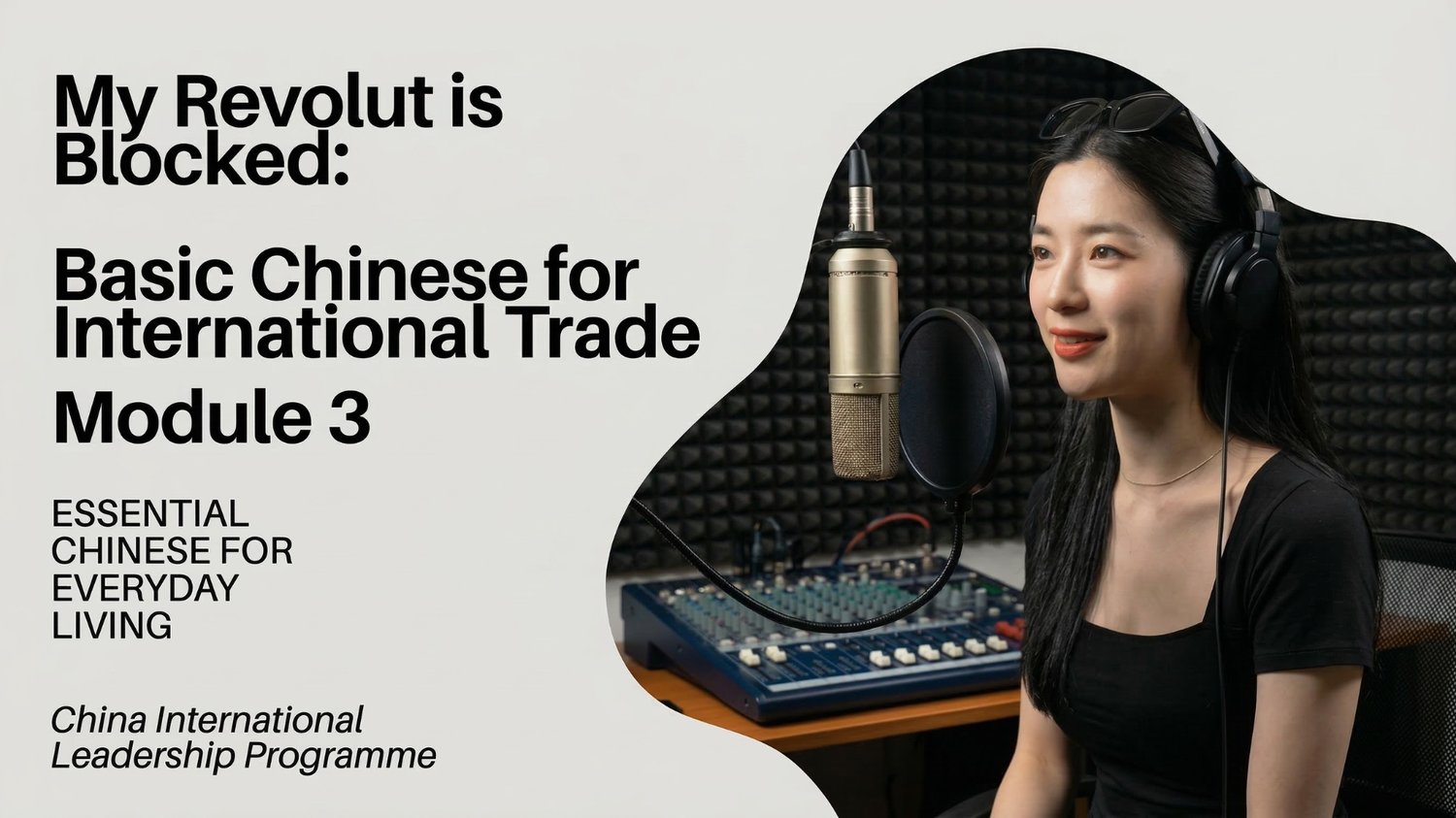
This blog post on Basic Chinese for International Trade is your gateway to China. As China has become the European Union’s largest source of imports, supplying everything from electronics and industrial machinery to automation equipment and clean-energy technologies, Mandarin is no longer just a useful skill; it is a serious professional advantage. Learning Mandarin lays the foundation for meaningful engagement with China and gives you a clear edge in international trade.
The 20 examples featured in this post and video include 10 common trade questions and 10 typical responses. Together, they provide a practical framework for real business situations. These language structures support successful trade interactions, helping you communicate clearly, solve problems efficiently, and negotiate with confidence.
Think of these phrases as the foundation of doing business with China: the first building block, or that essential first Lego piece. You cannot build a skyscraper without a base, and you cannot manage a high-stakes trade deal effectively if a language barrier leaves you stuck when a payment fails or a shipment is delayed.
This post also offers a glimpse into the China International Leadership Programme, a leading internship programme that combines structured online modules with immersive, on-the-ground experience in China.
The following sections include
- TOPICS COVERED
- BASIC CHINESE FOR INTERNATIONAL TRADE SCRIPT
- BASIC CHINESE FOR INTERNATIONAL TRADE QUESTIONS & RESPONSES
TOPICS COVERED:
- Asking for a Quotation (报价 - Bàojià)
- Checking the Minimum Order Quantity (起订量 - Qǐdìngliàng / MOQ)
- Requesting Samples (样品 - Yàngpǐn)
- Asking About Delivery Time (交货期 - Jiāohuòqī)
- Discussing Payment Terms (付款条件 - Fùkuǎn tiáojiàn)
- Confirming Shipping Methods (运输方式 - Yùnshū fāngshì)
- Checking Certifications (认证 - Rènzhèng)
- Customization and OEM (定制 - Dìngzhì)
- Asking About the Port of Loading (港口 - Gǎngkǒu)
- Negotiating for a Discount (折扣 - Zhékòu)
BASIC CHINESE FOR INTERNATIONAL TRADE SCRIPT
Jane Wang
Welcome to Basic Chinese for International Trade. This lesson is included in Module 3, Essential Chinese for Everyday Living, within the China International Leadership Programme. In this lesson, you will learn practical Chinese expressions and vocabulary commonly used in international trade and business communication, helping you develop the language skills needed to engage confidently in real-world commercial interactions. I’m Jane Wang.
Pat McCarthy
And I’m Pat McCarthy. I’ve got my briefcase packed and my negotiation face on. I’m ready to stop being a linguistic crash-test dummy and start being a global trade tycoon!
Jane Wang
That’s the spirit, Pat! Let’s start with the basics. Before you buy anything, you need to know the price. The important word here is 报价 (bàojià), meaning "quotation." Literally, 报 (bào) means "to report" and 价 (jià) is "price." To ask, "Could you provide a quotation for this product?" we say: 请问这个产品的报价是多少? (Qǐngwèn zhège chǎnpǐn de bàojià shì duōshao?)
Pat McCarthy
Okay, let me try this. 请问这个产品的报价是多少?(Qǐngwèn zhège chǎnpǐn de bàojià shì duōshao?)
Jane Wang
Great! Grammar focus: notice we end with 是多少 (shì duōshao), literally "is how much." You use 多少 (duōshao) whenever you expect a number as the answer. Now, to respond, they usually say: 我们稍后会发报价单给您的邮箱。 (Wǒmen shāohòu huì fā bàojiàdān gěi nín de yóuxiāng.) "We will send the quotation sheet to your email later or basically “we’ll email the quotation sheet to you later”.
Pat McCarthy
So how does that sentence work?
Jane Wang
Good question. 稍后 (shāohòu) means "later." And remember our grammar rule from the workplace lesson? Send something to someone: 发 (fā), 东西 (dōngxi), 给 (gěi), 人 (rén). Also, notice they added 单 (dān) to the word for quotation. 单 (dān) means "list" or "sheet," making it a quotation sheet!
Pat McCarthy
我们稍后会发报价单给您的邮箱。(Wǒmen shāohòu huì fā bàojiàdān gěi nín de yóuxiāng.) And this means: “we’ll email the quotation sheet to you later” Got it. "Check your inbox."
Jane Wang
Exactly. Number 2 is the big one: 起订量 (qǐdìngliàng), which means "Minimum Order Quantity" or MOQ. It translates perfectly: 起 (qǐ) is "starting," 订 (dìng) is "order," and 量 (liàng) is "quantity." We use our "how much" grammar again: 你们的起订量是多少?(Nǐmen de qǐdìngliàng shì duōshao?)
Pat McCarthy
Let me try. 你们的起订量是多少?(Nǐmen de qǐdìngliàng shì duōshao?) And I bet the answer isn't "one," is it?
Jane Wang
Rarely! They might answer: 我们的起订量是五百件. (Wǒmen de qǐdìngliàng shì wǔbǎi jiàn.) meaning "Our MOQ is 500 pieces." The grammar focus here is 件 (jiàn). It's the essential measure word you must use when counting individual items, clothing, or products.
Pat McCarthy
我们的起订量是五百件。(Wǒmen de qǐdìngliàng shì wǔbǎi jiàn.) Five hundred? I’m going to need a bigger warehouse.
Jane Wang
Well, before you buy 500, you need number 3: 样品 (yàngpǐn), meaning "samples." 样 (yàng) is "shape" or "appearance," and 品 (pǐn) is "product." Ask: 你们能提供样品吗? (Nǐmen néng tígōng yàngpǐn ma?) "Can you provide samples?" Grammar note: 能 (néng) means "can" or "have the ability to." Another useful word you are going to see over and over again 提供 (tígōng) which means to provide.
Pat McCarthy
Okay, here we go: 你们能提供样品吗?(Nǐmen néng tígōng yàngpǐn ma?) If I can get a free sample, I’m halfway to being a tycoon. How do they usually answer that?
Jane Wang
They often say: 可以,我们可以免费提供样品,但您需要支付运费. (Kěyǐ, wǒmen kěyǐ miǎnfèi tígōng yàngpǐn, dàn nín xūyào zhīfù yùnfèi.) "Yes, we can provide free samples, but you need to pay for the shipping." Let's translate two key words here. First, 免费 (miǎnfèi): 免 (miǎn) is "exempt" and 费 (fèi) is "fee"—free of charge! Second, the word 但 (dàn) means "but." It's the grammar pivot where the free stuff ends and the shipping fee begins!
Pat McCarthy
可以,我们可以免费提供样品,但您需要支付运费。(Kěyǐ, wǒmen kěyǐ miǎnfèi tígōng yàngpǐn, dàn nín xūyào zhīfù yùnfèi.) There’s always a catch!
Jane Wang
Speaking of shipping, number 4 is 交货期 (jiāohuòqī), the delivery time. Let's break it down: 交 (jiāo) to hand over, 货 (huò) goods, and 期 (qī) period. Ask: 交货期是多久?(Jiāohuòqī shì duōjiǔ?) How long is the delivery time?
Pat McCarthy
交货期是多久?(Jiāohuòqī shì duōjiǔ?)
Jane Wang
Perfect pronunciation. Grammar focus here: Instead of duōshao (how much), we use 多久 (duōjiǔ) for "how long" when asking about time duration. The response is usually straightforward: 海运需要三十天。 (Hǎiyùn xūyào sānshí tiān.) "It takes 30 days to ship by sea freight." 海运 (Hǎiyùn) literally means "sea transport."
Pat McCarthy
海运需要三十天. (Hǎiyùn xūyào sānshí tiān.) A long time to wait at the docks.
Jane Wang
Which brings us to number 5: 付款条件 (fùkuǎn tiáojiàn), meaning "payment terms." 付款 (fùkuǎn) is "to pay money" and 条件 (tiáojiàn) means "conditions." Ask: 你们的付款条件是什么? (Nǐmen de fùkuǎn tiáojiàn shì shénme?) What are the payment terms?
Pat McCarthy
你们的付款条件是什么?(Nǐmen de fùkuǎn tiáojiàn shì shénme?) Show me the money! How do we talk percentages?
Jane Wang
Great grammar question! In Chinese, percentages are read backwards. 30% is 百分之三十 (bǎi fēn zhī sānshí), literally "out of one hundred parts, thirty."
The response is: 百分之三十的预付定金,发货前付清尾款。(Bǎi fēn zhī sānshí de yùfù dìngjīn, fāhuò qián fùqīng wěikuǎn.) This means: 30% deposit in advance, with the balance to be paid before shipment.
Let's break down the business vocabulary here:
- 预付定金 (yùfù dìngjīn): 定金 (dìngjīn) means "deposit." 预付 (yùfù) means "to pay in advance" (where 预 (yù) means "in advance" or "pre-", and 付 (fù) means "to pay"). Put together, it means a "prepaid deposit," making it explicitly clear the money is needed upfront.
- 尾款 (wěikuǎn): This literally translates to "tail money." While that might sound a bit awkward at first, it makes perfect sense when you remember we use the exact same metaphor in English! Just like we talk about the "tail end" of a project, 尾款 (wěikuǎn) simply refers to the "tail end" of the funds—a great way to remember it is a noun meaning the final balance.
- 发货前付清 (fāhuò qián fùqīng): This gives us the timeline and the action. 发货前 (fāhuò qián) means "before shipment" 发货 (fāhuò) is to ship goods, 前 (qián) is before). 付清 (fùqīng) is the verb meaning "to pay in full" (付 (fù) is to pay, 清 (qīng) is to clear). You are literally "paying it clear."
Pat McCarthy
Very insightful but quite a mouthful. Thanks Jane. Let me give it a bash: 百分之三十的预付定金,发货前付清尾款. (Bǎi fēn zhī sānshí de yùfù dìngjīn, fāhuò qián fùqīng wěikuǎn.) And This means: 30% deposit in advance, with the balance to be paid before shipment.
Jane Wang
Number 6 is about the 运输方式 (yùnshū fāngshì) or shipping methods. 运输 (yùnshū) means transport, and 方式 (fāngshì) is method. Ask: 你们通常使用什么运输方式?(Nǐmen tōngcháng shǐyòng shénme yùnshū fāngshì?) What shipping methods do you usually use? 通常 (tōngcháng ) is an adverb of frequency and means “usually”. shǐyòng(使用) is a verb and it means “use or utilize”
Pat McCarthy
Okay, let me try this one. 你们通常使用什么运输方式?(Nǐmen tōngcháng shǐyòng shénme yùnshū fāngshì?) And this means “What shipping methods do you usually use?”
Jane Wang
They’ll give you options: 我们通常走海运,也可以走空运。(Wǒmen tōngcháng zǒu hǎiyùn, yě kěyǐ zǒu kōngyùn.) "We usually ship by sea, but we can also ship by air." Grammar alert: 走 (zǒu) literally means "to walk," but in logistics, we use it to mean "to take the route of." And notice 空运 (kōngyùn)—"air transport."
Pat McCarthy
That's handy to know. 我们通常走海运,也可以走空运。(Wǒmen tōngcháng zǒu hǎiyùn, yě kěyǐ zǒu kōngyùn.) Great. Air is faster, but my tycoon budget says "sea."
Jane Wang
Wise choice. Number 7 is 认证 (rènzhèng), meaning certification. 认 (rèn) is "to recognize" and 证 (zhèng) is "certificate" or "proof." Ask: 你们的产品有CE认证吗? (Nǐmen de chǎnpǐn yǒu CE rènzhèng ma?) "Do your products have CE certification?" Another key word is 产品 (chǎnpǐn), which means “product.” And when you go to China, you’re going to see all kinds of products.
Pat McCarthy
Yes, the CE mark is Very important for the European market.
Jane Wang
Exactly. A good supplier will say: 有的,我们所有的产品都通过了国际认证。 (Yǒu de, wǒmen suǒyǒu de chǎnpǐn dōu tōngguòle guójì rènzhèng.) "Yes, all of our products have passed international certification." Grammar focus: starting with 有的 (Yǒu de) is the standard, polite way to confirm "Yes, we have it." 通过认证 (tōngguò rènzhèng) is a very common and useful verb-object phrase meaning “to pass certification” or “to obtain certification.”
Pat McCarthy
有的,我们所有的产品都通过了国际认证。(Yǒu de, wǒmen suǒyǒu de chǎnpǐn dōu tōngguòle guójì rènzhèng.) Good to know they're legit. What does 国际 (guójì) mean?
Jane Wang
国际 (guójì) is a very useful word and it means “international”. So “international trade is 国际贸易 guójì màoyì. Number 8: 定制 (dìngzhì), meaning customization. 定 (dìng) is "custom" or "fixed," and 制 (zhì) is "to manufacture." Ask: 可以在产品上印我们的商标吗? (Kěyǐ zài chǎnpǐn shàng yìn wǒmen de shāngbiāo ma?) "Can we print our logo on the product?"
Pat McCarthy
Let me try. 可以在产品上印我们的商标吗?(Kěyǐ zài chǎnpǐn shàng yìn wǒmen de shāngbiāo ma?)
Jane Wang
Good! Grammar breakdown: 在...上 (zài... shàng) means "on top of." The word for trademark or logo is 商标 (shāngbiāo). So you are asking to print the 商标 (shāngbiāo) on top of the product. Most factories will agree: 可以,我们提供定制服务和OEM订单。 (Kěyǐ, wǒmen tígōng dìngzhì fúwù hé OEM dìngdān.) "Yes, we provide customization services and OEM orders."
Pat McCarthy
可以,我们提供定制服务和OEM订单。(Kěyǐ, wǒmen tígōng dìngzhì fúwù hé OEM dìngdān.) The McCarthy brand is going global!
Jane Wang
Number 9: 港口 (gǎngkǒu), meaning port. Ask: 你们通常从哪个港口发货?(Nǐmen tōngcháng cóng nǎge gǎngkǒu fāhuò?) "Which port do you usually ship from?"
Pat McCarthy
你们通常从哪个港口发货? (Nǐmen tōngcháng cóng nǎge gǎngkǒu fāhuò?)
Jane Wang
A common answer: 我们通常从深圳港发货。(Wǒmen tōngcháng cóng Shēnzhèn gǎng fāhuò.) "We usually ship from Shenzhen port." Grammar note: 从...发货 (cóng... fāhuò) means "to dispatch goods from [a location]." 发 (fā) is "to send" and 货 (huò) is "goods."
Pat McCarthy
我们通常从深圳港发货. (Wǒmen tōngcháng cóng Shēnzhèn gǎng fāhuò.) Shenzhen—the Silicon Valley of hardware.
Jane Wang
Finally, number 10. 折扣 (zhékòu), which means “discount”. Ask: 如果我们大量订购,能给折扣吗? (Rúguǒ wǒmen dàliàng dìnggòu, néng gěi zhékòu ma?) "If we order in large quantities, can you give us a discount?"
Pat McCarthy
如果我们大量订购,能给折扣吗? (Rúguǒ wǒmen dàliàng dìnggòu, néng gěi zhékòu ma?) Now we’re talking. What’s the grammar there, Jane?
Jane Wang
It's all about 如果 (rúguǒ), which means "if." It sets up the condition. 订购 (dìnggòu) means “to order” and 大量 (dàliàng) means “large quantities". If we order big, can you give a discount?" If you’re a big buyer, they might say: 如果订单超过一万件,我们可以给您百分之五的折扣。 (Rúguǒ dìngdān chāoguò yíwàn jiàn, wǒmen kěyǐ gěi nín bǎi fēn zhī wǔ de zhékòu.) "If the order exceeds 10,000 pieces, we can give you a 5% discount."
Pat McCarthy
如果订单超过一万件,我们可以给您百分之五的折扣. (Rúguǒ dìngdān chāoguò yíwàn jiàn, wǒmen kěyǐ gěi nín bǎi fēn zhī wǔ de zhékòu.) Ten thousand pieces for 5% off? I’ll have to check my bank balance. My Revolut is blocked.
Jane Wang
Great job, Pat! You survived the factory floor.
Pat McCarthy: I feel ready to trade. Just don't ask me to count to ten thousand in Chinese yet!
BASIC CHINESE FOR INTERNATIONAL TRADE QUESTIONS & RESPONSES
1. Asking for a Quotation (报价 - Bàojià)
Question: 请问这个产品的报价是多少?
(Qǐngwèn zhège chǎnpǐn de bàojià shì duōshao?)
English: Could you provide a quotation for this product?
Response: 我们稍后会发报价单给您的邮箱。
(Wǒmen shāohòu huì fā bàojiàdān gěi nín de yóuxiāng.)
English: We will send the quotation sheet to your email later.
2. Checking the Minimum Order Quantity (起订量 - Qǐdìngliàng / MOQ)
Question: 你们的起订量是多少?
(Nǐmen de qǐdìngliàng shì duōshao?)
English: What is your minimum order quantity (MOQ)?
Response: 我们的起订量是五百件。
(Wǒmen de qǐdìngliàng shì wǔbǎi jiàn.)
English: Our MOQ is 500 pieces.
3. Requesting Samples (样品 - Yàngpǐn)
Question: 你们能提供样品吗?
(Nǐmen néng tígōng yàngpǐn ma?)
English: Can you provide samples?
Response: 可以,我们可以免费提供样品,但您需要支付运费。
(Kěyǐ, wǒmen kěyǐ miǎnfèi tígōng yàngpǐn, dàn nín xūyào zhīfù yùnfèi.)
English: Yes, we can provide free samples, but you need to pay for the shipping.
4. Asking About Delivery Time (交货期 - Jiāohuòqī)
Question: 交货期是多久?
(Jiāohuòqī shì duōjiǔ?)
English: How long is the delivery time/lead time?
Response: 海运需要三十天。
(Hǎiyùn xūyào sānshí tiān.)
English: It takes 30 days to ship by sea freight.
5. Discussing Payment Terms (付款条件 - Fùkuǎn tiáojiàn)
Question: 你们的付款条件是什么?
(Nǐmen de fùkuǎn tiáojiàn shì shénme?)
English: What are your payment terms?
Response: 百分之三十的预付定金,发货前付清尾款。
(Bǎi fēn zhī sānshí de yùfù dìngjīn, fāhuò qián fùqīng wěikuǎn.)
English: 30% deposit in advance, with the balance to be paid before shipment.
6. Confirming Shipping Methods (运输方式 - Yùnshū fāngshì)
Question: 你们通常使用什么运输方式?
(Nǐmen tōngcháng shǐyòng shénme yùnshū fāngshì?)
English: What shipping methods do you usually use?
Response: 我们通常走海运,也可以走空运。
(Wǒmen tōngcháng zǒu hǎiyùn, yě kěyǐ zǒu kōngyùn.)
English: We usually ship by sea, but we can also ship by air.
7. Checking Certifications (认证 - Rènzhèng)
Question: 你们的产品有CE认证吗?
(Nǐmen de chǎnpǐn yǒu CE rènzhèng ma?)
English: Do your products have CE certification?
Response: 有的,我们所有的产品都通过了国际认证。
(Yǒu de, wǒmen suǒyǒu de chǎnpǐn dōu tōngguòle guójì rènzhèng.)
English: Yes, all of our products have passed international certification.
8. Customization and OEM (定制 - Dìngzhì)
Question: 可以在产品上印我们的商标吗?
(Kěyǐ zài chǎnpǐn shàng yìn wǒmen de shāngbiāo ma?)
English: Can we print our logo/trademark on the product?
Response: 可以,我们提供定制服务和OEM订单。
(Kěyǐ, wǒmen tígōng dìngzhì fúwù hé OEM dìngdān.)
English: Yes, we provide customization services and OEM orders.
9. Asking About the Port of Loading (港口 - Gǎngkǒu)
Question: 你们通常从哪个港口发货?
(Nǐmen tōngcháng cóng nǎge gǎngkǒu fāhuò?)
English: Which port do you usually ship from?
Response: 我们通常从深圳港发货。
(Wǒmen tōngcháng cóng Shēnzhèn gǎng fāhuò.)
English: We usually ship from Shenzhen port.
10. Negotiating for a Discount (折扣 - Zhékòu)
Question: 如果我们大量订购,能给折扣吗?
(Rúguǒ wǒmen dàliàng dìnggòu, néng gěi zhékòu ma?)
English: If we order in large quantities, can you give us a discount?
Response: 如果订单超过一万件,我们可以给您百分之五的折扣。
(Rúguǒ dìngdān chāoguò yíwàn jiàn, wǒmen kěyǐ gěi nín bǎi fēn zhī wǔ de zhékòu.)
English: If the order exceeds 10,000 pieces, we can give you a 5% discount.