
Europe’s Climate Transition Depends on China
Europe’s future competitiveness—and its decarbonisation goals—are increasingly tied to how effectively it can engage with China. This is no longer a theoretical debate; it is visible in the supply chains underpinning Europe’s green transition, industrial strategy, and long-term economic resilience.
According to the International Energy Agency (IEA), China now controls over 80 percent of global solar photovoltaic (PV) manufacturing capacity, spanning the entire value chain from polysilicon processing to finished modules. This level of industrial concentration has direct consequences for Europe’s climate ambitions. That reality is already evident on the ground. Reuters reports that around 94 percent of solar panels and cells installed in the European Union are manufactured in China, following the collapse of much of Europe’s domestic solar manufacturing industry in the early 2010s. As Europe accelerates its de-carbonisation plans, reliance on Chinese clean-energy technology is expected to remain a structural feature of the transition.
China’s Technological Momentum Across Key Sectors
China’s influence extends well beyond solar energy. It continues to set benchmarks in infrastructure, logistics, and industrial execution. A striking example is the Shanghai Maglev, which reached commercial operating speeds of up to 431 km/h, demonstrating China’s ability to deploy advanced technologies rapidly and at scale. The same combination of speed, coordination, and manufacturing depth underpins China’s leadership in advanced electronics, e-commerce, electric vehicles, clean energy systems, and emerging fields such as humanoid robotics.
The implication is clear: Europe–China literacy is becoming a core professional skill. Those who understand China’s language, culture, systems, and working realities will be better positioned to contribute to Europe’s future in trade, sustainability, education, technology, and international cooperation.
Why the China International Leadership Programme
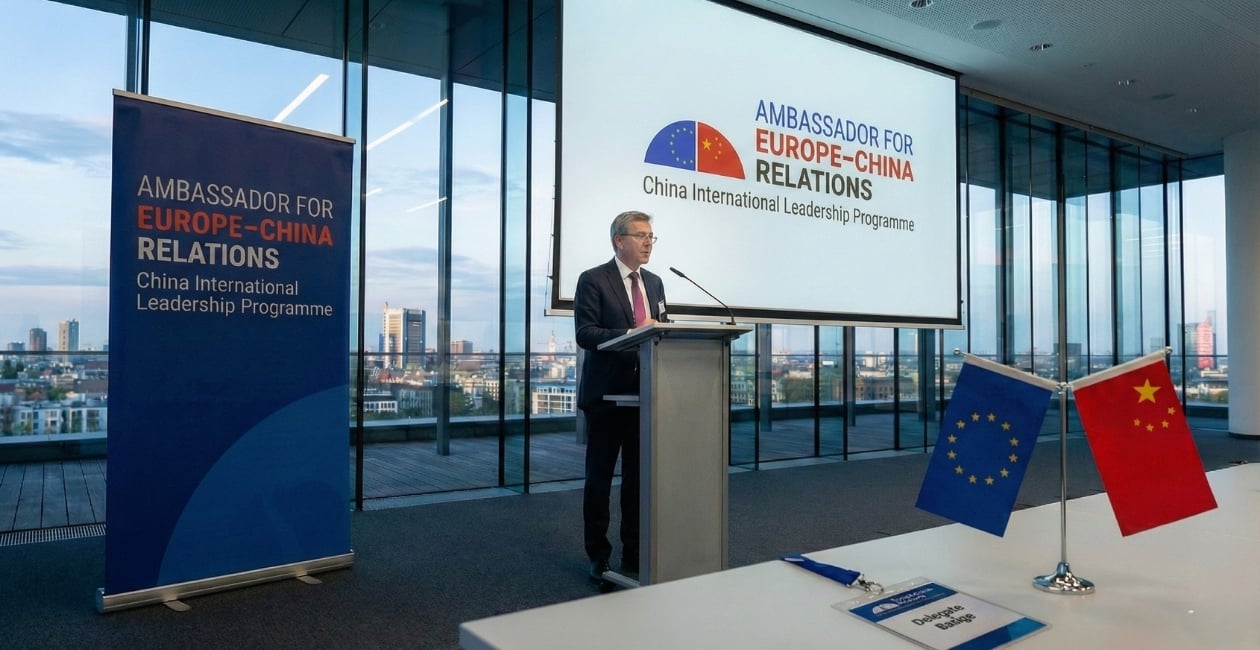
The China International Leadership Programme (CILP) was created in direct response to these global shifts. Its most advanced pathway—the Ambassador for Europe—China Relations Track—is designed to develop people who can engage China with confidence, credibility, and competence.
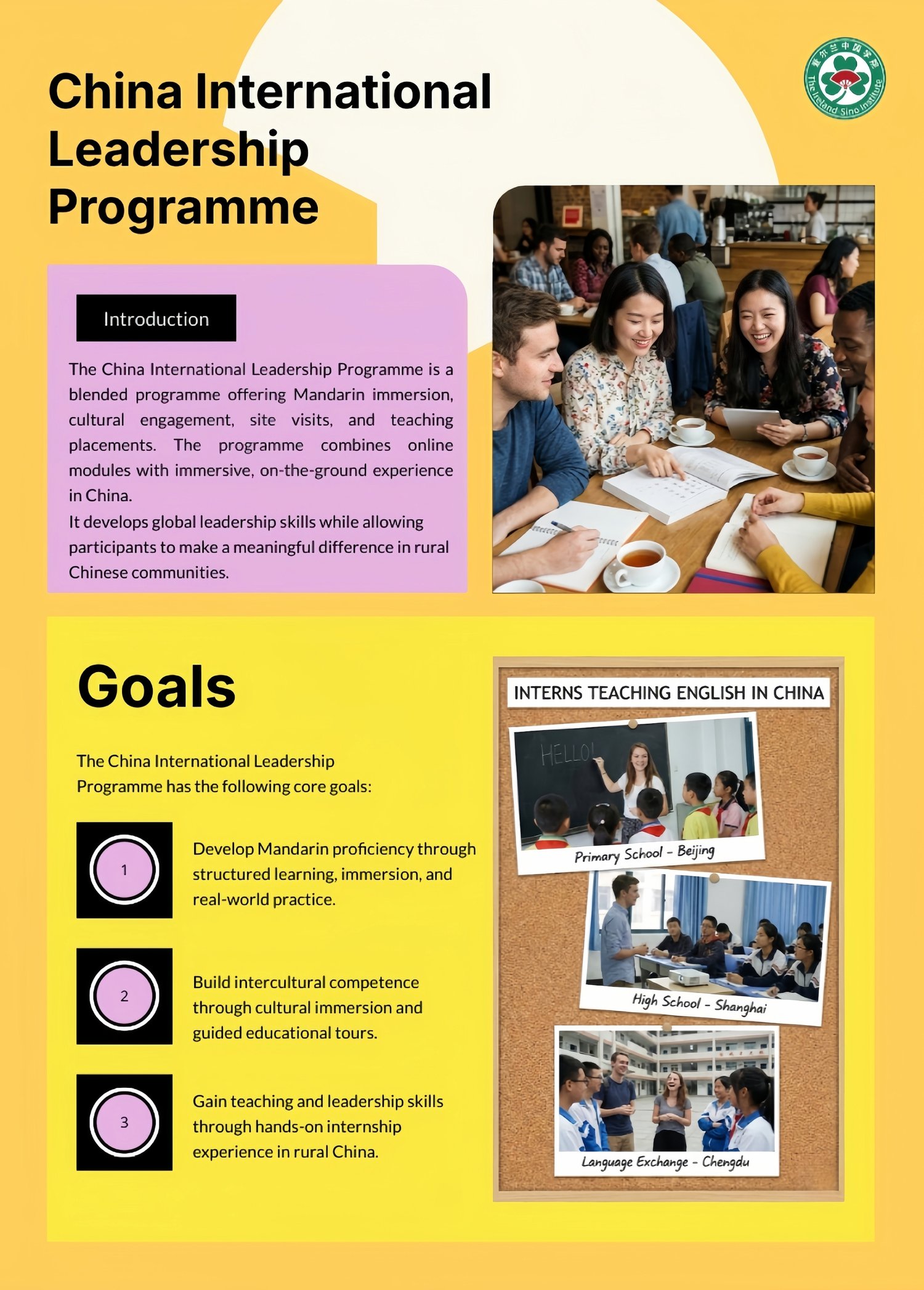
This is a blended programme, combining structured online learning with an immersive in-China experience. Every element of the track is intentional and aligned with the realities shaping Europe–China relations today.
China International Leadership Programme Core Programme Components
· Mandarin Language Immersion
· Chinese Cultural Immersion
· Guided China Tours & Regional Exploration
· Leadership Development Through Teaching Experience
Why Mandarin Matters — and Why HSK Alignment Counts
As Europe becomes more dependent on Chinese markets, suppliers, and partners, language becomes a strategic asset. Mandarin is the key to access—to relationships, trust, nuance, and decision-making processes that cannot be fully understood through English alone.
Participants complete:
· 15 hours per week of advanced Mandarin instruction, aligned with HSK standards
· 5 hours per week of cultural and conversational practice, reinforcing classroom learning through daily use in authentic contexts.
HSK alignment ensures that Mandarin development is internationally recognised, measurable, and transferable—supporting long-term professional and academic progression.
Why Cultural Immersion Is Essential
China’s scale and speed cannot be grasped from reports or remote learning alone. Cultural immersion transforms knowledge into understanding. Through:
· Family-style dining
· Language exchanges
· Community engagement
· Real-life communication with local residents
Participants experience how relationships are built, how trust is established, and how cooperation works in practice—critical skills for anyone engaging across Europe–China environments.
Why Iconic Sites and Regional Exposure Matter
China is not a single, uniform story—it is diverse, regional, and deeply layered. Guided exploration of iconic landmarks alongside lesser-known regions provides essential historical, cultural, and economic context, helping participants understand how modern China has developed across different eras and geographies. Experiencing these contrasts first-hand reveals how regional variation shapes opportunity, innovation, governance, and collaboration—insights that are critical for anyone seeking to engage China beyond the surface level.
Why Leadership Is Developed Through Teaching
Europe–China relations require leaders who can contribute meaningfully, not just observe. Teaching and community-based engagement are powerful leadership tools because they demand:
· Clear cross-cultural communication
· Adaptability and empathy
· Responsibility and initiative
Participants gain leadership experience through teaching practice and mentoring in rural or community environments, alongside broader educational and cultural exchange initiatives. This model develops grounded, service-based leadership—highly relevant to education, diplomacy, business, and international development roles.
Practical Support for a Sustainable Year in China
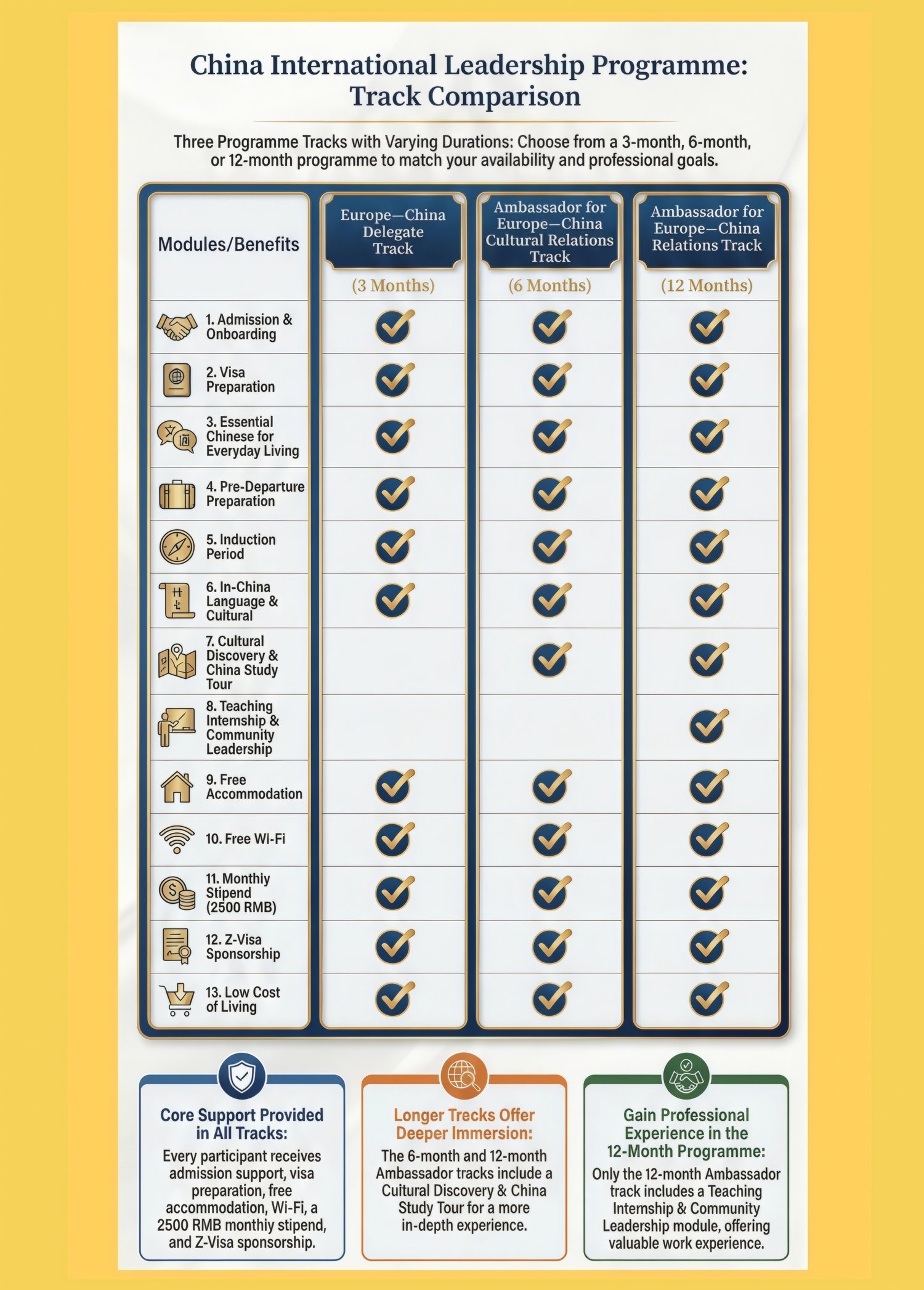
The programme is structured to make long-term immersion realistic and accessible:
· Free accommodation with Wi-Fi
· Monthly stipend of 2,500 RMB
· Z-visa sponsorship (legal work, study, and teaching visa)
· Internship and teaching placement coordinated by the Ireland Sino Institute (Liaoning Province)
· Low cost of living for a stable and fulfilling year in China
Preparing for the Future of Europe–China Relations
As Europe navigates de-carbonisation, technological transformation, and global competition, the need for people who understand China from the inside will only increase. The Ambassador for Europe—China Relations Track prepares participants for that reality—by combining HSK-aligned Mandarin fluency, deep cultural immersion, and leadership developed through real contribution.
This is not simply an international experience. It is strategic preparation for a world where Europe and China remain deeply interconnected.
The China International Leadership Programme is coordinated by the Ireland Sino Institute. The Institute is dedicated to strengthening Europe–China relations through initiatives in education, business, philanthropy, culture, tourism, and technology. It operates offices in both Europe and China and runs non-profit schools across China registered with the Ministry of Education and the Ministry of Civil Affairs of the People’s Republic of China. Pat McCarthy is the Chairman of the Ireland Sino Institute.
References
- International Energy Agency (IEA). Solar PV Global Supply Chains.
- https://www.iea.org/reports/solar-pv-global-supply-chains/executive-summary
- Reuters. Italy awards solar capacity first not made in China at auction.
- https://www.reuters.com/sustainability/boards-policy-regulation/italy-awards-solar-capacity-first-not-made-china-auction-2025-12-11/
- Maglev Board. Transrapid Maglev Shanghai.
- https://www.maglevboard.net/en/facts/26-transrapid-maglev-shanghai