
Quick answer: Forced Oscillation Technique (FOT) measures lung function by sending small, gentle sound-wave-like pressure pulses into the airways while a patient breathes normally, then calculating airway resistance and reactance from how those pulses are altered on their way in and out. Unlike spirometry, FOT requires no forced breathing maneuver — the patient simply breathes tidally through a mouthpiece for 15–30 seconds.
This distinction matters more than it might first appear. A significant share of patients young children, frail or elderly individuals, and anyone too breathless to perform a forced exhalation cannot reliably complete spirometry. FOT, also known as respiratory oscillometry, was developed specifically to measure airway mechanics without asking the patient to do anything except breathe.
This article breaks down exactly how FOT works, what it measures, and how clinicians interpret the results.
What Is Forced Oscillation Technique (FOT)?
Forced Oscillation Technique is a non-invasive method of assessing respiratory mechanics by applying an external, low-amplitude oscillating pressure signal at the mouth and measuring the resulting airflow. The relationship between the applied pressure and the resulting flow is called respiratory impedance, and it can be broken down into two components:
- Resistance — the mechanical opposition to airflow through the airways
- Reactance — the elastic and inertial properties of the respiratory system
Because the technique doesn't rely on a forced exhalation, it's sometimes described in clinical literature as respiratory oscillometry. The two terms are used largely interchangeably, with "oscillometry" now the more common term in international technical standards, including the 2020 European Respiratory Society (ERS) technical standard on the subject.
How Does FOT Actually Measure Lung Function? (Step-by-Step)
FOT works in a fundamentally different sequence than a spirometry test. Here's what happens during a typical assessment:
- The patient breathes normally through a mouthpiece. No coaching, no maximal inhalation, no forced blow — just quiet, tidal breathing, usually for 15 to 30 seconds.
- A small oscillatory pressure signal is superimposed on top of normal breathing. This signal is generated by a loudspeaker or similar oscillating source and layered onto the patient's own breathing pattern, typically across a frequency range of 5–40 Hz.
- Pressure and flow are recorded simultaneously at the mouth. Sensors capture how the applied oscillation is altered as it travels through the airway tree.
- The device calculates impedance across the tested frequency range. This is mathematically separated into resistance (in-phase with flow) and reactance (out-of-phase with flow) at each frequency.
- Results are reported as a set of parameters — most commonly R5, R20, R5–R20, X5, AX, and resonant frequency (Fres) — which together describe where and how airway mechanics are altered.
The entire test typically takes under a minute of actual data collection, and because there's no forced maneuver, it can be repeated multiple times in the same visit (for example, before and after a bronchodilator) without patient fatigue affecting the result.
Why Low-Frequency and High-Frequency Signals Matter
One of the more clinically useful features of FOT is that different oscillation frequencies probe different parts of the airway tree.
- Low-frequency signals (around 5 Hz) travel further into the respiratory system and are influenced by both central (large) and peripheral (small) airways.
- High-frequency signals (around 20 Hz) tend to reflect resistance mainly in the central, larger airways, since they don't penetrate as effectively into the periphery.
This is why comparing resistance at these two frequencies — expressed as R5–R20 — is diagnostically meaningful. A wide gap between R5 and R20 suggests that the extra resistance is coming from the smaller, peripheral airways rather than the larger central ones, which is a pattern often seen in conditions like asthma and small-airway dysfunction.
The Key Parameters FOT Reports
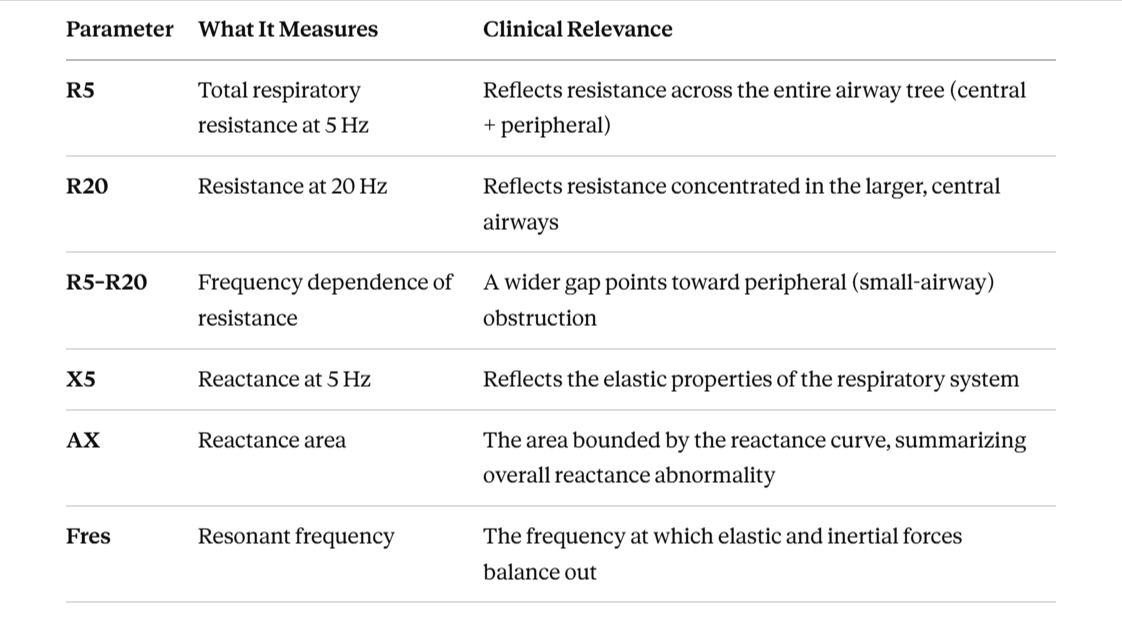
Interpretation of these values is always the responsibility of the treating clinician and is typically evaluated against a reference population and, where relevant, pre- and post-bronchodilator comparisons.
How Is FOT Different From Spirometry?
This is one of the most common points of confusion, so it's worth stating plainly: FOT does not replace spirometry — it measures something different, in a different way.
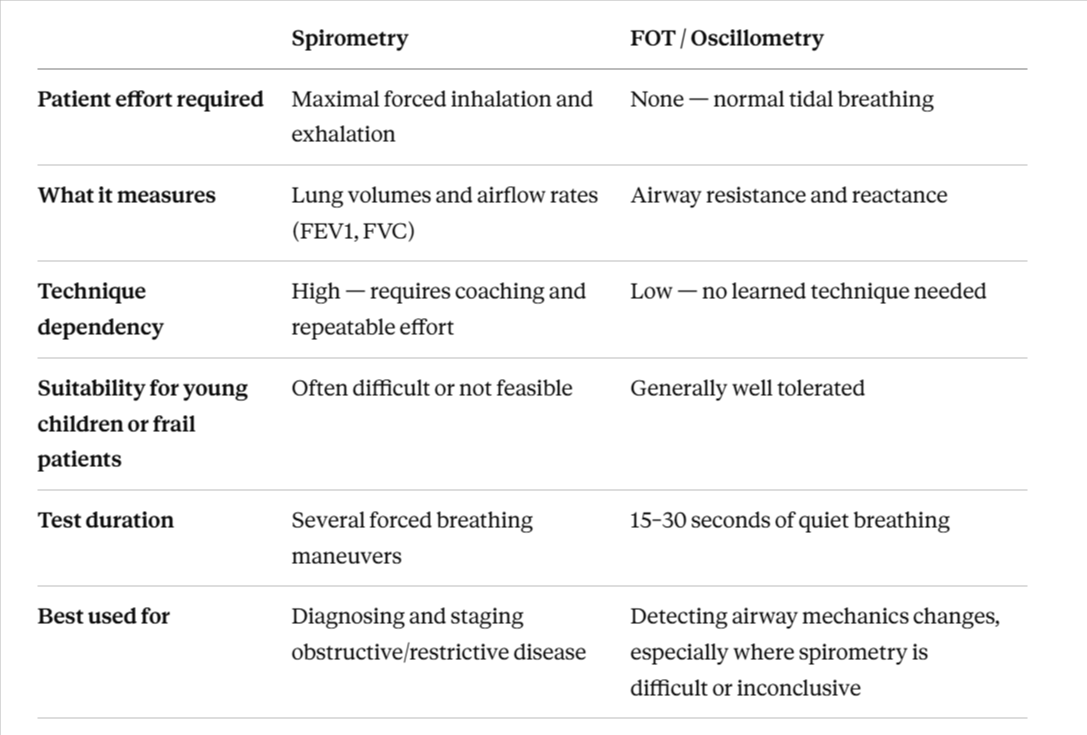
Because the two methods measure different physiological properties, most respiratory specialists treat oscillometry as a complement to spirometry, not a substitute. Where both are clinically indicated, running them in the same visit — often through the same mouthpiece, on the same device — gives a more complete picture without requiring separate equipment or a second appointment. Platforms like the alveoflow® FOT system are built around this pairing, combining oscillometry and spirometry on one device specifically because clinics frequently need both.
What Does an FOT Result Actually Look Like?
A typical FOT report presents resistance and reactance values across the tested frequency spectrum, often shown as a graph with frequency on one axis and impedance on the other. For bronchodilator response testing, results are shown pre- and post-medication side by side, with the percentage change highlighted.
For example, a patient with small-airway obstruction might show a raised R5, a normal R20, and therefore a wide R5–R20 gap — a pattern consistent with peripheral airway narrowing. After a bronchodilator, a meaningful drop in R5–R20 and improvement in reactance values would suggest a reversible component to the obstruction.
These patterns are why oscillometry has found particular clinical interest in asthma, COPD, and small-airway dysfunction, where standard spirometry alone can sometimes miss early or localized changes in airway mechanics.
Frequently Asked Questions About FOT
Does FOT require special patient preparation?
No special preparation is typically needed beyond what's standard for any respiratory test (avoiding bronchodilators before a baseline reading, if reversibility testing is planned). Because the test only requires normal breathing, there's no need to coach the patient on technique beforehand.
Is FOT painful or uncomfortable?
No. The oscillatory pressure signal is low-amplitude and is generally imperceptible to the patient as anything beyond a very faint vibration at the mouthpiece. Most patients describe the test as easier than spirometry.
Can FOT be used on children?
Oscillometry is frequently used in pediatric populations specifically because it doesn't require the forced maneuver that many young children struggle to perform correctly. That said, minimum validated age varies by specific device, so this should always be confirmed against the manufacturer's validated age range.
How long does an FOT test take?
The tidal breathing measurement itself typically takes 15–30 seconds. A full assessment, including a pre- and post-bronchodilator comparison, takes longer but still remains a fast test relative to spirometry protocols that require multiple repeated forced maneuvers.
Does FOT replace the need for spirometry?
No. FOT and spirometry measure different aspects of respiratory function airway mechanics versus forced airflow and volume. Clinical guidelines and technical standards describe them as complementary rather than interchangeable.
What conditions is FOT most useful for?
FOT is most frequently used in the assessment of asthma, COPD, and small-airway dysfunction, as well as bronchodilator response testing and longitudinal monitoring of airway mechanics over time.
The Bottom Line
Forced Oscillation Technique measures lung function by analyzing how the airways respond to a small external pressure oscillation during normal breathing, rather than requiring the patient to perform a forced breathing maneuver. This makes it especially valuable for patients who cannot reliably complete spirometry, and it provides a different — and complementary — window into airway mechanics through resistance and reactance measurements across multiple frequencies.
For clinics evaluating how to add oscillometry alongside existing spirometry workflows, the practical question is less "which test is better" and more "how do these two measurements work together for this patient." Devices that combine both tests on a single platform, such as the alveoflow® FOT system, are built around exactly that question — running spirometry and oscillometry from the same mouthpiece in a single sitting.