
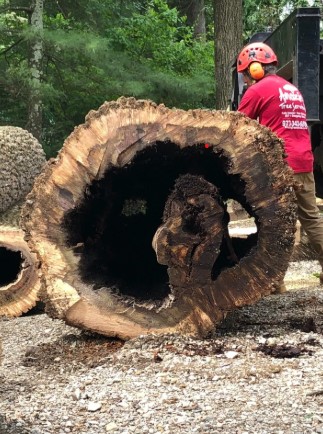
Every time a major storm hits, insurance companies receive thousands of claims for crushed roofs, shattered windows, and destroyed vehicles. In the vast majority of these cases, the damage was entirely preventable. Homeowners often assume that because a large trunk has stood in their garden for decades, it is strong enough to withstand high winds. This is a dangerous assumption. Mature wood is highly susceptible to internal rot, root disease, and structural weaknesses that are invisible from a distance. Waiting for a storm to test the strength of the branches hanging over your home is a massive financial gamble, and the odds are not in your favour.
You need to actively inspect your property for early warning signs of failure. Look closely at the points where large branches attach to the main trunk. If you see deep cracks, peeling bark, or a V-shaped union that looks tight and compressed, that joint is highly prone to splitting. Check the base of the trunk for fungal growth, like mushrooms growing directly on the wood or in the soil immediately surrounding it. Fungi are a guaranteed indicator of decaying organic matter, meaning the root system or the interior heartwood is actively rotting away. A structure with a compromised base will simply uproot and fall entirely when the ground becomes saturated and the wind picks up.
Hiring the best tree trimming service nj offers is the most effective way to mitigate this liability. A professional assessment identifies deadwood that is just waiting to snap off and become an airborne projectile. Dead branches hold no moisture; they are brittle and highly dangerous. Furthermore, experts can identify if the canopy is too dense. A canopy loaded with thick, overlapping leaves acts like a massive sail during a storm. It catches the wind, putting immense leverage and strain on the root system. Selectively thinning these branches allows the wind to blow safely through the structure, drastically reducing the force applied to the trunk.
Consider the severe financial consequences of negligence. If a decaying branch falls and damages your neighbour's property, you may be held legally liable for the repairs. Insurance companies investigate claims thoroughly. If their adjusters determine that the wood was obviously dead or diseased long before the storm, they may deny your claim based on a lack of standard maintenance. The out-of-pocket costs for repairing a smashed roof or replacing a crushed car can easily run into tens of thousands. Compared to those catastrophic costs, the price of routine, preventative maintenance is incredibly small.
Do not ignore the heavy limbs hovering over your gutters, power lines, and driveway. Take immediate action to protect your family and your financial assets. Have the deadwood removed, reduce the wind resistance of the canopy, and secure any structurally weak joints. High winds and severe weather are inevitable, but property damage is not. By being proactive and addressing these hazards today, you eliminate the risk and ensure that your property remains safe, secure, and fully intact regardless of what the weather brings.
Conclusion
Assuming mature vegetation is strong enough to withstand severe weather without regular inspection is a serious financial and safety risk. Hidden rot, weak branch unions, and brittle deadwood turn ordinary garden features into severe hazards during high winds. Identifying and addressing these issues before a storm hits is the only way to prevent catastrophic property damage and complex insurance liabilities. Proactive maintenance is a necessary safeguard for your home and finances.
Call to Action
Do not wait for a storm to expose the hidden dangers hanging over your roof. Contact our specialists right away to secure your property and eliminate severe hazards before they cause expensive damage.
Visit: https://atreeservicenj.com/