

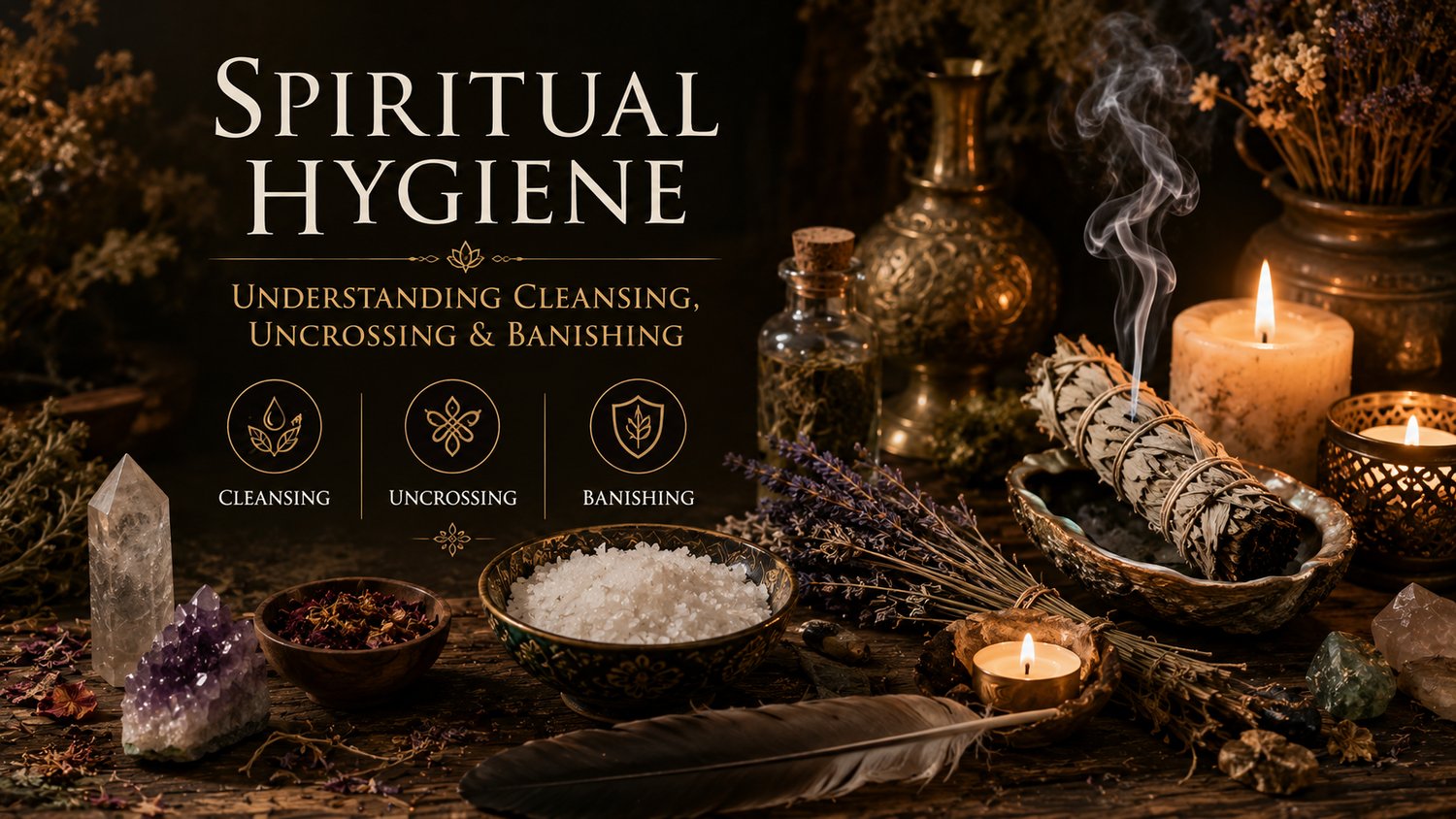
Spiritual Hygiene: Understanding Cleansing, Uncrossing & Banishing
"Just as we care for our physical health, many spiritual traditions teach that our energetic well-being also requires regular attention."
Life leaves its mark on all of us.
Stress, conflict, emotional wounds, unhealthy relationships, crowded places, and difficult experiences can weigh heavily on both the mind and the spirit. Across many spiritual traditions—from folk magic and Hoodoo to ceremonial practices and ancestral paths—it is believed that these experiences can leave behind energetic residue that, over time, may interfere with our clarity, motivation, and sense of inner peace.
This is why spiritual hygiene has always been considered an essential part of a balanced practice.
One of the biggest misconceptions among beginners is assuming that cleansing, uncrossing, and banishing all mean the same thing.
They don't.
Each serves a different purpose.
Understanding the difference allows you to approach your spiritual practice with greater discernment and intention.
Cleansing – The Foundation of Spiritual Hygiene
In many traditions, cleansing is considered the equivalent of spiritual maintenance.
Just as we clean our homes before dust accumulates or shower to remove physical dirt, cleansing is believed to remove the energetic residue collected through everyday life.
Arguments.
Stress.
Negative environments.
Heavy emotions.
Difficult interactions.
All of these are traditionally believed to leave an energetic imprint.
Cleansing is not usually performed because something is seriously wrong.
It is performed to prevent imbalance before it develops.
Many practitioners cleanse themselves after emotionally draining situations, before ritual work, after receiving many visitors, or simply as part of their weekly spiritual routine.
The goal is simple:
to restore balance, clarity, and harmony.
However, experienced practitioners also remind us that cleansing has its limits.
According to these traditions, cleansing removes surface-level energetic buildup, but it is not always intended to address deeper or more persistent spiritual conditions.
Uncrossing – Releasing Persistent Negative Influences
Many traditions distinguish cleansing from what is often called uncrossing or unhexing.
While cleansing is general, uncrossing is traditionally viewed as specific.
Within Hoodoo, folk magic, and several ceremonial traditions, uncrossing rituals are used when someone believes they are experiencing persistent negative spiritual influences.
Some practitioners describe these as crossed conditions, spiritual attacks, envy, the accumulated effects of prolonged negativity, or intentional harmful spiritual work.
Whether one interprets these experiences literally or symbolically depends on personal belief and spiritual tradition.
What remains consistent across many teachings is that uncrossing is not simply about performing a ritual.
It is also about reclaiming personal power.
Many experienced practitioners emphasize that inner work is inseparable from spiritual work.
Fear.
Limiting beliefs.
Unhealthy attachments.
Self-sabotaging patterns.
These are often viewed as equally important to address during the uncrossing process.
In other words, rituals alone are rarely considered enough.
Real transformation begins when both the external practice and the inner work happen together.
Banishing – Establishing Spiritual Boundaries
Banishing is perhaps the most misunderstood of the three.
Many beginners use the word as if it simply means "sending away negative energy."
Traditionally, however, banishing has a much more specific meaning.
It is generally understood as the intentional removal of an unwanted presence or influence from one's spiritual space.
Rather than refreshing energy, banishing establishes boundaries.
It is a declaration that something no longer has permission to remain within your personal or sacred space.
For this reason, many experienced practitioners recommend discernment before performing banishing work.
Different traditions encourage understanding the situation first rather than immediately assuming that every unexplained experience requires a banishing ritual.
Discernment is considered one of the greatest spiritual skills.
The Importance of Personal Responsibility
One of the most valuable teachings shared across many authentic traditions is surprisingly simple:
Not every challenge is caused by external spiritual influences.
Sometimes the greatest obstacle is our own unwillingness to change.
Before looking outside ourselves, many practitioners recommend asking difficult but honest questions.
Have I remained in unhealthy relationships?
Am I constantly exposing myself to environments that exhaust me?
Am I ignoring my intuition?
Have I neglected my own emotional well-being?
Self-reflection is often considered the first and most important spiritual practice.
Because no ritual can permanently solve a problem that we continue feeding through our daily choices.
Building a Healthy Spiritual Hygiene Routine
Spiritual hygiene is rarely viewed as a one-time event.
Like physical hygiene, it is understood as an ongoing practice.
Many practitioners include some combination of the following:
✨ Regular house cleansing.
✨ Spiritual baths.
✨ Prayer or meditation.
✨ Ancestor veneration, where it is part of their tradition.
✨ Keeping the home clean and orderly.
✨ Spending time in nature.
✨ Journaling and self-reflection.
✨ Limiting exposure to draining environments and relationships.
The specific practices vary from one tradition to another.
What they all share is consistency.
A Home Reflects the Spirit
Many traditions teach that our external environment mirrors our internal state.
A cluttered space often contributes to a cluttered mind.
For this reason, physical cleaning is frequently considered part of spiritual hygiene.
Opening windows.
Removing unnecessary objects.
Cleaning the floors.
Burning incense as part of prayer or meditation.
Creating an atmosphere of peace.
These simple acts can become meaningful rituals that encourage presence and mindfulness.
Protection Is More Than Ritual
Spiritual protection is often misunderstood as something that happens only during ceremonies.
Yet many experienced practitioners believe protection begins long before any candle is lit.
It begins with healthy boundaries.
Choosing who has access to your life.
Being mindful of the environments you enter.
Protecting your peace.
Living with integrity.
Developing emotional resilience.
For many traditions, these daily choices are considered the strongest foundation of spiritual protection.
A Practice of Awareness
Whether your path is rooted in folk magic, ancestral traditions, ceremonial practice, or personal spirituality, one lesson appears again and again:
Awareness comes before action.
Discernment comes before ritual.
Humility comes before certainty.
Understanding the purpose of cleansing, uncrossing, and banishing allows each practice to be approached with greater respect for the traditions from which it comes.
Rather than reacting from fear, we learn to respond with clarity.
Rather than seeking quick solutions, we develop consistent spiritual discipline.
And perhaps that is the true purpose of spiritual hygiene.
Not simply removing negativity...
But creating the inner and outer conditions where peace, clarity, and spiritual growth can flourish.
Continue Your Spiritual Practice
If you're ready to go beyond theory and experience a structured spiritual cleansing practice, I've created a complete guide designed to help you establish a consistent cleansing and protection routine.
📖 General Spiritual & Energetic Clearing Ritual PDF includes a comprehensive spiritual cleansing ritual, an Ancient Curse Removal Decree, Evil Eye Protection practices, and energetic clearing techniques inspired by traditional spiritual methods.
Whether you're looking to refresh your energy, create stronger spiritual boundaries, or develop a regular spiritual hygiene practice, this guide offers practical steps you can incorporate into your own path.
✨ Explore the guide here:
Final Reflection
"A healthy spiritual practice is not built on fear.
It is built on awareness.
On discipline.
On discernment.
And on the daily choice to care for both the home we live in... and the spirit we carry within."
— Aquarian Oracle
Comments ()