

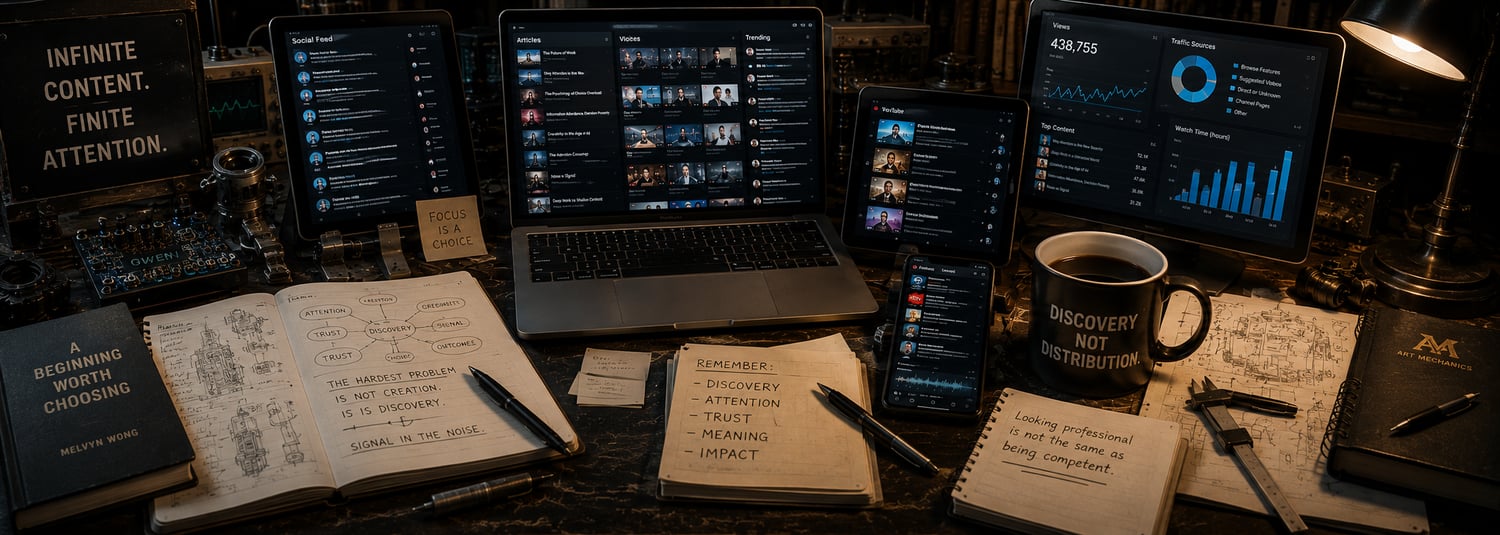
When competence can be simulated, what becomes valuable?
For most of human history, mastery was visible.
- Either the musician could play or could not.
- Either the engineer could build or could not.
- Either the writer could write or could not.
- Either the craftsman produced quality work or did not.
- Either the teacher understood the subject or did not.
There were certainly exceptions. There were (and still are) frauds, pretenders and charlatans in every generation. But in most professions, capability eventually revealed itself. The work spoke loudly enough that competence became difficult to fake for very long.
Ever heard of “…fake it until you make it…?”
Today, something fundamentally has changed. We are entering a period where competence can be simulated at unprecedented scale, and that may prove to be one of the most disruptive consequences of artificial intelligence. Artificial intelligence does not replace expertise nor does it render expertise irrelevant. What we are witnessing is that competence itself can now be simulated.
Until very recently, producing professional-looking work required a certain level of technical ability.
- Writing required writing.
- Graphic design required design.
- Video production required editing.
- Music production required engineering.
- Marketing required research.
- Presentation decks required structure.
Today, much of that has changed.
- A person can generate an article in seconds.
- A presentation in minutes.
- A logo before lunch.
- A video before dinner.
- An entire campaign before the end of the day.
The cost of producing something that looks professional has collapsed. From a business perspective, this is an extraordinary achievement. However, it is also creating a problem that few people are discussing.
Because when everybody and anybody can produce professional-looking output, how do we distinguish genuine capability from the appearance of capability?
The distinction matters more than many realise.
Consider the world of audio engineering.
Not long ago, producing a polished recording required years of accumulated experience. Engineers learned microphone placement, gain staging, equalisation, compression, mastering and acoustics. Mistakes were audible. Experience mattered.
Today, almost all of those processes are automated.
- Noise is removed automatically.
- Vocals corrected automatically.
- Tracks mastered automatically.
- Even entire songs can be generated from simple prompts, while the prompts themselves can be generated by another AI.
This results in more music but not necessarily better music.
The same pattern exists in video production.
Professional editing once required specialised knowledge and expensive equipment. In the past, templates supported a production process. Today, one-button templates replace much of the process entirely with very little technical understanding.
Again, this is not necessarily a bad thing.
Lower barriers allow more people to create. More creators often means more experimentation and experimentation has historically been a powerful driver of innovation. Many of the techniques and tools we take for granted today emerged because musicians, engineers and creators pushed existing technologies beyond their intended purpose.
Tape delays, distortion effects, synthesisers and countless production techniques were not born from templates. They emerged through curiosity, experimentation and a willingness to explore the unknown.
That is the positive side of the story.
The challenge today is that artificial intelligence dramatically lowers the cost of production without necessarily increasing understanding. More content is being created than ever before but much of it is built using tools that hide the underlying processes from the user.
As a result, output is becoming a poor proxy for expertise.
Looking professional is no longer evidence of competence.
A polished video does not guarantee storytelling ability. A professionally mastered track does not guarantee musical understanding. A well-written article does not guarantee original thinking.
The appearance of capability has become easier to manufacture than capability itself.
Recently, while observing a classroom exercise, I noticed something that felt strangely familiar.
- Assignments were completed quickly.
- Responses were polished.
- Grammar was excellent.
- Formatting was professional.
- Everything appeared correct.
Yet very little discussion took place. Very few questions were asked.
- Almost nobody challenged assumptions.
- Almost nobody explored alternatives.
The answers existed. The thinking was harder to find.
Artificial intelligence did not create that problem.
It merely exposed it.
For years, educational systems have often measured outputs because outputs are easy to measure.
- Assignments.
- Reports.
- Presentations.
- Assessments.
- Certificates.
But an uncomfortable question now emerges.
- If outputs can be generated almost instantly, what exactly are we measuring?
The same question applies to business. For decades, producing content was expensive.
- Producing a report required effort.
- Producing a presentation required effort.
- Producing marketing material required effort.
- Producing media required effort.
That effort acted as a natural filter. Today, the filter is disappearing. As production becomes easier, the internet becomes flooded with competent-looking material.
- Articles.
- Videos.
- Podcasts.
- Graphics.
- Courses.
- Books.
- Reports.
- Strategies.
- Opinions.
- Recommendations.
Everything.
The result is a paradox.
Humanity has never had access to more information. Yet finding signal within the noise has never felt more difficult. This is where many discussions about artificial intelligence miss the point.
People often ask whether AI will replace creators.
- Whether AI will replace marketers.
- Whether AI will replace engineers.
- Whether AI will replace teachers.
So... what happens when everybody can appear competent?
Because appearance scales much faster than expertise.
- Expertise still requires experience.
- Expertise still requires failure.
- Expertise still requires observation.
- Expertise still requires judgement.
Artificial intelligence can compress production however it cannot compress reality.
- A marketing strategy generated in thirty seconds still has to survive the market.
- An engineering design still has to function.
- A product still has to work.
- A business still has to generate revenue.
- A watch winder still has to wind watches.
Reality remains stubbornly resistant to prompts.
This may explain why so many industries feel increasingly noisy.
- Not because there are too many creators.
- Not because there are too many ideas.
But because the ratio between appearance and capability is changing. The internet has become extremely good at producing the appearance of competence. Whether genuine competence has increased at the same rate remains an open question. This shift has profound implications for distribution.
Historically, creation was the bottleneck. If you wanted to publish a book, record music, build software or launch a product, creating the thing was the difficult part. Today, creation is becoming easier every year. Yet we are further away from being discovered.
The bottleneck is moving elsewhere.
- Discovery.
- Attention.
- Trust.
These are becoming scarce.
Consider the modern creator.
- Artificial intelligence can help write articles.
- Generate graphics.
- Edit videos.
- Create marketing copy.
- Produce presentations.
- Build websites.
What it cannot guarantee is attention.
The internet is now filled with people creating more content than ever before. Yet attention remains finite. No matter how much content is generated, human attention does not scale at the same rate.
- There are still only twenty-four hours in a day.
- There are still only so many books people can read.
- Only so many videos they can watch.
- Only so many products they can evaluate.
- Only so many creators they can follow.
Content has become abundant yet attention remains scarce.
This may be the most important economic shift created by artificial intelligence. Not the automation of production. The collapse of scarcity.
For centuries, scarcity created value.
- Scarcity of information.
- Scarcity of expertise.
- Scarcity of media.
- Scarcity of distribution.
Artificial intelligence is rapidly removing many of those constraints. But scarcity does not disappear. It relocates.
- When content becomes abundant, attention becomes valuable.
- When answers become abundant, judgement becomes valuable.
- When appearances become abundant, trust becomes valuable.
- When production becomes abundant, distribution becomes valuable.
This is why I increasingly believe the next decade will not belong to those who create the most. It will belong to those who can establish credibility.
- Those who can build trust.
- Those who can demonstrate real-world outcomes.
- Those who can connect meaningful work with the people who genuinely care about it.
In other words, discovery.
Artificial intelligence has dramatically expanded humanity's ability to create. That achievement should not be underestimated. But creation alone is no longer enough.
The internet is already full of articles.
- Already full of videos.
- Already full of music.
- Already full of opinions.
- Already full of content.
What remains scarce is attention.
What remains scarce is trust.
What remains scarce is demonstrated capability.
And perhaps that is where the future becomes interesting. Not because machines are becoming more capable. But because human beings must become better at recognising what capability actually looks like.
Artificial intelligence solved many production problems.
- It lowered barriers.
- Expanded access.
- Accelerated creation.
But it did not solve discovery.
And in a world overflowing with content, discovery may turn out to be the hardest problem of all.