

When the Music Comes Home
Being stocked is not the same as being supported.
Being listed is not the same as being distributed.
After more than a decade, The Illumine Symphony is once again under independent control. That sounds like an ending. However, in many ways, it feels more like returning to the beginning.
My relationship with music goes back to the 1980s. This was long before software instruments, streaming platforms and the idea that someone working independently could place an entire catalogue within reach of listeners around the world.
Places such as Plaza Singapura opened a very different window into what making music could mean. There were messy shops, noisy cafes and places where people who cared crossed paths. There were physical instruments. There were synthesisers, workstations, sequencers and drum machines.
Yamaha Music School, Do-Re-Mi cafeteria and Swee Lee were part of that landscape for me. MIDI itself was just emerging and the industry's move towards greater integration was already opening the door to new forms of collaboration and new possibilities.
So were the people who taught me, challenged me and sometimes simply allowed me to observe how computers and technology were changing the way music was approached. Some became mentors and important influences. Countless others probably never realised their influence at all. For them, too, I am eternally grateful.
Their names are less important here than what they passed on: standards, judgement, curiosity and the understanding that technology is useful only when you know what you are trying to express with it.
Over time, technology; both hardware and software, has changed enormously. Companies such as Steinberg helped define what an independent musician could realistically do. The computer gradually became more than a recording device. It became a compositional environment, an arranging room, a production studio and eventually part of the orchestra itself.
That did not make creating music easy. It just made more things possible. That remains an important distinction in today’s conversation around AI.
Independent production is sometimes described as though independence means doing everything alone. It does not.
Every independent work sits on top of things created by other people: instruments, software, engineering, manufacturing, musical traditions, technical standards and knowledge passed from one generation to another. Independence is not the absence of other people. It is accepting responsibility for what you eventually make with everything they made possible.
That accumulated journey eventually became The Illumine Symphony.
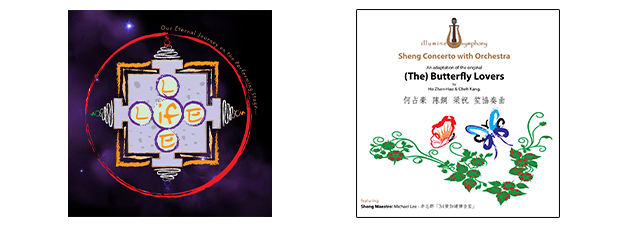
Our first album was released in 2012 and the second followed in 2018.
Producing the work was one problem.
Getting it into the world was another.
Like many independent creators, I learned that having something available for sale does not necessarily mean anybody cares enough to actively distribute it.
At one point, limited numbers of physical CDs were placed with local retailers. Copies sold. Great. At the most basic level, the arrangement did what it was supposed to do.
But there was another lesson hiding inside that experience.
When stock ran low or disappeared, there was no machinery automatically asking whether more should arrive. There was no continuing conversation about where the work was going, who was finding it or what should happen next. If there was stock, something might sell. If there was no stock, there was nothing to sell.
!!! Simple !!!
That physical experience stayed with me because digital distribution created the same illusion on a much larger scale. A work can appear on a platform. It can technically be available almost everywhere. But that does not mean anyone is actively helping people discover it.
Availability is not distribution.
Distribution itself becomes strategically valuable only when someone has enough interest in the work to actually do something with it. Otherwise, what you may have gained is another shelf.
Today, that shelf might be physical. It might be a streaming service, marketplace, online bookstore or digital storefront. The shelf changes. The underlying problem does not. Someone still has to care enough for the work to be found. Eventually, for the independent creator, that responsibility tends to bounce back home.
This is where The Illumine Symphony is today.
The music has travelled through different technologies, different channels and different arrangements over more than a decade. Now it sits once again directly with its creator.
There is something satisfying about that. There is also something inconvenient about it.
Because once it is yours again, whatever happens next is yours to live with.
If the presentation needs attention, that is now my problem. If nobody discovers it, that is my problem too. If the work needs to be repositioned, preserved, repackaged or simply left alone, the decision belongs here.
That is probably what ownership really means. Not control for its own sake.
Responsibility.
Art Mechanics now brings together writing, orchestral music and an experimental mechanical system that were created at completely different times and through very different processes.
Yet all three eventually arrive at the same question:
What happens after you build something?
There is no distributor, no platform and no algorithm that can answer that completely.
Sometimes the uncomfortable answer is simpler:
…if it works, good.
If it does not, it is still your problem…
Support may exist. Programmes may exist. Encouragement may exist.
But results cannot be outsourced.
And when something fails to find an audience, the owner is usually the one left carrying the cost and asking what could have been done differently.
That is the part no distributor, platform or programme can carry for you.
The music has come home. So has the outcome.
When creative work returns fully to its creator years later, should it be preserved exactly as it was or should the creator reconsider what it can become now?