

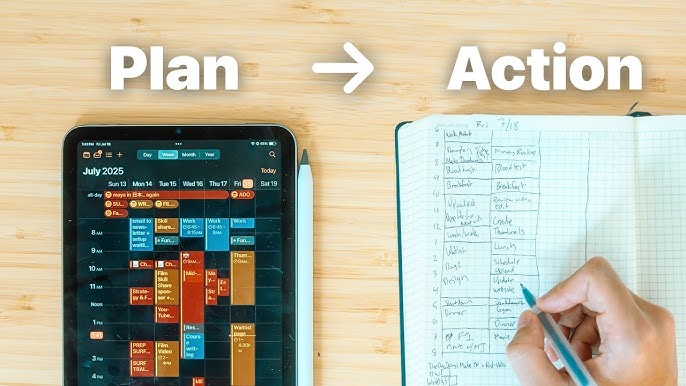
Most people either don't plan their week at all, or they spend an overwhelming hour on Sunday night trying to map out every hour of every day... only to abandon the whole thing by Tuesday. If that sounds familiar, you're not alone.
The good news is that effective weekly planning doesn't have to be complicated, time-consuming, or perfect. In fact, the most productive people keep it remarkably simple.
In this guide, you'll learn exactly how to plan your entire week in just 15 minutes, courtesy of a realistic, beginner-friendly routine that actually works whether you're a student juggling assignments or just someone trying to feel less chaotic.
Why Weekly Planning Changes Everything
Before we get into the how, it's worth understanding why weekly planning is worth doing at all.
When you don't plan your week, you essentially wake up every morning and react to whatever feels urgent, to whatever comes to mind, to whatever mood you're in. Days blur together, important tasks get forgotten, and by the end of the week, you have that uncomfortable feeling of having been busy all week but not actually getting anywhere.
Weekly planning fixes this. It gives you a bird's-eye view of your week before it starts, so you're making decisions from a calm, clear-headed place rather than a reactive one. Research published in the Journal of Applied Psychology found that people who spent time planning their week reported 25% higher satisfaction and were significantly more productive than those who didn't plan at all. The reason is simple - planning reduces decision fatigue, eliminates the stress of forgetting things, and creates mental space to actually focus.
And the best part? You only need 15 minutes!
When Should You Plan Your Week?
Timing matters more than most people realize. The best time to plan your week is Sunday evening or Monday morning, before the day gets away from you. Sunday evening works well because you start Monday already knowing exactly what the week looks like. Monday morning works if you prefer to plan with fresh energy at the start of the week.
What doesn't work is planning mid-week, planning reactively when things are already falling apart, or skipping it entirely and "winging it." Pick one consistent time - same day, same time every week, and treat it like a non-negotiable appointment with yourself. Consistency matters far more than which specific time you choose.
The 15-Minute Weekly Planning Routine (Step by Step)
Here's the exact process, broken into four simple steps. The whole thing takes 15 minutes or less once you get into the rhythm of it.
Step 1: Do a Quick Brain Dump (3 minutes)
Open a blank page, whether that's a notebook, a Notion page, or any planner, and then write down everything that's on your mind. Assignments, Appointments, Errands, Emails you need to send, Anything you've been meaning to do. Don't organize anything yet, just get it all out of your head and onto the page.
This step alone is transformative. The mental weight of trying to hold every task in your head is exhausting without you even realizing it. Getting it down on paper immediately makes you feel lighter and more in control.
Step 2: Identify Your Top 3 Priorities (2 minutes)
Look at your brain dump and ask yourself: if I could only accomplish three things this week, what would actually move the needle? These become your non-negotiables - the things that must happen before anything else.
For students, this might be submitting an assignment, studying for an upcoming test, and finishing a group project. For someone focused on daily productivity, it might be completing a work deadline, exercising three times, and clearing out a backlog of emails. The number three is important here. Not five, not ten, just three. When everything is a priority, nothing is.
Step 3: Assign Tasks to Days (7 minutes)
Now take your full list and loosely assign tasks to specific days of the week. The keyword here is loosely. You're not scheduling every hour — you're simply deciding that Monday is for X, Tuesday is for Y, and so on.
A good weekly planning habit includes mapping out not just your tasks but also your priorities, so that you're not always caught up sorting out what's urgent at the last minute. Think about what each day naturally looks like, such as your class schedule, energy levels, and existing commitments, among others, and place heavier tasks on days when you have more capacity, and lighter tasks on days that are already full.
One practical trick: always leave one day slightly lighter than you think you need. Life will fill it. Something will come up. That buffer is what separates people who stick to their plan from people who abandon it by Wednesday.
Step 4: Review What Carries Over From Last Week (3 minutes)
Quickly glance at the previous week. What didn't get done? Does it still matter? If yes, slot it into this week. If it's been rolling over for three weeks and you keep avoiding it, either schedule a specific block of time to deal with it or accept that it's not actually a priority and remove it entirely. A weekly review is what keeps your plan connected to reality, rather than becoming a wishlist that gradually loses meaning.
Common Weekly Planning Mistakes to Avoid
Even with the best intentions, there are a few pitfalls that derail most people early on.
- Over-scheduling - Filling every single hour with tasks feels productive in theory, but leads to burnout and frustration in practice. Always leave breathing room.
- Planning without priorities. A list of 25 equally weighted tasks is not a plan. It's just a longer source of anxiety. Always anchor your week to your top three priorities first.
- Skipping the review. Planning for next week without looking at last week means you keep making the same mistakes. The three-minute review at the end of the process is what makes your system smarter over time.
- Making your system too complicated. The best planning system is the one you'll actually use consistently. Simple beats sophisticated every single time.
Make It Even Easier With a Weekly Planner Template
If you want to make this 15-minute routine even smoother, having a dedicated planner makes the whole process faster and more satisfying. Instead of staring at a blank page every Sunday, a good weekly planner template gives you a clear structure to fill in - brain dump space, priority slots, day-by-day task columns, so you can move through the routine almost on autopilot.
A well-designed Notion weekly planner works particularly well for this because everything is in one place, it's accessible from any device, and it stays organized from week to week without the clutter of physical notebooks piling up.
Conclusion
Weekly planning is one of the highest-return habits you can build, and at just 15 minutes a week, the time investment is genuinely tiny compared to the clarity and control it gives you. The four-step routine mentioned above - brain dump, set three priorities, assign tasks to days, review last week - is all you need to start.
You don't need a perfect system on day one. You just need to start, stay consistent, and refine as you go. Try it this Sunday evening and notice how differently Monday morning feels. Chances are, you'll never go back to winging it again.
Comments ()