
Hi, Sachi Here
Before you read, here’s a little song to play while you go through the poem. I think it’ll make the experience a little nicer.
https://open.spotify.com/track/6NaEOG5NByrFEf04shAKTK?si=BhLRlhMnRCC3269Qh4Oygw
Welcome to my first blog!
I thought I’d start with a poem that won me an award some months ago. I’ve since gone back to it, made a few changes, and decided to share the revised version here.
The poem is called All Is Well That Ends in War.
I’ve always been a bit of a pacifist. I’m against war, and I’m particularly sympathetic to those who find themselves caught in conflicts they had no part in creating. I stand with Palestine, and I find it difficult to understand what the ordinary person is supposed to gain from war.
Maybe my lack of knowledge in economics is showing, but I struggle to see the benefit of destroying people’s homes, separating families and taking children’s lives. Someone, somewhere, will call it a victory. I’m just not sure who gets to enjoy it.
Anyway, here’s the poem.
All Is Well That Ends in War
Appear, our heroes!
Arise, you armoured and august few.
Let the avenues awaken with applause,
let the ale be poured, let the old songs return.
The adversary has abandoned his ground,
and mothers may ululate at last.
Ah, what a triumph we shall tell our children.
For even the living have returned dead,
and the dead have yet to return.
A few things about it.
I wanted the opening to sound like a homecoming. The heroes have arrived, the enemy has retreated, and the town is ready to celebrate. There’s a little pomp and pageantry in those first lines. I also had fun with the repeated A sounds: appear, arise, armoured, august, avenues, applause, ale, adversary, abandoned. I wanted the language to almost march.
I particularly like the word ululate. It refers to that high-pitched cry often heard at celebrations and mourning. I thought it suited the line about mothers. They may finally make that sound again, but we aren’t told whether they’re celebrating or grieving.
Then there’s the line:
Ah, what a triumph we shall tell our children.
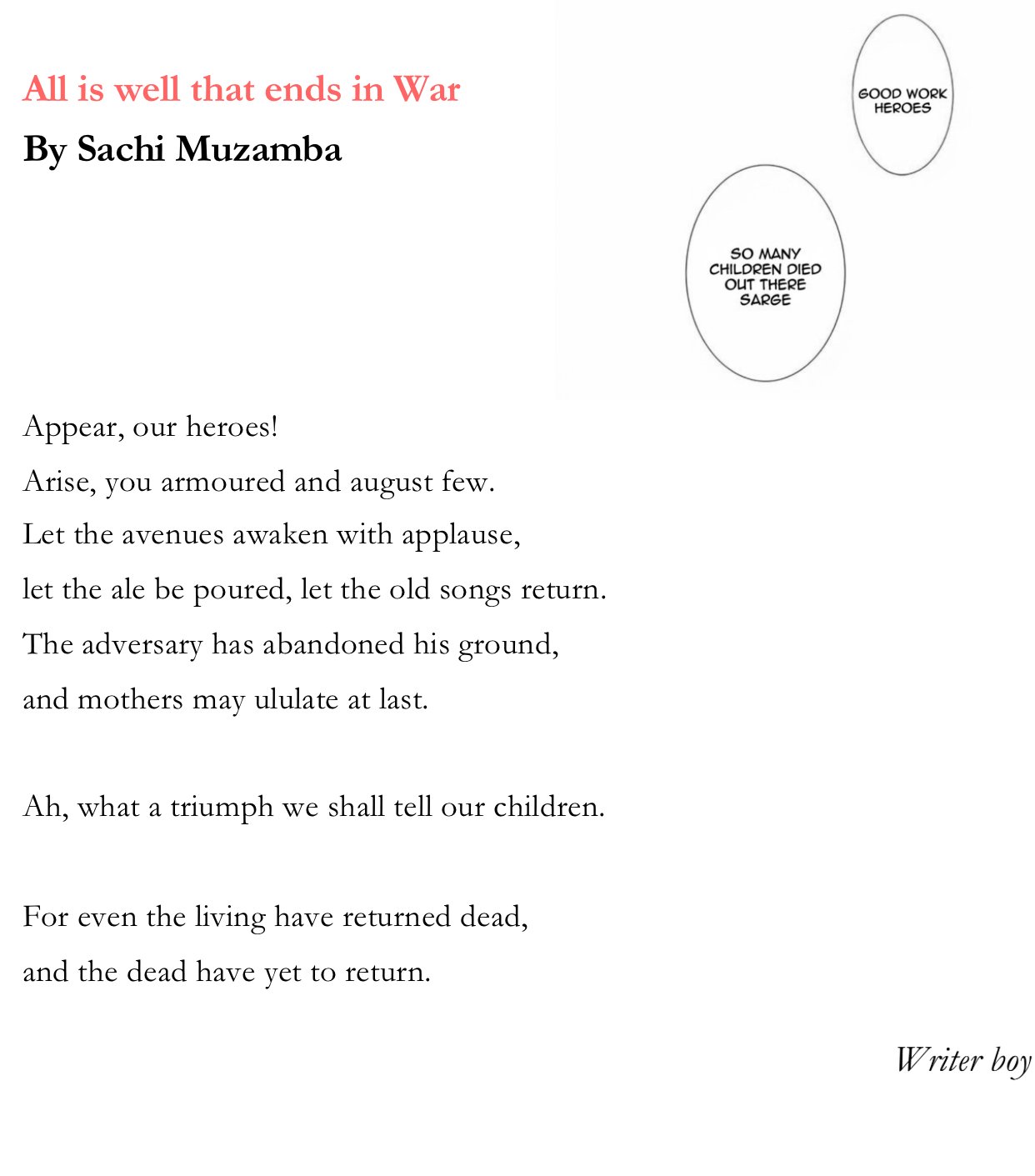
I find something rather unsettling about it. We are already preparing the story of our victory for the next generation. What will we tell them about the children who never got to grow up? Will they make it into the story at all?
And the ending is really what the whole poem was leading towards.
For even the living have returned dead,
and the dead have yet to return.
I wanted to say something about the people who make it home but never really recover from what they’ve seen. And, of course, those who don’t make it home at all.
The title plays on the familiar expression All’s well that ends well. I changed the ending because I don’t think the end of a war necessarily means that everything is well. Sometimes the fighting stops, the celebrations begin, and the people left behind are still trying to put their lives together.
I suppose that’s what I wanted to leave with you.
Thank you for reading. This is the first of hopefully many little conversations about poetry and writing.
Until next time,
Sachi
Comments ()