

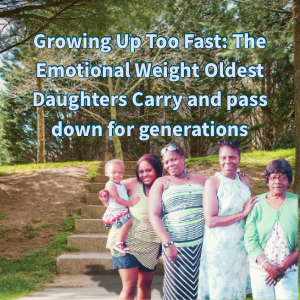
Growing Up Too Fast: Being The “Little Parent” & Emotional Overwhelm
How Oldest Daughters Become Caretakers and the Hidden Cost That Follows Them Into Adulthood
Some daughters grow up. And some daughters are raised into adulthood before they’re ready. If you were the oldest child, especially the oldest daughter…you know exactly what I mean. Oldest daughters don’t get childhoods they get responsibilities. They get expectations. They get emotional weight no one ever warned them about. And many of us spend the rest of our lives trying to untangle who we are…from who we had to be.
The Oldest Daughter: Born First, Grown First
There’s something unspoken about being the oldest daughter a quiet contract you never signed but were forced to honor. You become:
- the fixer
- the helper
- the emotional sponge
- the mediator
- the second mother
- the over-functioner
- the one who “should know better”
- the one who “can handle it”
You grow up measuring your worth by:
- how much you do
- how much you carry
- how little you need
And when you finally become an adult, the world still expects you to hold the same weight with no rest, no softness, no break. But being strong wasn’t your personality. It was your position in the family hierarchy.
✨ When a Child Becomes the Parent
Parentification happens when the roles flip.
The child becomes:
- the emotional support
- the babysitter
- the therapist
- the problem-solver
- the protector
- the one who holds the secrets
- the one who absorbs the dysfunction
And in many families especially Black and brown families this is normalized.
They call it:
- “being responsible”
- “helping out”
- “maturing fast”
- “being the little mom”
But the truth is: It’s emotional trauma disguised as ‘strength.’
It robs children of:
- play
- safety
- emotional development
- identity
- boundaries
- the right to be cared for
And you don’t realize the damage until later in the way you relate, love, and choose people who reflect the same imbalance you grew up surviving.
✨ The Generational Pattern: Children Raising Children
Let’s talk about teen pregnancy gently, honestly, without shame.
Because teen pregnancy is not just about two kids having a baby. It’s about generational trauma, poverty, lack of support, and inherited emotional patterns.
A teen mom is often:
- a former parentified daughter
- a girl who didn’t get guidance
- someone who mistook survival for maturity
- someone seeking love she never received
- someone forced to parent when she hasn’t fully developed emotionally or neurologically
And then suddenly a child is raising a child with no emotional blueprint, no stability, no regulated model to follow. The trauma doubles. The pressure multiplies. And the oldest daughter of a teen mom? She becomes a third-generation parentified child. A girl growing up inside the same emotional story her mother never got to rewrite.
✨ Oldest Daughter of an Oldest Daughter
There is a special kind of weight in raising a daughter when you were once the daughter who carried everything. I didn’t fully understand this until I became a mother myself until I saw my daughter’s face and realized: I refuse to hand her the burden I was given.
But breaking generational patterns isn’t just emotional work
It’s neurological. It’s spiritual. It’s learning what safety feels like when you’ve only known survival.
For oldest daughters who now have oldest daughters, this becomes a mirror:
- “Am I repeating my mother?”
- “Am I giving her too much responsibility?”
- “Am I projecting my trauma?”
- “Am I healing or recycling the pain?”
The truth is: We parent from the place we haven’t healed. And our daughters feel that in their bones.
✨ The Invisible Trauma of Growing Up Too Fast
Older daughters often grow up with:
- hyper-independence
- emotional numbness
- anxiety disguised as responsibility
- guilt for saying “no”
- a constant sense of danger
- fear of asking for help
- perfectionism
- relationship patterns where they over-give and under-receive
They become women who:
- love men who need mothering
- stay in friendships where they play therapist
- work jobs where they’re over-relied on
- feel guilty resting
- choose partners who mirror their family dynamics
- confuse chaos with passion
- feel safest when they’re taking care of everyone else
Because when you grow up being the fixer, you become addicted to fixing. And underneath that addiction
is a little girl who never got to be little.
✨ How This Shows Up in Adult Relationships
Parentified daughters often:
- become the emotional caretaker in relationships
- feel guilty having needs
- never feel “good enough”
- settle for people who take but don’t reciprocate
- attract emotionally unavailable partners
- struggle with vulnerability
- shut down emotionally during conflict
- feel responsible for everyone’s feelings
Because they were trained that love = labor.
Care = sacrifice.
Worth = usefulness.
Safety = staying strong.
And sometimes healing begins with the painful realization:
No one ever taught you how to be loved. Only how to be needed.
💌 A Note from Lily
Hey love,
You deserved a childhood.
A real one.
With softness, rest, imagination, and safety.
None of what you carried makes you weak.
It makes you human.
You were a child doing the emotional work of adults.
And that wasn’t your fault.
You don’t owe anyone your strength anymore.
You don’t have to carry the entire house on your back to feel worthy.
You don’t have to raise your daughter the way you were raised.
You get to begin again.
You get to build the childhood you never had inside the woman you are today.
One breath.
One boundary.
One healed generation at a time.
With love,
Lily

✨ Try This Today
Write these questions down:
1. What part of my childhood did I skip over because I had responsibilities?
2. In what ways do I still try to be the “strong one”?
3. What emotional needs did I never have met as a child?
4. How do I see my childhood patterns showing up in motherhood?
5. What do I want my daughter to experience differently than I did?
You can’t heal what you won’t name. And you can’t break cycles you can’t see. You’re already doing the work by reading this.
If this blog touched something tender your childhood, your motherhood, or the oldest daughter inside you still holding it together you are not alone. Parentification is a wound too many of us carry quietly.
My journal Blurred Lines Between Us has deeper prompts, reflections, and emotional regulation tools to help you unpack that weight and rewrite your story with intention, clarity, and compassion.
✨ Purchase your copy here: CLICK HERE
And before you go Were you the oldest daughter?
What part of this resonated with your story?
Comment below.
Your voice matters.
Your story matters.
You matter.
Comments ()