

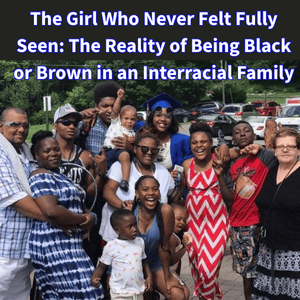
Growing Up Too Fast: Identity, Belonging & The Silent Trauma of Black and Brown Daughters in Interracial Families
Part Two
There’s a kind of emotional labor Black and brown girls learn early a labor that doesn’t have a name in most families, a labor no one acknowledges, a labor you feel in your bones long before you understand it. And nowhere is this more visible than in interracial families.
Growing up as the “different-looking child,” the “brown one,” the one with skin that tells a story the house refuses to talk about comes with a kind of trauma that rarely gets discussed especially when the adults think “love is enough.” Love matters, yes. But love without understanding becomes another wound. And Black and brown daughters often grow up carrying the cost of that silence.
The Identity Split: When Your Family Doesn’t Match Your Face
There is a loneliness that comes from being a child who looks different from the people raising you.
You learn:
- to question your beauty
- to question where you belong
- to question why you feel so different
- to explain or defend your existence
- to shrink parts of yourself that make others uncomfortable
Black and brown daughters in interracial homes often become:
- the bridge between cultures
- the fixer of misunderstandings
- the educator
- the translator
- the peacekeeper
- the one who absorbs microaggressions silently
Because no one taught them how to navigate the emotional weight of being “the only one.”
The Unspoken Wounds: When Your Family Doesn’t Share Your Race
Depending on the family dynamic, this creates unique emotional wounds:
1. When Your Mother/Grandma/Aunt/Sister Is White (or non-Black)
You learn that:
- she cannot fully understand your hair, your skin, your experience
- she may not recognize racism because she’s never lived it
- she may misinterpret your emotions through her own cultural lens
- she may dismiss things that deeply hurt you (“Are you sure?” “Maybe you’re overthinking it.”)
- she may love you but not know how to protect you
You grow up feeling both loved and misunderstood. Protected and exposed. Seen and unseen.
2. When Your Father Is Absent or Emotionally Unavailable
Many Black and brown girls internalize:
- that something about them is “too much”
- that their existence wasn’t prioritized
- that their identity is tied to abandonment
- that their cultural roots are only connected to pain or silence
This shapes how they love, trust, and choose relationships as adults.
3. When Extended Family Treats You Differently
You notice:
- the stares
- the comments
- the favoritism
- the microaggressions
- the subtle exclusion
- the curiosity about your hair or your skin
- the pressure to “not make things racial”
And because you don’t want to disrupt family peace, you shrink. You smile. You stay quiet. You become the emotional cushion for their discomfort.
When Colorism Lives Inside the Home
Black and brown daughters often absorb messages like:
- “Don’t get too dark.”
- “Your hair looks better straight.”
- “Why don’t you look like your sister?”
- “You’re pretty for a brown girl.”
These comments cut deeper when they come from inside the house from parents, siblings, grandparents, cousins. And instead of being protected from colorism, many daughters learn to perform around it.
To be palatable. Liked. Accepted. Complimented. Enough.
But the truth is:
Most of that “acceptance” is a performance you learned to survive.
The Emotional Labor of Being the Minority in Your Own Family
Black and brown girls in interracial families learn to do things adults should’ve done for them:
- educate others on racism
- explain cultural differences
- defend their feelings
- absorb microaggressions silently
- hold the emotional reactions of relatives
- pretend nothing hurts
- perform gratitude for inclusion
- downplay their pain so their parents don’t feel guilty
This is a type of parentification too but instead of raising siblings, you’re raising adults’ awareness. And that emotional labor is heavy.
How This Impacts the Mother–Daughter Bond
When a mother is not the same race as her daughter, the emotional gap can feel like an entire ocean.
Daughters may feel:
- unseen in their racial experience
- misunderstood when they express pain
- invalidated when the mother “doesn’t see color”
- frustrated when the mother defends racist relatives
- silenced to protect the mother’s feelings
- pressured to act “less Black” or “less ethnic” to keep peace
- unprotected in the face of identity-based harm
Mothers may feel:
- defensive
- guilty
- uneducated
- overwhelmed
- unsure how to help
- triggered by their own upbringing
- afraid of being “the bad guy”
Love exists deeply. But understanding does not. And without understanding, connection suffers.
The Impact on Adult Relationships
Black and brown daughters from interracial families often grow into adults who:
- attract relationships where they feel “not enough”
- silence themselves to avoid conflict
- struggle with identity and self-worth
- internalize the belief that their feelings are “too intense”
- tolerate microaggressions in dating
- feel disconnected from their cultural roots
- choose partners who mirror the validation they never got
- avoid vulnerability because being misunderstood is painful
You learn to love in the same way you learned to survive by not taking up too much space.
Healing: Returning to Yourself
Healing these wounds means gently returning to your whole identity:
your culture
your voice
your hair
your beauty
your pain
your softness
your boundaries
your girlhood that was interrupted
your womanhood that was shaped by survival
And this kind of healing takes time. It takes unlearning silence. It takes rebuilding self-worth. It takes reclaiming the parts of you that you had to hide. You don’t have to heal this alone. You never should have had to carry it alone.
💌 A Note from Lily
Hey love,
You deserved to grow up in a home that understood every piece of you
your story, your culture, your identity, your feelings.
The world already questions Black and brown girls.
Your home should’ve been the place where you were affirmed, protected, and celebrated.
But here you are
breaking cycles your parents didn’t even know existed.
Healing wounds they never had words for.
Becoming the woman your younger self prayed for.
You’re not too complicated.
You’re not too sensitive.
You’re not “making everything racial.”
You’re not imagining things.
You are finally telling the truth about what hurt you.
With love,
Lily
Try This Today
Write down:
1. What parts of my identity did I hide growing up?
2. Where did I feel different inside my own family?
3. What comments or moments shaped the way I saw myself?
4. What do I want my daughter (or future daughter) to know about her identity that I didn’t know?
Your story matters not just to you, but to the generations coming after you.
If this blog touched something deep a memory, a wound, or the younger version of you who never felt fully seen you’re not alone. So many Black and brown daughters carry these invisible stories in silence.
My journal Blurred Lines Between Us gives you the space and the tools to explore those identity wounds, break old patterns, and build the emotional clarity you deserved from the beginning.
✨ Purchase your copy here: CLICK HERE
Before you go
Did you grow up in an interracial family?
What part of this blog resonates the most with your experience?
Comment below. Your story could be the light someone else needs.
Comments ()