

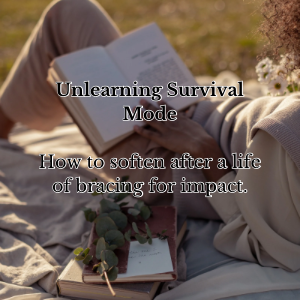
There’s a different kind of healing that comes after you understand survival mode. It’s the part that feels unfamiliar quiet, slow, uncertain. It’s the moment your body asks a new question:
“What do I do now that I’m no longer in danger?”
For those of us who grew up in chaos, unpredictability, or fear-based religion, softness is not natural.
Softness feels like risk. Softness feels like exposure. Softness feels like something that can be taken advantage of. But this next chapter of the healing journey? This is where we learn softness again not as weakness, but as safety.
When Your Body Doesn’t Know You’re Safe Yet
Survival mode doesn’t shut off just because life gets calmer. Your body can be in a peaceful environment, but your nervous system is still scanning for danger because:
- calm was never familiar
- silence meant someone was mad
- peace meant the storm was coming
- emotions weren’t safe
- questioning was disrespect
- relaxation felt irresponsible
So you grow up and:
- brace for impact even when no one is yelling
- stay guarded even in healthy relationships
- overthink everything
- get loud to protect yourself
- feel uncomfortable when someone treats you gently
- struggle to trust your own decisions
- keep waiting for something to go wrong
This isn’t you being “dramatic.” This is your body remembering. Survival rewires the nervous system. Safety has to be relearned.
Growing Up With Fear-Based Religion in Black/Brown Homes
Let’s talk about the part most people avoid: Religion wasn’t always a comfort. Sometimes, it was another source of fear. And in many Black and Brown homes, religion showed up like this:
- obedience over understanding
- fear over relationship
- silenced emotions over expressed emotions
- control over communication
- “because the Bible says so” instead of “let’s talk about it”
Adults rarely modeled the compassion they preached. Parents used scripture as a shortcut for accountability. Questions were treated as rebellion. Feelings were labeled sinful. Children learned to obey, not to trust themselves. And here’s the truth nobody said out loud:
When love is taught through fear, you grow up believing fear is normal in relationships.
When God is presented as punishment, you grow up second-guessing your worth.
When “respect” means silence, you grow up losing your voice.
This is the religious trauma no one talks about not losing faith, but losing the ability to feel safe inside your own beliefs.
How Survival Mode Shows Up in Adult Relationships
When you’ve lived your entire life in protection mode, even kindness feels suspicious.
Survival mode shows up like:
- expecting rejection
- overexplaining yourself
- getting defensive fast
- shutting down when you feel vulnerable
- staying hyper-independent
- choosing emotionally unavailable partners
- mistaking intensity for love
- feeling unsafe in calm relationships
- parenting from fear instead of guidance
And here’s the hardest part: Your body reacts before your mind has time to think. That’s what survival mode does. It protects. Even when you don’t need protecting anymore.
How to Relearn Softness When Your Body Resists It
Softness is a skill. And like any skill, it can be practiced and relearned.
Here’s how you begin:
Slow your body first.
Softness starts in the nervous system, not the mind.
Deep breathing.
Long exhales.
Warm showers.
Quiet moments.
Let your body know you’re okay.
Create small moments of safety.
Not big changes small ones:
drinking water slowly
putting your hand on your chest
unclenching your jaw
lowering your voice
pausing before you respond
Your nervous system trusts what you repeat.
Let yourself receive.
Compliments.
Support.
Help.
Gentle love.
Even if it feels uncomfortable at first let it land.
Question the fear-based beliefs.
Ask:
“Is this God… or is this someone’s control speaking through me?”
“Is this my truth… or my childhood programming?”
“Does this belief bring peace… or fear?”
Healthy faith does not require fear to function.
Practice soft responses.
Not because you’re weak but because softness interrupts survival mode.
Give yourself permission to trust yourself.
Your intuition is not rebellion.
Your voice is not disrespect.
Your questioning is not sin.
Your boundaries are not disobedience.
Softness comes back when self-trust comes back.
Rebuilding Your Faith Without Fear
Healing doesn’t mean abandoning faith. It means unlearning the fear-based version you inherited.
You get to rebuild your relationship with God or spirituality:
- without shame
- without fear
- without manipulation
- without losing yourself
You get to believe in a God who welcomes your emotions, your questions, your boundaries, your growth.
A God who doesn’t require you to shrink to be loved. You get to unlearn the idea that love must hurt. You get to unlearn the belief that obedience equals silence. You get to unlearn using fear to guide your decisions.
Your faith can be soft.
Your faith can be healing.
Your faith can be your safe place.
Lily’s Note
Hey love,
Softness is not weakness.
Softness is what your heart has been craving since the world first taught you to harden.
You are not wrong for wanting gentleness.
You are not wrong for wanting peace.
You are not wrong for questioning the beliefs that made you fear yourself.
You deserve a life where your shoulders can finally drop.
Where your breath isn’t always caught in your chest.
Where your voice doesn’t tremble from bracing for impact.
Unlearning survival mode isn’t about forgetting your past. It’s about choosing a future where your body no longer has to live like it.
You are safe to soften now. Let your healing meet you where fear once lived.
With love,
Lily

Reflection Questions
- What does my body do when it’s trying to protect me?
- What beliefs about myself came from fear, not truth?
- What religious messages shaped me in a negative way?
- What does softness look like in my daily life?
- When do I feel most safe and why?
- What is one small practice I can do today to tell my nervous system: “We’re safe now”?
If this blog touched something in you if it reminded you of your own story, your mother, your daughter, or the parts of yourself you’re still learning to love I want you to know you’re not alone. Healing doesn’t happen in one day, or in one conversation. It happens in small moments of awareness… just like this one.
If you’re ready to go deeper, my healing journal Blurred Lines Between Us was created to guide you through the next steps with compassion, clarity, and real tools you can use in everyday life.
Inside you’ll find:
- emotional regulation practices
- mother–daughter connection prompts
- nervous system resets
- personal reflection exercises
- gentle guidance from Lily
- space to understand your story without judgment
✨ You can purchase your copy here: CLICK HERE
And before you go I would love to hear from you. Your thoughts. Your reflections. Your “this is me” moment. Drop a comment below and let me know what part of this blog resonated with you the most.
Your words might be exactly what someone else needs to read today.
With softness and growth,
La’Jon
Comments ()