
There is an idea we often attach to grief: that enough time will eventually make it go away.
We expect the hardest days to happen in the beginning. Then, little by little, we’re supposed to hurt less, think about it less, and eventually reach some invisible point where we’ve “moved on.”
But adoption grief doesn’t always work that way.
For a birth mother, placement may happen on one particular day, but the emotions connected to that decision can continue changing throughout her life.
I know that because I’ve lived it.
There have been periods of my life when the grief wasn’t at the front of my mind. Life continued. I raised other children. There were ordinary days, happy days, busy days, and years of experiences that had nothing to do with adoption.
But continuing to live my life didn’t erase what happened.
Sometimes the grief returned because of something obvious—a birthday, a holiday, or another milestone. Other times, it came from something I never could have predicted.
That’s one of the things people don’t always understand about adoption grief.
Time can change grief without eliminating it.
Something that was unbearable in the beginning may eventually become something you can carry. Then years later, you may encounter a new stage of life and discover a completely different part of that grief.
It doesn’t mean you’ve gone backward.
It doesn’t mean you haven’t healed.
It means your relationship with what happened is continuing to change as you change.
And adoption creates an especially complicated kind of grief because the person you’re grieving isn’t necessarily gone.
A birth mother can love her child, know her child is living a life somewhere else, feel happiness about things happening in that child’s life, and still grieve what she herself is missing.
Those feelings don’t cancel one another out.
Gratitude doesn’t erase grief.
Love doesn’t erase loss.
And healing doesn’t require pretending either one disappeared.
That’s why I don’t think birth mothers should be expected to reach some imaginary deadline when adoption is no longer supposed to affect them.
There isn’t a six-month mark.
There isn’t a five-year mark.
There isn’t even a twenty-year mark when someone gets to say, Surely you should be over this by now.
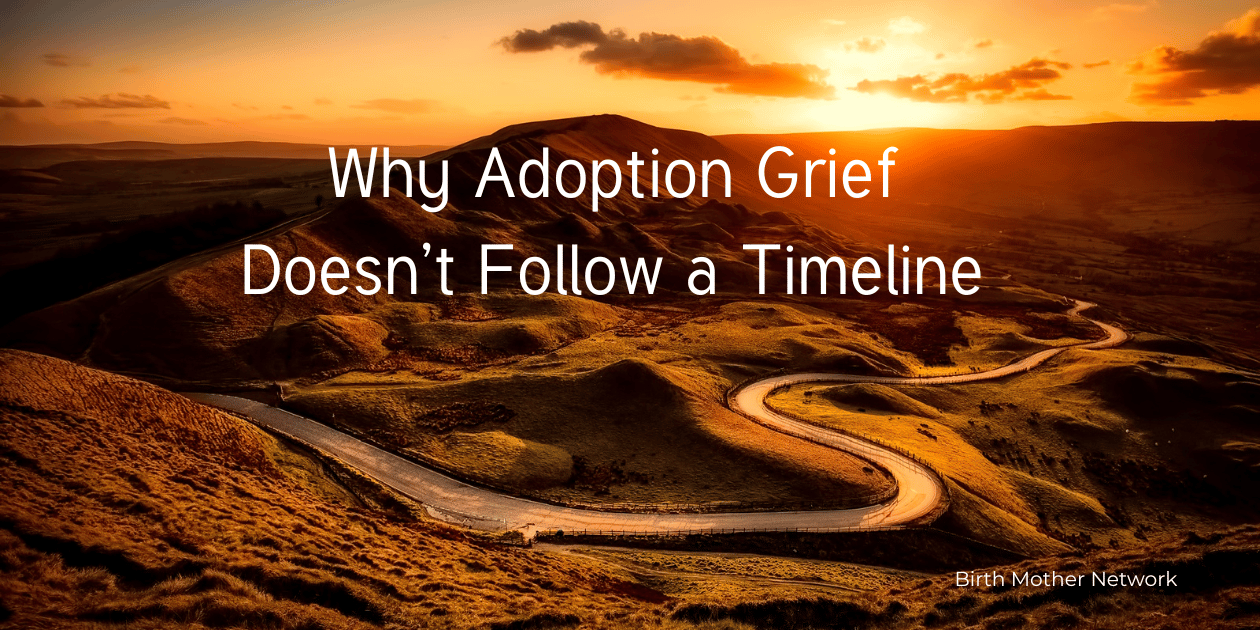
There are simply different parts of the road.
Some stretches are easier. Some are harder. Some twists you can see coming, while others appear without warning.
And sometimes you may look back and realize you’ve traveled much farther than you thought—even though you still can’t see exactly where the road leads.
Healing doesn’t always mean reaching the end.
Sometimes it means learning how to keep moving while making room for everything you still carry.
And no birth mother should have to navigate that lifetime alone.
— Birth Mother Network