
• Colour Stories • Art history & colour science
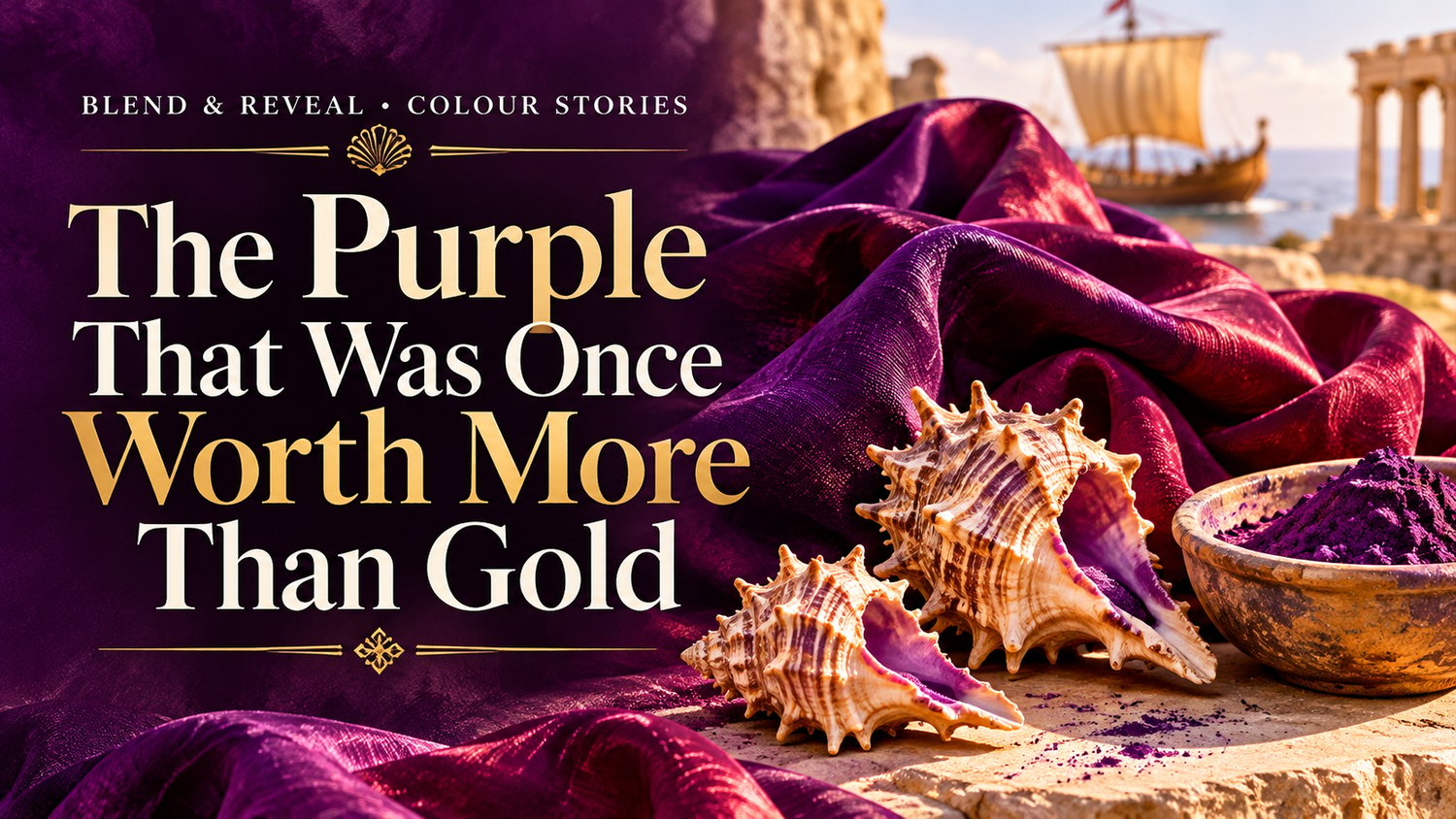
How sea snails, ancient Mediterranean craftspeople and an extraordinary chemical transformation created one of history’s most coveted colours.
Imagine a colour so desirable that powerful rulers wanted it for themselves. A colour that could travel across the Mediterranean as an expensive luxury. A colour whose ingredients came not from gemstones or flowers—but from small sea snails.
That colour was Tyrian purple, sometimes called royal purple or shellfish purple.
Today, we can pick up a tube of purple paint in seconds. But in parts of the ancient Mediterranean world, creating a richly purple-dyed textile demanded remarkable labour, specialised knowledge and access to marine life. The story of Tyrian purple is therefore about much more than a pretty hue. It is about chemistry, trade, identity and the extraordinary value that people can assign to colour.
And its most fascinating secret is this: the famous purple did not simply exist, ready-made, inside the snail.
A colour with a remarkable price tag
The Smithsonian’s National Museum of Natural History reports that producing a single gram of purple pigment may have required approximately 10,000 marine snails, and that the dye could command a price of up to three times its weight in gold in the Roman world. Those are historical estimates, not a fixed price that applied to every era or every piece of cloth. Even allowing for uncertainty, the scale of the work helps explain the colour’s extraordinary reputation. Source: Smithsonian National Museum of Natural History.
A different, well-documented illustration comes from 1909. The chemist Paul Friedländer processed around 12,000 snails to obtain only 1.4 grams of purified purple pigment during his research into its chemical identity. That was an experimental extraction, not a universal recipe for ancient production, but it makes the problem of scale vivid. Source: Molecules, 2010.
The resulting dye was sought after in part because its colour could persist on textiles. Its scarcity, complicated manufacture and associations with rank all helped turn it into a luxury. Source: Smithsonian.
In other words, people weren’t just paying for purple. They were paying for the knowledge, the effort and the social meaning woven into the fabric.
Why is it called Tyrian purple?
The name points to Tyre, an ancient Mediterranean coastal city in what is now Lebanon.
Tyre became closely associated with the Phoenicians, skilled maritime traders whose networks carried goods, ideas and craft traditions throughout the region. Purple-dyed textiles became one of the luxury products linked to this world of seaborne commerce.
However, the story did not begin with one person having a single flash of inspiration in Tyre. Evidence for shellfish-purple production reaches into the Bronze Age Mediterranean, and researchers have identified related dyeing traditions and archaeological traces in more than one place. Calling it Tyrian tells us about a famous centre of production, not an absolutely certain moment of invention. Sources: University of Chicago Library, scientific review.
That distinction matters. The history of colour becomes more interesting, not less, when we allow different cultures and centuries to be part of the picture.
The unexpected ingredient: three kinds of sea snails
The famous dye came from several marine snail species. Among those named in the Smithsonian’s research are:
- Bolinus brandaris — historically also called Murex brandaris.
- Hexaplex trunculus — historically called Murex trunculus.
- Stramonita haemastoma — another shellfish associated with Mediterranean purple dyeing.
These are not ordinary garden snails. They are marine gastropods, and specialised tissues in their bodies contain chemical precursors from which coloured substances can develop. Source: Smithsonian National Museum of Natural History.
Imagine the scale of collecting, handling and processing thousands of tiny sources of colour. Then consider that textile dyeing required controlled conditions and craftsmanship to achieve a desirable result.
It was an industry, not a casual craft experiment.
The real magic: how something nearly colourless became purple
Here is the reveal that makes Tyrian purple so extraordinary.
The finished purple dye was not stored inside the animal as a jar of purple paint. Instead, secretions from particular glands contained chemical precursors. When those substances were processed and exposed to the right conditions, reactions produced coloured compounds.
The major colourant of the famous dye is called 6,6′-dibromoindigo—a relative of the indigo family of colourants. Researchers also identify other related compounds in some shellfish-derived mixtures. The mixture and the method affect the appearance. Source: chemical review in Molecules.
Air, light and the chemistry of the dye bath could all matter. Ancient accounts describe prolonged, labour-intensive processing, while modern science has helped explain why some stages work. But the exact techniques of every historical workshop have not survived intact.
One beautiful detail is that the colour could develop through transformation, rather than simply being squeezed out of something already purple.
For a modern artist, that idea feels wonderfully familiar: the most memorable colour reveals sometimes happen only after two or more materials interact.
Was Tyrian purple actually the purple we imagine today?
Not necessarily. And this may be the biggest surprise of all.
When someone says royal purple, you might picture a single deep violet: dark, dramatic and slightly blue.
But historical shellfish-purple textiles were not one universally standardised colour. Researchers have found that shellfish species, mixtures of colouring compounds, exposure to light, processing methods and the textile being dyed can shift the final appearance.
Some results lean reddish-purple or wine-coloured. Others can lean violet or bluer. Source: research on ancient dye compounds and colour variation.
This means there is no single trustworthy HEX code that reproduces all ancient Tyrian purple. A digital swatch might be a lovely modern interpretation, but it is not a scientific colour measurement of the entire historical tradition.
And that is important for Blend & Reveal: a colour can carry a historical name while still having a family of possible appearances.
How purple became a language of power
Purple’s value was never only about chemistry.
In Greek, Roman and later Byzantine settings, highly prized purple textiles became associated with rulers, status and privilege. Some forms of purple clothing or decoration were restricted by law or custom in particular periods; the rules changed over time, so it would be misleading to say that only kings could ever wear any purple.
The underlying message was clear: rare materials could make power visible.
Picture an expensive length of purple cloth among more commonly available garments. Anyone familiar with its cost and significance would understand that it communicated wealth or authority even before the wearer spoke.
That history helps explain why purple is still frequently used to suggest luxury, mystery and grandeur in branding and design. These associations have changed and spread across cultures, but the old royal story remains influential.
Sources: The George Washington University Museum and The Textile Museum; University of Chicago Library.
Why didn't people simply mix red and blue dye?
They sometimes did.
Historical dyers produced purple hues by combining a red dye, such as madder, with a blue dye, such as indigo or woad. The Smithsonian notes that some surviving historic purple fabrics were made this way. Source: Smithsonian.
But making a purple-looking fabric and making genuine shellfish-purple dye were not the same thing. The chemistry, manufacturing process, colour properties and prestige associated with the materials differed.
It's rather like making two modern paint swatches that appear almost identical on a screen but are created from different pigments. They may look similar under one condition and behave differently in mixing, transparency or lightfastness.
The appearance of a colour is only part of its identity. The material matters too.
The science finally caught up with the ancient craft
For centuries, the exact chemical character of shellfish purple remained mysterious.
In 1909, Paul Friedländer’s research established the identity of the major purple compound as 6,6′-dibromoindigo. Later researchers used improved analytical methods to identify additional related colourants and investigate surviving dyed objects.
Today, chemists can study—and even produce—the molecule without needing to recreate the ancient marine harvesting process. A 2020 study, for example, investigated biological production pathways for the Tyrian purple dye compound. Sources: historical chemistry review; Nature Chemical Biology.
Yet the story is still evolving. Scientists can identify molecules much more confidently than they can recreate every visual detail of a specific ancient garment after thousands of years.
That's the difference between understanding a colourant and recovering a completely exact historical colour experience.
Your artist's studio: mixing a modern royal-purple palette
You do not need shellfish to explore colours inspired by this history. Modern acrylic, oil, gouache and watercolour paints can create beautiful purple families with readily available artist pigments.
A particularly useful starting combination is:
Quinacridone Magenta + Ultramarine Blue
Artist paint maker GOLDEN has demonstrated this violet-friendly combination in its colour-mixing guidance. Adjusting the balance creates purples that lean warmer or cooler
Try making three interpretations inspired by the story, rather than pretending there was one definitive ancient shade:
1. Royal Plum — a red-leaning purple
Start with more Quinacridone Magenta than Ultramarine Blue. Introduce the blue gradually until the colour becomes a rich, wine-like plum. Keep a separate small swatch so you can compare it after drying.
2. Imperial Violet — a blue-leaning purple
Begin with your original mixture and add a little more Ultramarine Blue. Stop when the colour feels noticeably cooler but still reads as violet instead of blue.
3. Antique Amethyst — a muted purple
Make a separate purple mixture, then add a trace of Yellow Ochre to lower the chroma. This is intentionally a modern, muted interpretation—not a historically verified Tyrian dye formula.
Useful reminders:
- Begin with tiny adjustments. Pigments and brands have different tinting strengths.
- In acrylic, oil or gouache, a small amount of white can create a lighter tint, but it also changes how saturated the purple appears.
- In transparent watercolour, use more water and allow the white paper to provide much of the lightness.
- Let your samples dry and compare the results in natural light.
- Label your actual paint brands and pigment codes if you want repeatable mixes.
This experiment is about creating a palette inspired by the history, not reproducing genuine shellfish dye or promising a precise ancient match.
A simple colour-story project to try today
Take one sheet of paper and divide it into four small swatch areas.
- The historical idea: Write Tyrian purple — a prized Mediterranean shellfish dye.
- The warm version: Mix and paint a red-leaning Royal Plum.
- The cool version: Mix and paint a blue-leaning Imperial Violet.
- The softened version: Create Antique Amethyst by gently reducing the chroma.
Beside each swatch, make a short note: What does this purple remind me of? What kind of painting, fabric or design would it suit?
Suddenly, you're doing more than choosing a colour. You're connecting colour history, pigment behaviour and personal creativity.
Questions people often ask about Tyrian purple
Was Tyrian purple really worth more than gold?
Some historical estimates put the dye's value above gold by weight, and the Smithsonian reports figures as high as three times its weight. That should be understood as an estimate for particular contexts, not an eternal market price.
Did Tyrian purple come from Tyre?
The name is strongly associated with Tyre, in modern Lebanon, but shellfish-purple production existed in the wider ancient Mediterranean. A single inventor or birthplace cannot be established with certainty.
Was it one exact shade of dark violet?
No. Species, chemical composition, methods and fabric could change the result, from redder purples to more bluish hues.
Can I make genuine Tyrian purple by mixing modern paints?
You can make beautiful visually inspired approximations, but mixing modern magenta and blue paints does not create the historical dye molecule or authenticate a historical colour match.
Why was it associated with royalty?
Its difficult production, rarity, desirable textile properties and role in social traditions made it a powerful marker of wealth and authority.
The colour was never just the colour
The most remarkable thing about Tyrian purple is not simply that it looked beautiful.
It is that so many human stories became attached to it: specialised craftspeople working with marine materials, merchants travelling between ports, rulers claiming visual symbols of status, and scientists centuries later trying to understand what made the dye possible.
A single colour carried biology, chemistry, economics, artistry and history within it.
The next time you mix a deep violet at your palette, look at the result for a moment before reaching for another tube. The colour may have taken you seconds to make—but its history reaches back thousands of years.
And sometimes, the most extraordinary thing about a shade isn't how it looks. It's the story it reveals.
Keep exploring colour with Blend & Reveal
If you enjoy discovering why colours behave the way they do, explore The Colour Companion: The Complete Colour Mixing Handbook for practical colour theory, pigment bias, mixing recipes and exercises you can use at your own palette.
You can also browse the full collection of Blend & Reveal colour guides and creative resources.
Blend & Reveal — Every shade has a story.
Research and further reading
- Smithsonian National Museum of Natural History — The History of the World in Seven Snails
- Smithsonian — Why Was Purple the Color of Royalty?
- University of Chicago Library — Tyrian Purple
- The George Washington University Museum and The Textile Museum — Color
- Cooksey, Tyrian Purple: 6,6′-Dibromoindigo and Related Compounds
- GOLDEN Artist Colors — Just Six Paints: The Almost Double-Primary Approach
© Blend & Reveal • Colour education & creative guides