
Oct 7, 2026 · @Blend&Reveal
Art is not a luxury. It is biology.
Most of us file art under "nice to have": a hobby for weekends, something we will get back to when life slows down. Neuroscience is quietly overturning that idea. A growing body of research shows that making art, even something as simple as colouring a page, measurably changes your stress hormones, your brain activity and, over the long run, your health.
This is the central argument of Your Brain on Art: How the Arts Transform Us, the New York Times bestseller by Susan Magsamen of the Johns Hopkins International Arts + Mind Lab and Ivy Ross, vice president of design for hardware at Google. Their book introduces many readers to neuroaesthetics: the study of how the brain and body respond to art, beauty and creative activity.
In this article we walk through what that science actually says, explain the brain mechanisms in plain language, and turn the findings into a simple daily practice you can start tonight with a set of pencils and a single page.
What happens in your brain when you make art
When you pick up a pencil and start filling in a shape, several brain systems switch on at once. Understanding them explains why colouring can feel so absorbing.
1. The reward system lights up. In a 2017 study published in The Arts in Psychotherapy, Drexel University researchers used fNIRS, a light-based brain imaging method, to watch 26 adults colour a mandala, doodle and free-draw for three minutes each. All three activities increased blood flow in the prefrontal cortex, an area tied to reward, emotion and motivation. Afterwards, participants also reported feeling more capable of having good ideas and solving problems. As lead researcher Girija Kaimal put it, there may be "inherent pleasure in doing art activities independent of the end results."
2. Attention narrows and steadies. Colouring asks your brain to do a manageable task: choose a colour, follow a line, fill a space. That gentle, sustained focus gives the executive attention network something calm to hold onto. The repetitive motion is similar to what happens in other rhythmic, mindful activities like knitting or slow breathing.
3. The worrying mind quietens. When we are not focused on a task, the brain's default mode network tends to wander into rumination: replaying the day, planning tomorrow, worrying. A simple, absorbing activity pulls attention away from that loop and into the present moment.
4. You can slip into "flow". Psychologist Mihaly Csikszentmihalyi described flow as the state of being fully absorbed in an activity that is challenging enough to hold attention but not so hard it causes frustration. A well-designed colouring page sits right in that sweet spot, which is why an hour can pass without you noticing.
45 minutes, any skill level: the stress evidence
The headline finding most people quote from Your Brain on Art comes from a 2016 study by Girija Kaimal, Kendra Ray and Juan Muniz, published in the journal Art Therapy.
- Who: 39 adults aged 18 to 59, nearly half of whom said they had little art experience.
- What: 45 minutes of free art-making with markers, paper, modelling clay and collage materials.
- Measured: cortisol, the body's main stress hormone, in saliva before and after.
- Result: about 75% of participants had lower cortisol after the session.
The most important detail is what did not matter: prior art experience made no difference. Beginners benefited as much as experienced artists. The point was never to make something beautiful. The point was to make something at all.
The researchers were careful to note that cortisol is not "bad". Some is essential for focus and energy, and a few participants' levels rose, which may reflect healthy engagement rather than stress. But for most people, three-quarters of an hour of hands-on creativity brought the body measurably closer to calm.
Why colouring works so well
Colouring is one of the most accessible forms of art-making there is. The lines are already drawn, so there is no blank-page anxiety and no fear of "getting it wrong". You only make small, pleasant decisions: which colour, which shape next. Researchers have tested it directly.
- Ten minutes a day for a week. In a 2017 randomized study at New Zealand's University of Otago, published in the Creativity Research Journal, 115 women either coloured for 10 minutes a day or worked on logic puzzles. After one week, the colouring group reported fewer symptoms of depression and anxiety. The puzzle group did not show the same change. The authors concluded that, given its low risk and accessibility, colouring belongs on "the growing list of creative activities for improving mental health outcomes."
- Mandalas and patterns. An early 2005 study by Curry and Kasser found that colouring a structured mandala or plaid pattern reduced anxiety more than free drawing on a blank page. Later studies, including Mantzios and Giannou (2018, Frontiers in Psychology), found the picture is more nuanced: both colouring and free drawing helped, and colouring with a mindful intention (noticing colours, breath and movement) helped most.
The honest takeaway: no single type of page is magic. What matters is the combination of gentle focus, repetition and choice, and above all doing it regularly.
The long view: art and a longer, healthier life
The effects are not only short-term. In 2019, the World Health Organization published a review of more than 3,000 studies on arts and health. It concluded that the arts play a major role in preventing ill health, promoting well-being across the lifespan, and helping people manage and recover from illness.
The same year, researchers Daisy Fancourt and Andrew Steptoe at University College London published a striking study in The BMJ. They followed 6,710 adults aged 50 and over in England for 14 years:
- People who engaged with the arts (galleries, museums, concerts, theatre) every few months had a 31% lower risk of dying during the study period.
- Even engaging once or twice a year was linked to a 14% lower risk.
These results held after accounting for wealth, health, age, mental health and physical activity. It is important to read this carefully: the study shows a strong association, not proof that art alone adds years to your life. But together with the hormone and brain-imaging research, it points in a clear direction.
This evidence is why several health systems, including the UK's NHS, now support social prescribing, where a doctor or link worker can refer a patient to an arts or community activity alongside conventional care. Closer to home, in 2018 the Montreal Museum of Fine Arts launched a pilot with Médecins francophones du Canada that let member physicians prescribe free museum visits to their patients.
Colour and emotion: what your palette does
At Blend & Reveal, colour is what we do every day, so we want to be precise here. Popular articles often claim that blue always calms and red always excites. The research is more interesting than that.
- Colour associations are real but personal. Studies across many countries find broad patterns, such as soft, light colours feeling gentle and saturated, warm colours feeling energetic. But culture and personal memory shape them strongly. Red can mean danger in one place and celebration in another.
- Choosing is part of the benefit. Deciding which colours go together gives you a small, low-stakes sense of control and creativity. That feeling of agency is one of the reasons art-making lifts mood.
- Blending holds attention. Layering one pencil over another and watching a new shade appear demands just enough focus to keep the mind in the present. It is the same small moment of surprise that makes colour-mixing videos so satisfying to watch.
So pick the palette that feels right to you today. There are no wrong colours, only different moods.
Your art prescription: a simple daily practice
You do not need a studio, talent or an hour of free time. Here is a realistic routine based on the studies above.
- Start with 10 minutes. The Otago study saw benefits from just 10 minutes a day. Set a timer if it helps, and stop when it rings if you want to.
- Work up to 45 minutes when you can. That is the session length linked to lower cortisol. A weekend afternoon or a quiet evening is perfect.
- Make it a ritual. Same chair, same time, a warm drink, phone face-down or in another room. Rituals tell the brain it is time to downshift.
- Pick the right level of challenge. On tired days, choose bold, simple shapes. On focused days, choose intricate mandalas or detailed scenes. Flow lives where difficulty matches your energy.
- Colour mindfully. Notice the sound of the pencil, the feel of the paper and the way two colours blend. Mindful attention was the strongest ingredient in the 2018 colouring study.
- Let go of the result. You are not making a masterpiece. The benefit comes from the process, which is why beginners gain as much as experts.
- Share it, if you like. Creativity is social. Showing a finished page to a friend, or online, adds a sense of connection and accomplishment.
What art can do, and what it cannot
The science on art and health is exciting, but it deserves to be stated honestly.
- Many studies are small (dozens of people, not thousands) and measure short-term effects.
- Large studies like the UCL research show associations, which means other factors may also play a part.
- Colouring and art-making are a complement to care, not a replacement for it. If you are living with depression, anxiety or chronic stress, please speak with a doctor or mental health professional. Creative activity can be a wonderful part of your toolkit alongside their support.
What the evidence does support clearly is this: creative activity is low-risk, low-cost, open to everyone regardless of skill, and for most people it measurably helps.
Your next 45 minutes
The message of Your Brain on Art, and of the research behind it, is simple: creativity is not a reward you earn after the important work is done. It is part of how a healthy brain and body work. You do not need talent. You need a page, a few colours and a little time that belongs only to you.
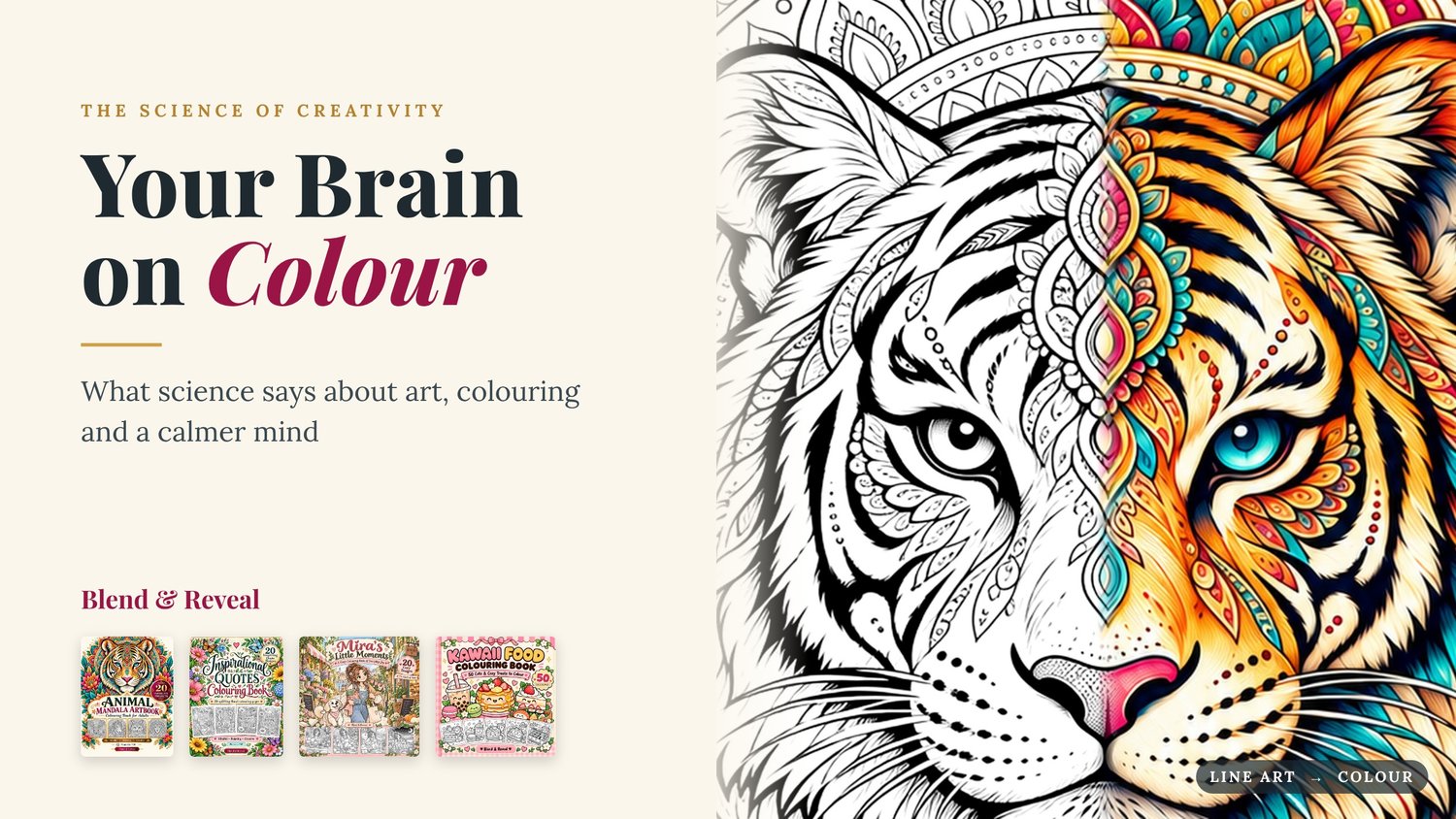
If you would like a place to start, our printable colouring books were made for exactly this kind of slow, joyful practice:
- Animal Mandala Artbook: 20 intricate animal mandalas for deep, absorbing focus.
- Inspirational Quotes Colouring Book: 20 floral quote pages to colour words worth keeping.
- Mira's Little Moments: 20 cozy seasonal scenes of everyday joy.
- Kawaii Food Colouring Book: 50 cute treats, from easy bold pages to detailed cozy scenes.
You will find them all at payhip.com/BlendandReveal. Print a page tonight, put your phone away, and give your brain the gift of colour. When you finish, share it and tag @blendandreveal. We would love to see what you create.
This article is for general information and education. It is not medical advice.
Sources
- Magsamen, S. & Ross, I. (2023). Your Brain on Art: How the Arts Transform Us. Random House.
- Kaimal, G., Ray, K. & Muniz, J. (2016). Reduction of cortisol levels and participants' responses following art making. Art Therapy. Drexel University summary
- Kaimal, G. et al. (2017). Functional near-infrared spectroscopy assessment of reward perception based on visual self-expression. The Arts in Psychotherapy. Drexel University summary
- Flett, J., Lie, C., Riordan, B. et al. (2017). Sharpen your pencils: preliminary evidence that adult coloring reduces depressive symptoms and anxiety. Creativity Research Journal. Otago Daily Times summary
- Mantzios, M. & Giannou, K. (2018). When did coloring books become mindful? Frontiers in Psychology. Full text
- Fancourt, D. & Steptoe, A. (2019). The art of life and death: 14 year follow-up analyses of associations between arts engagement and mortality. The BMJ. UCL summary
- Fancourt, D. & Finn, S. (2019). What is the evidence on the role of the arts in improving health and well-being? A scoping review. World Health Organization. WHO Europe
- Montreal Museum of Fine Arts and Médecins francophones du Canada museum prescription pilot (2018). CBC News