
How to Improve Your Business English at Work Without Memorising Endless Vocabulary Lists
"I know the words... but I can't think of them when I need them."
If that sounds familiar, you're certainly not alone.
Many professionals spend years learning English. They attend Business English courses, read articles, make vocabulary lists, use language apps and fill notebooks with new expressions. Yet when they need to contribute during an important meeting, negotiate with an international client or explain a complex idea, the words seem to disappear.
Why?
Because learning vocabulary is not the same as being able to use it.
As a Business English Coach and certified Neurolanguage® Coach, I hear this challenge almost every day. Professionals often believe they need to learn more English, when in reality they need to learn English in a way that works with their brain rather than against it.
Traditional language learning encourages us to memorise long lists of vocabulary. Twenty new words. Thirty business expressions. Pages of synonyms. The intention is good, but the approach often isn't. Neuroscience has shown that our working memory has limited capacity. When we overload it with too much new information at once, our brain struggles to organise, store and retrieve that information when we need it most.
This is why you may recognise a sophisticated Business English expression when reading an email, yet struggle to recall it during a meeting. It isn't because your English isn't good enough. It's because your brain wasn't designed to memorise endless vocabulary lists.
Instead, your brain learns much more effectively when information is presented in small, meaningful chunks and connected to a real-life context. This principle forms the foundation of Neurolanguage® Coaching and is one of the reasons why I developed my Business English Fluency Cards.
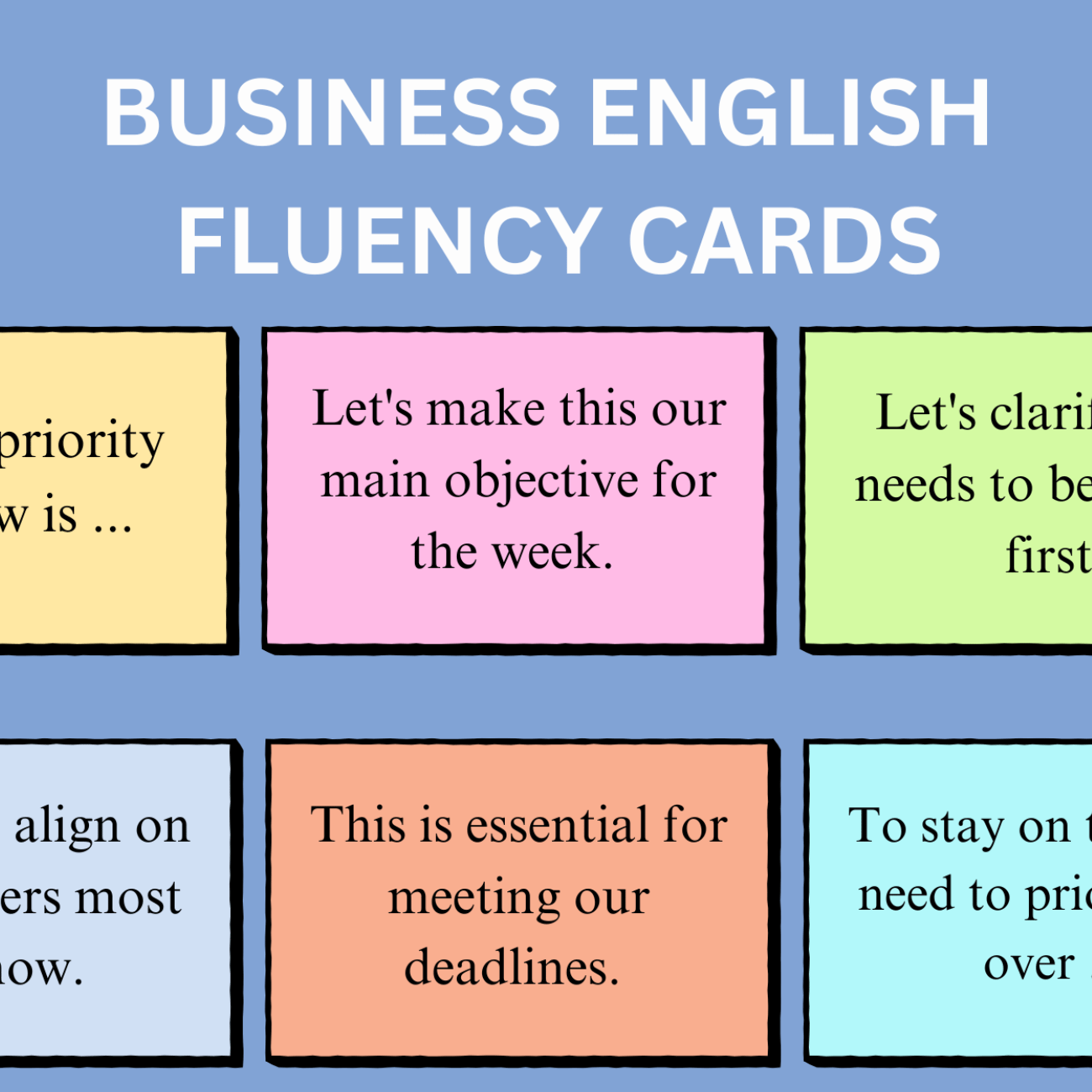
Rather than asking professionals to memorise hundreds of unrelated expressions, each fluency card focuses on one specific workplace situation and introduces just six carefully selected Business English phrases. Whether you're presenting results, negotiating with a client, handling conflict diplomatically, clarifying misunderstandings or explaining the benefits of a proposal, the expressions are grouped together because they belong to the same professional context.
This approach makes a significant difference. Your brain naturally creates stronger neural connections when new language is linked to situations you experience every day. Instead of remembering isolated words, you remember conversations. Instead of translating in your head, you begin to retrieve complete expressions that fit the situation.
Another important reason why professionals struggle to become fluent is forgetting. Without regular retrieval and repetition, newly learned vocabulary gradually fades from memory. Many people recognise this feeling. They learn dozens of useful expressions during a course, only to realise a few weeks later that they can't remember most of them.
The solution isn't to study harder. It's to study smarter.
Because each Fluency Card contains only six expressions, it becomes easy to review them regularly. You can spend five minutes before work reading one card, revise another during your lunch break, or consciously use one new expression in your next online meeting. These small, consistent learning moments strengthen your memory far more effectively than one long study session once a week.
Over time, something remarkable happens. The expressions become familiar. Then they become natural. Eventually, they become part of your own professional vocabulary.
This is often the difference between an upper-intermediate (B2) speaker and an advanced (C1) communicator. The difference isn't usually grammar. It's having immediate access to professional language at exactly the right moment.
Instead of saying "The numbers are good," you naturally say, "Overall, the figures are in line with our expectations."
Rather than saying "There is a problem," you explain, "The results highlight a few areas of concern." These are the kinds of expressions that make you sound more polished, confident and credible in international business.
My Business English Fluency Cards (C1–C2) were created specifically for busy non-native professionals who want to improve their English communication at work. The collection contains 162 workplace-focused cards covering 25 essential Business English topics, including asking for and checking data, giving results, negotiating and persuading, handling conflict, sounding more diplomatic, strengthening your arguments, explaining benefits, concluding positively and discussing priorities.
The cards can be used independently or as part of my one-to-one Business English coaching sessions. Together, they combine practical Business English with principles from neuroscience and Neurolanguage® Coaching, helping professionals remember vocabulary more effectively, recall it faster and use it confidently in real workplace conversations. Business English Fluency Cards - Payhip
Whether you're looking for a Business English course, Business English coaching, or practical English for work, lasting progress doesn't come from memorising hundreds of new words. It comes from learning language in context, revisiting it regularly and applying it in meaningful professional situations.
Fluency isn't built overnight. It's built one conversation, one meeting and one expression at a time.
Because true Business English fluency isn't about knowing more English.
It's about confidently using the English you already know, and adding new professional expressions in a way your brain can genuinely remember.
Thank you for reading this article.
Until next time,
Keep learning.
Monika Brabers
For more information about my Business English Coaching visit my website:
Cursus zakelijk Engels in Den Bosch - 1-op-1 Lessen | Fluency & Beyond www.fluencyandbeyond.nl
Email me: mbrabers@planet.nl
Business English Coaching in s-Hertogenbosch and online.
Connect with me on LinkedIn