
You created the product. You built the business. But when it's time to sell, you hesitate. Here's how to start promoting your offers with more confidence.
Have you ever written a promotional post, read it over several times, and then decided not to publish it?
Maybe you worried that people would think you were only interested in making money.
Perhaps you thought your followers would get annoyed if you mentioned your product again.
Or maybe you imagined someone judging your offer, questioning your price or scrolling past without buying.
So you deleted the post, changed the subject and went back to sharing free content.
You told yourself you would promote your business tomorrow.
If this sounds familiar, you're not alone in experiencing these concerns. Selling can feel uncomfortable when you're worried about how other people will respond.
But here's something worth remembering:
You can sell your products without being pushy, and you don't have to wait until you feel completely confident to start.
Why selling can feel so uncomfortable
When you run an online business, promoting your products means putting your work in front of other people.
You're not just sharing a product. You may feel as though you're exposing your ideas, your skills, your prices and even your credibility to judgement.
That can make selling feel much more personal than it needs to be.
Here are four common reasons business owners avoid promoting their offers.
1. You're worried about annoying your audience
You don't want people to unfollow you, mute your posts or think you're constantly trying to sell them something.
So you share helpful information, motivational quotes and educational content, but rarely mention what you actually offer.
The problem is that people cannot buy from you if they don't know what you sell or how it could help them.
You can provide value and promote your products. These activities don't have to compete with each other.
2. You're afraid people will judge you
Perhaps you worry that someone will think your product isn't worth the price.
Maybe you wonder what friends, family or former colleagues will say when they see you promoting your business.
You might even question whether you're experienced enough to charge for your knowledge.
These thoughts can make you second-guess every post.
Instead of trying to convince yourself that nobody will ever judge you, focus on communicating honestly with the people your offer is designed to help.
You don't need universal approval to run a business.
3. You're afraid of rejection
You publish a promotional post and nobody buys.
You share your offer and receive no comments.
You put yourself out there and hear nothing back.
It's easy to interpret that silence as a personal rejection.
But a person not purchasing doesn't automatically mean your product is bad or that you aren't capable of selling.
They may not need it right now. They may not understand its value yet. They may not be the right customer. Your message, offer or reach may also need improvement.
A lack of sales is information you can investigate, not a verdict on your worth.
4. You don't know what to say
You know you need to promote your offer, but every sales message sounds awkward when you write it.
You don't want to sound desperate, overly enthusiastic or like someone using a script that doesn't feel natural.
So you spend ages rewriting your caption, avoid making a clear offer and hope people will somehow discover your product.
The solution isn't necessarily to become a naturally persuasive salesperson.
Sometimes, you simply need a straightforward structure and words you feel comfortable using.
You don't have to sell by pressuring people
Let's change the way you think about selling.
Instead of asking, "How do I convince people to buy my product?"
Try asking, "How can I help the right person understand whether my product is useful for them?"
That small shift changes the purpose of your message.
You're not trying to force someone into making a purchase. You're explaining what you offer, who it helps, what it includes and how someone can buy if it meets their needs.
Good selling makes the decision clearer. It doesn't remove the customer's freedom to say no.
Here are three ways to promote your business without feeling pushy.
1. Lead with the problem you solve
Rather than immediately talking about your product, start with a challenge your audience recognises.
For example:
"Do you struggle to promote your digital products because you don't want to sound pushy?"
Then explain one useful idea and introduce your offer as a possible next step.
This approach connects your product to a real need instead of making every post feel like a sales pitch.
2. Explain the value clearly
Don't assume people understand what your product does just because you know how much work went into creating it.
Explain what customers receive, how they might use it and which problem it is designed to help solve.
For example, instead of saying, "My new business toolkit is available," you could say:
"If you struggle to find the words to promote your products, this toolkit includes ready-to-use sales scripts and prompts to help you explain your offer, answer common questions and invite people to buy."
Specific information helps people decide whether the product is right for them.
3. Make a clear, low-pressure invitation
You don't need to apologise for selling.
You also don't need to pressure people into buying.
Try language such as:
- "If this is something you're working on, here's a resource that may help."
- "You can explore the toolkit here if you'd like support with this."
- "If you're ready to take the next step, you can find all the details here."
You can be direct about the offer while leaving the decision with the customer.
Five sales scripts you can use today
If you find yourself staring at a blank screen every time you need to promote your business, start with these simple scripts.
Script 1: The problem-aware post
"If you've been struggling with [specific problem], I created [product name] to help you [specific benefit]. It includes [key features] so you can take a more practical approach. You can find out more here: [link]."
Script 2: The educational post
"One thing that can make [desired outcome] easier is [helpful tip]. If you want more support putting this into practice, [product name] gives you [specific resources or guidance]. Details here: [link]."
Script 3: The product introduction
"Let me introduce you to [product name]. It's designed for [target audience] who want to [desired outcome] without [common frustration]. Inside, you'll find [key inclusions]. Explore it here: [link]."
Script 4: The objection-handling post
"Wondering whether [product name] is right for you? It's designed for [intended customer] and includes [specific features]. Here's what it can help you work on, and what you'll receive: [details and link]."
Script 5: The gentle follow-up
"Hi [name], I wanted to follow up on your interest in [product or service]. Is there anything you'd like me to clarify? No pressure either way — I'm happy to answer your questions."
Use these scripts as starting points, not words you must copy exactly. Adapt them to your voice, your product and your audience.
How to build confidence through action
Confidence doesn't always arrive before you take action.
Sometimes, it develops because you take action repeatedly and discover that you can handle the outcome.
You publish a post and realise the world doesn't end.
You explain your product and learn how to communicate its value more clearly.
Someone asks a question, and you practise answering it.
Someone says no, and you learn to respect their decision without treating it as a personal failure.
You begin to understand that selling is a business skill you can practise, rather than a personality trait you either have or don't have.
Start small.
Choose one product. Write one honest promotional message. Publish it. Give people a clear next step.
Then reflect on what you learned.
You don't have to turn every conversation into a sale. You simply need to become more comfortable letting people know how you can help.
 Your challenge: Promote one offer today
Choose an existing product or service you want more people to discover.
Then answer these questions:
- Who is this product designed to help?
- What problem does it address?
- What will the customer receive?
- Why might it be useful to the right person?
- How can someone find out more or buy it?
Use your answers to write a short promotional post.
Keep it honest. Keep it clear. Don't spend an hour trying to make every word perfect.
Then publish it.
Your goal isn't to guarantee a sale today. Your goal is to practise promoting your offer instead of automatically avoiding it.
Ready to stop avoiding sales?
If fear of judgement, rejection or sounding pushy has been keeping you from promoting your online business, you don't have to figure out every sales message from scratch.
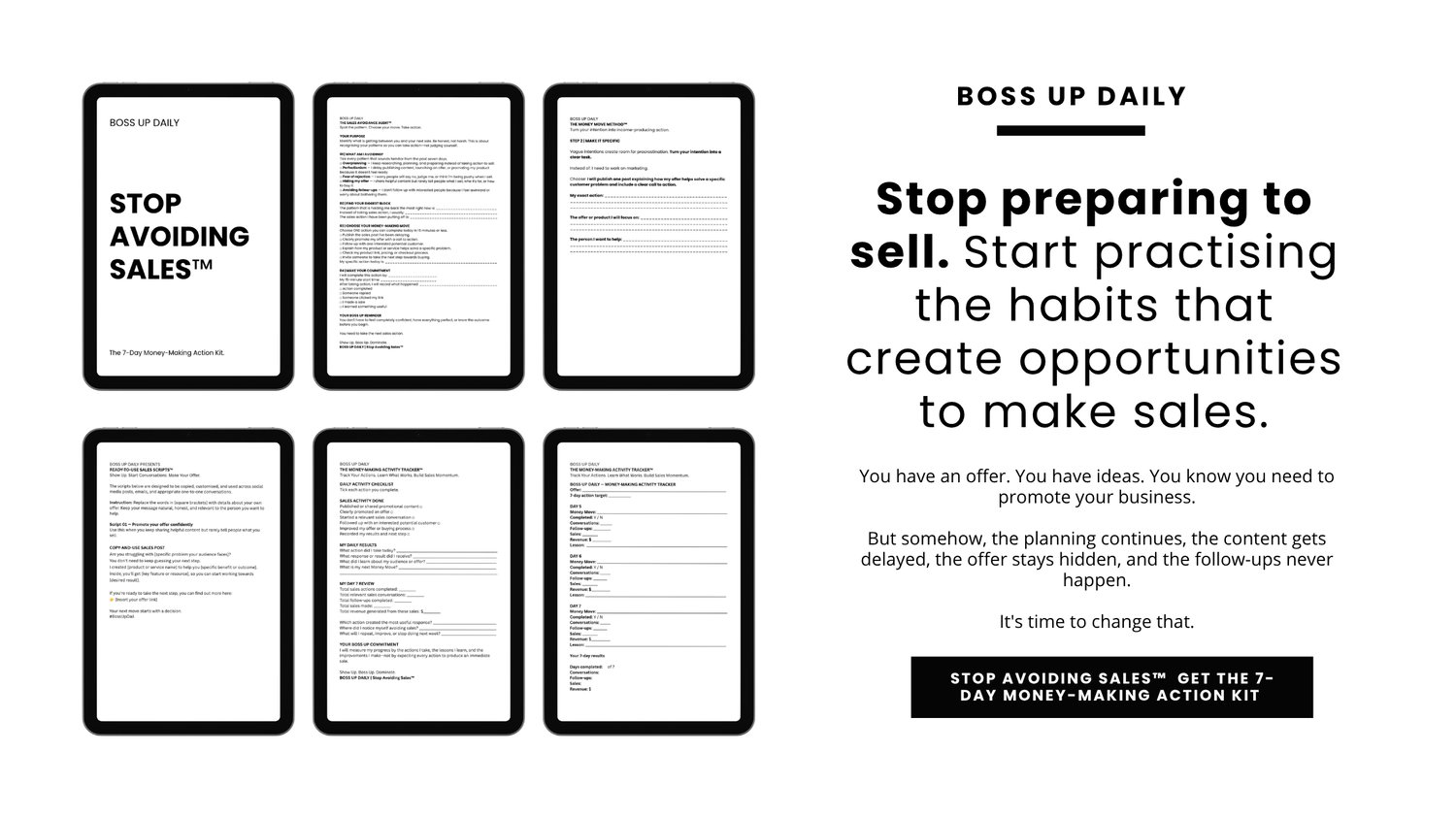
Stop Avoiding Sales™ — The 7-Day Money-Making Action Kit is designed to help you identify your sales-avoidance habits and take practical steps towards more consistent selling.
Inside, you'll find:
- The Sales Avoidance Audit to help you recognise what's holding you back.
- The Money Move Method™ to help you choose a focused daily action.
- Ready-to-use sales scripts for promoting offers, explaining value, answering objections and following up.
- The seven-day sales action challenge to help you practise taking action.
- The Money-Making Activity Tracker to record your actions and review your results.
It's for online business owners who want to stop overthinking every promotional post and start communicating their offers with greater clarity.
Suggested price: $19.99 AUD.
You don't need to become pushy. You don't need everyone to approve of you. And you don't need to wait until every doubt disappears.
You can learn to sell in a way that feels honest, helpful and aligned with your business.
Stop preparing to make money. Start taking action to sell.
Show Up. Boss Up. Dominate.
Explore Stop Avoiding Sales™ — The 7-Day Money-Making Action Kit.
Comments ()