
You promote your offer for a few days, wait for sales, get discouraged and disappear back into planning. Here's how to break the cycle and build a more consistent sales routine.
You decide that this is the week you're going to take your online business seriously.
You're going to promote your products, show up consistently and finally get some sales momentum going.
You write a promotional post. You share your offer. You create content explaining what you sell.
You check your notifications.
Nothing.
You try again the next day. Still no sales.
A few days pass, and you start questioning everything.
Maybe the product isn't good enough. Perhaps the price is wrong. Maybe your audience isn't interested.
You might even wonder whether you're wasting your time.
So you stop promoting.
Instead, you return to planning. You research new strategies, rethink your offer, work on another product or decide you need a completely different approach.
Then, a week or two later, you feel motivated again.
You start promoting.
And the cycle repeats.
If this sounds familiar, the problem may not be that you don't know how to sell. It may be that you haven't developed a consistent way to keep selling when the results aren't immediate.
An online business needs more than occasional bursts of promotion. It needs a repeatable sales habit.
Why you stop selling when nobody buys
Selling online can be emotionally challenging because you put effort into an action without knowing exactly what will happen next.
You publish a post, but you can't control how many people see it.
You share a product, but you can't control whether someone purchases it.
You spend time explaining your offer, but you can't force a customer to make a decision.
When sales don't happen quickly, it's tempting to interpret the silence as evidence that something is wrong.
Sometimes your offer or messaging does need improvement. Sometimes you need more relevant traffic, a clearer customer benefit or a better understanding of what your audience wants.
But sometimes, you've simply stopped before you've gathered enough useful information to understand what's happening.
When you disappear from your sales activities every time results disappoint you, you make it harder to build momentum, learn from your audience and identify which approaches deserve more attention.
The answer isn't to keep repeating an ineffective strategy forever.
It's to remain consistent in taking action while being willing to evaluate and improve what you're doing.
Five signs you're stuck in the inconsistent selling cycle
1. You only promote when you feel motivated
You have a burst of enthusiasm, publish several promotional posts and feel optimistic about your business.
But when motivation fades, your sales activity disappears too.
A business routine that depends entirely on how you feel will be difficult to sustain.
Instead, decide in advance what manageable sales actions you'll complete and when you'll complete them.
2. You stop when your first posts don't generate sales
You publish an offer and expect a quick response.
When nobody buys, you assume the strategy isn't working.
But one post may reach very few relevant people. Your audience may need more information. Your message may not communicate the value clearly enough.
Rather than making a snap decision, review the evidence.
Are people seeing the post? Are they clicking? Are they asking questions? Are visitors reaching the checkout?
Different results point towards different next steps.
3. You keep changing strategies before giving them a fair test
You try promotional posts for a few days, switch to motivational content, redesign your sales page and then start researching another marketing method.
You never stay with one sensible approach long enough to understand what is working.
Consistency doesn't mean refusing to change. It means making deliberate changes based on what you learn rather than changing everything whenever you feel discouraged.
4. You return to planning because it feels safer
When selling feels uncomfortable, planning can become an attractive alternative.
You organise your calendar, create new resources and map out future launches.
These activities have value, but they cannot replace the ongoing work of connecting with potential customers and making your offers available.
If planning is repeatedly replacing promotion, it's time to rebalance your priorities.
5. You have no way to track your sales actions
Without a simple record of your activity, it's easy to forget how often you've promoted your offer or what happened when you did.
You might feel as though you've been selling consistently when you've only shared your offer twice.
Or you might feel as though nothing is working when you've actually made progress in reach, enquiries or clicks.
Tracking helps you separate your feelings about your results from the information you can use to make decisions.
Consistency doesn't mean posting sales content all day
You don't need to turn every social media post into an advertisement.
You don't need to spend hours promoting your business every day.
And you don't need to pressure your audience into buying.
Consistent selling means giving your sales activities a regular place in your business.
You can educate your audience, share helpful information, explain customer problems, demonstrate your expertise and promote your products.
The important thing is that your audience regularly has opportunities to understand what you offer and decide whether it is right for them.
A useful starting point is to choose one existing offer and create a simple weekly sales routine around it.
The seven-day sales-action challenge
Instead of waiting until you feel motivated to sell again, commit to seven days of manageable sales activity.
The purpose isn't to guarantee sales within a week. It's to establish a repeatable process and collect information about your marketing.
Day 1: Choose your offer
- Select one product or service you want to focus on.
- Write down who it helps, what problem it addresses and what the customer receives.
- Avoid switching to another offer halfway through the challenge simply because you feel uncertain.
Day 2: Make the offer visible
- Publish a clear promotional post.
- Explain what you're selling, who it's for and how interested people can find out more.
- Make sure your purchase link works.
Day 3: Educate your audience
- Create content that addresses a problem your product helps solve.
- Give readers a useful tip, explain a common mistake or answer a question.
- Then connect the topic naturally to your offer.
Day 4: Communicate the value
- Highlight one feature and explain why it matters to your customer.
- Don't just list what's included. Explain how the resource is intended to help and who is most likely to benefit.
Day 5: Follow up appropriately
- Respond to enquiries, answer questions and reconnect with people who have previously expressed interest where appropriate.
- Be helpful, respect people's decisions and avoid pressuring anyone who isn't interested.
Day 6: Make another clear invitation
- Promote your offer again from a different angle.
- You might share who it's for, demonstrate how it works, explain what's included or address a common objection.
- People may miss your earlier content, so one promotional post shouldn't be your only opportunity to communicate your offer.
Day 7: Review and plan your next week
- Record the actions you completed and what happened.
- Review available measures such as reach, clicks, enquiries, conversions and purchases.
Ask yourself:
- Which actions did I complete?
- Which posts reached relevant people?
- Did people click through to my offer?
- What questions or objections appeared?
- What should I repeat, improve or test next?
Use the information to plan your next week rather than automatically starting over with a completely different strategy.
How to keep yourself accountable
A challenge is easier to complete when you know exactly what you're expected to do.
Keep your daily commitment small enough to fit into your working routine.
At the start of each day, identify your sales action. Set aside a specific time to complete it. At the end of the day, record whether you followed through and what you learned.
You could use a simple tracker:
Today's sales action: What am I going to do?
Completion: Did I do it?
Evidence: What happened?
Next step: What will I repeat or improve?
This approach makes accountability about taking responsibility for your actions rather than punishing yourself when a sale doesn't happen.
You can't control every buying decision. You can control whether you make reasonable efforts to communicate your offer, serve your customers and learn from the results.
What if seven days pass and you still haven't made a sale?
First, recognise the progress you made if you completed actions you've previously been avoiding.
Then investigate what the evidence tells you.
If very few relevant people saw your offer, you may need to work on reach and visibility.
If people saw the offer but didn't click, the message, audience fit or call to action may need attention.
If people clicked but didn't purchase, review the sales page, pricing, offer clarity, checkout experience and any questions customers might have.
If people enquire but don't buy, learn what concerns or objections are influencing their decisions.
These are possibilities to investigate, not automatic diagnoses. Your results will help you determine what deserves attention.
The goal is to stop treating every slow sales period as a reason to abandon your routine.
Keep taking deliberate action. Review the evidence. Make thoughtful adjustments.
Ready to stop starting over?
If you keep promoting your products for a few days and then disappear when sales don't happen, you may not need another complicated strategy.
You may need a simple system that helps you keep taking action.
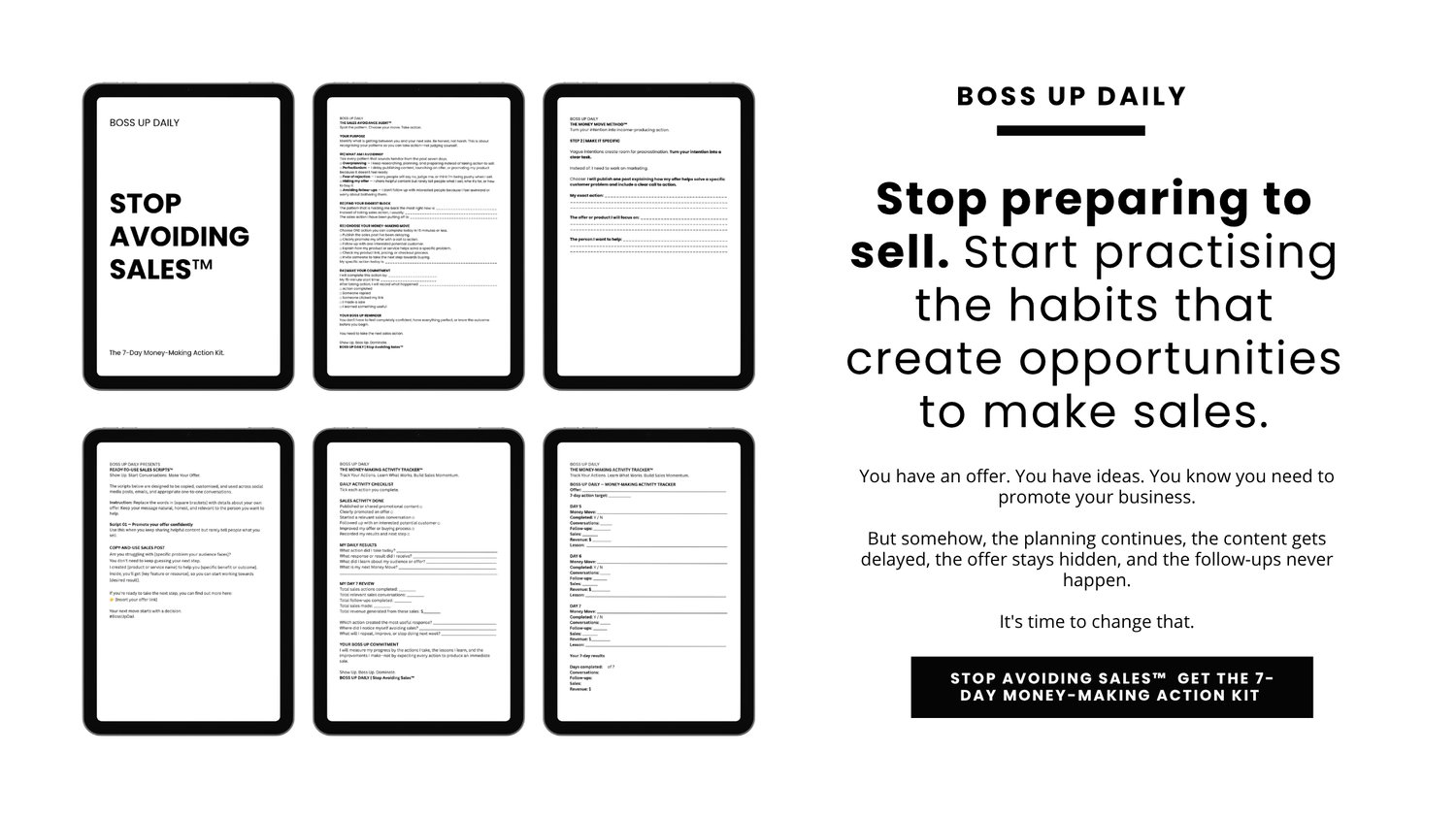
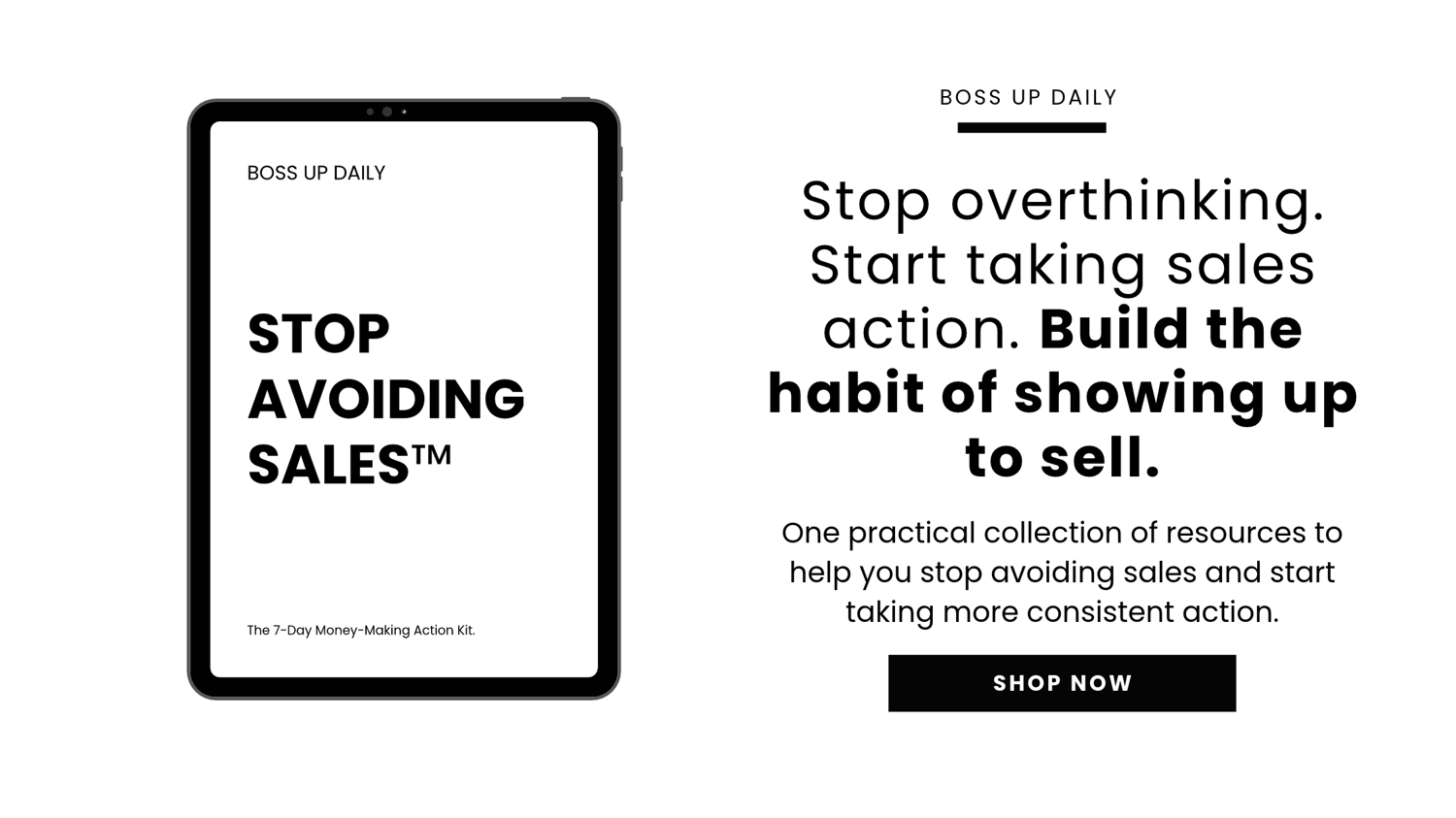
Stop Avoiding Sales™ — The 7-Day Money-Making Action Kit is designed to help online business owners move from inconsistent selling towards a more repeatable sales routine.
Inside, you'll find:
- The Sales Avoidance Audit: Identify the habits that interrupt your sales activity.
- The Money Move Method™: Choose one focused, practical sales action.
- Ready-to-Use Sales Scripts: Make it easier to communicate your offer and follow up.
- The 7-Day Sales Action Challenge: Give your sales activities a clear daily structure.
- The Money-Making Activity Tracker: Record completed actions and review your results.
The challenge helps you practise showing up for your business even when motivation fluctuates or sales are slower than expected.
Price: $19.99 AUD.
You don't need to start over every Monday.
You need a sales habit you can return to, a way to track your actions and the willingness to learn from the results.
Stop waiting for motivation. Start building your sales routine.
Show Up. Boss Up. Dominate.
Explore Stop Avoiding Sales™ — The 7-Day Money-Making Action Kit.
Comments ()