
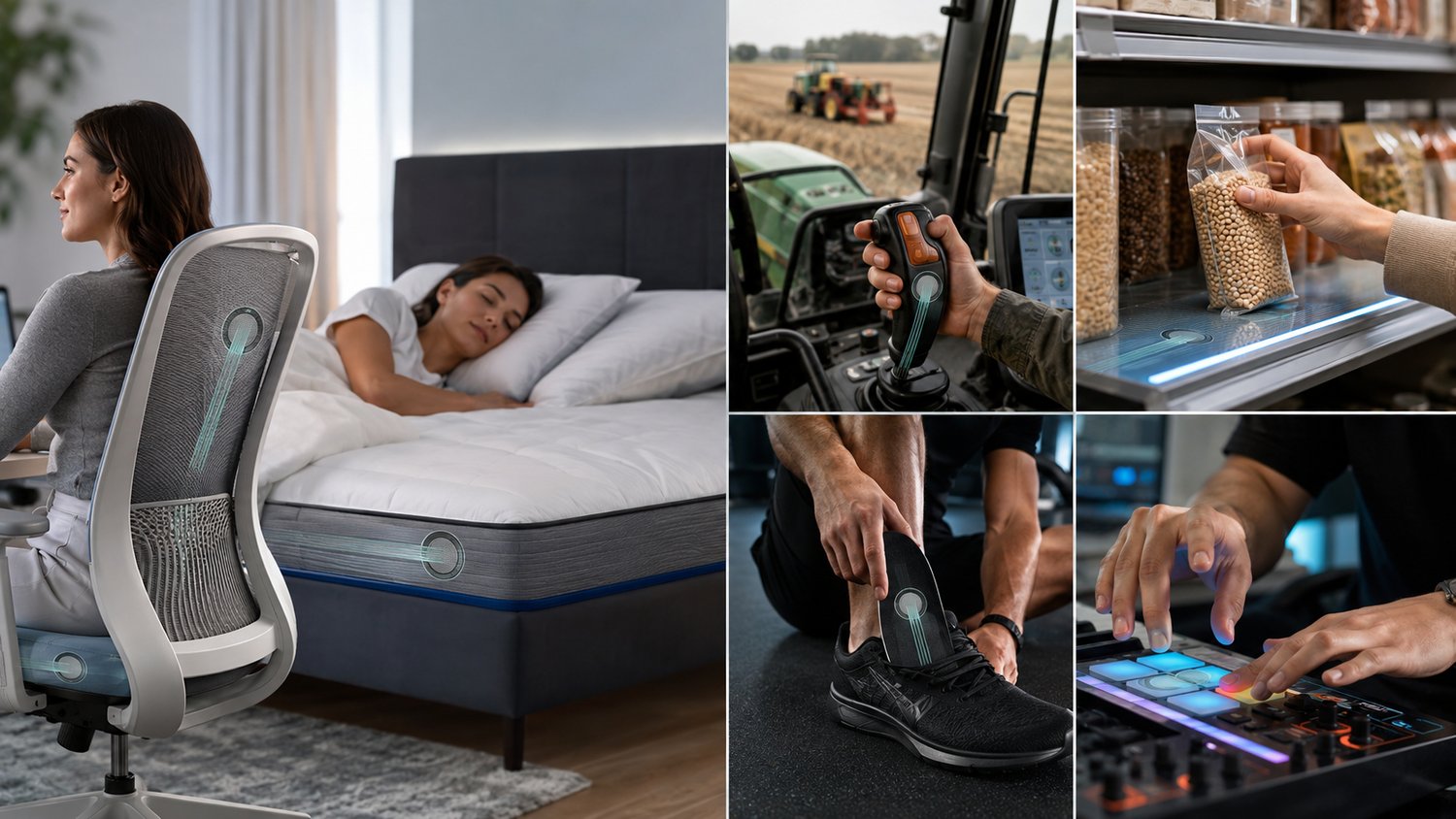
Most people first meet force sensing resistors in robotics or medical devices. But FSRs have quietly spread far beyond those familiar fields.
Because they are thin, flexible, cheap, and easy to shape, they show up wherever a product benefits from knowing how hard something is being pressed.
Here are five industries using FSRs that might surprise you.
Quick answer: Beyond robotics and medical devices, force sensing resistors are used in smart furniture and bedding, agriculture and heavy equipment, retail and inventory, sports and fitness, and musical instruments, anywhere a product benefits from sensing pressure or grip.
Demand is climbing across these fields: the flexible force sensing resistor market is projected to grow from about USD 409 million in 2024 to nearly USD 893 million by 2033 (9 percent CAGR), with Asia Pacific holding over 40 percent of revenue.
1. Smart Furniture and Bedding
Furniture is getting smart, and force sensing resistors are a big reason why. Embedded in seats and mattresses, FSRs detect occupancy, track posture, and map pressure distribution.
- Beds that detect presence and monitor sleep position
- Chairs that sense posture and prompt healthier sitting
- Pressure mapping to help prevent bedsores in care settings
2. Agriculture and Heavy Equipment
On tractors and heavy machinery, FSRs handle rugged sensing jobs that keep operators safe and equipment efficient.
- Seat occupancy detection for safety interlocks
- Grip and control-force sensing on levers and joysticks
- Load and contact detection on implements and attachments
3. Retail and Inventory
Retail is using force sensing to make shelves and checkouts smarter.
- Smart shelves that detect when products are removed or restocked
- Interactive displays that respond to a customer's touch pressure
- Point-of-sale surfaces with pressure-aware controls
4. Sports and Fitness
Athletes and coaches use FSRs to turn physical performance into measurable data.
- Insoles that analyze gait, balance, and foot pressure
- Grips and handles that measure force and technique
- Training equipment that tracks how hard and how evenly force is applied
5. Musical Instruments and Creative Technology
For musicians and artists, FSRs add expression that on/off switches cannot. A harder press can mean a louder note, a brighter effect, or a stronger response, giving digital instruments a human, analog feel.
Why FSRs Work Across So Many Fields
The same handful of traits makes FSRs useful in wildly different industries.
- Thin and flexible enough to fit almost anywhere
- Low-cost compared to traditional load cells
- Cut and shaped into custom geometries for each application
- Low power and easy to integrate with simple electronics
Where Manufacturing Precision Becomes Critical
Whatever the industry, an FSR only performs consistently if it is made consistently. Precise printing and controlled materials are what make the same sensor reliable in a mattress or a musical instrument.
Organizations working in printed electronics, force sensing resistors and printed sensors, and related interface components, such as Butler Technologies, Inc., build these products on controlled, in-house production lines so performance stays consistent from the first unit to the ten-thousandth.
Hiding in Plain Sight
Force sensing resistors have become one of the most quietly versatile components in modern products. The next time a surface responds to how hard you press it, there is a good chance an FSR is behind it.
Key Takeaways
- Smart furniture and bedding use FSRs for occupancy, posture, and pressure mapping
- Agriculture and heavy equipment use them for seat occupancy and control-force sensing
- Retail uses them for smart shelves and pressure-aware displays
- Sports and fitness use them for gait, grip, and technique analysis
- Musical instruments use them for expressive, pressure-based control
FAQs
What industries use force sensing resistors?
Beyond robotics and medical devices, FSRs are used in smart furniture and bedding, agriculture and heavy equipment, retail and inventory, sports and fitness, and musical instruments and creative technology.
Why are FSRs used in so many different products?
Because they are thin, flexible, low-cost, low-power, and can be shaped into custom geometries, which makes them easy to add to almost any product that benefits from sensing pressure or grip.
How are FSRs used in smart furniture?
They detect occupancy, track posture, and map pressure distribution in chairs and beds, enabling features like presence detection, posture prompts, and pressure-injury prevention.
Can FSRs be used in sports equipment?
Yes. FSRs are used in insoles for gait analysis, in grips to measure force and technique, and in training equipment to track how hard and how evenly force is applied.