
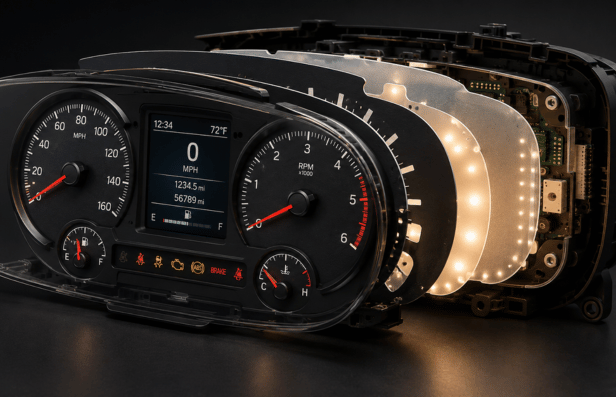
An instrument cluster is the driver’s single source of truth. Speed, distance, fuel, warnings: all of it has to be readable at a glance, in daylight and darkness, for the life of the vehicle. Behind that clean face is a set of components engineered to work together.
A custom instrument cluster is not an off-the-shelf part. It is built around the specific gauges, displays, lighting, and graphics a vehicle or machine needs, which is why understanding its components matters when specifying one.
Quick answer: A custom instrument cluster combines analog gauges and dials (such as speedometers and tachometers), digital displays, odometer and trip functions, backlit graphics, warning indicators, and a printed graphic dial face, integrated into one sealed, readable panel. The components match the vehicle’s data, environment, and styling.
The Analog Gauges and Dials
Even in an increasingly digital world, analog gauges remain central to many clusters because a sweeping needle is fast and intuitive to read.
- Speedometer: the primary gauge, showing vehicle speed
- Tachometer: engine RPM, important in performance and heavy equipment
- Fuel, temperature, and pressure gauges for system status
These rely on precisely printed dials and gauges whose graphics must stay legible in daylight and when backlit at night.
The Odometer and Trip Functions
The odometer records total distance travelled and is often paired with resettable trip meters. In modern clusters, these are usually digital, shown on a small display within the cluster, but they remain a core function drivers and fleets rely on for maintenance and record-keeping.
Digital Displays and Indicators
Most custom clusters now blend analog and digital. A central display can show trip data, navigation, diagnostics, or configurable readouts, while dedicated warning indicators alert the driver to specific conditions.
- Central digital display for trip, diagnostic, or configurable data
- Warning and telltale indicators for system alerts
- Configurable readouts that adapt to the vehicle or mode
Backlighting and the Graphic Dial Face
The face of the cluster is a printed graphic dial, and its readability is decided by how it is printed and lit. Backlighting has to illuminate the dial evenly so every number and marking reads clearly at night, without hotspots or glare in daylight.
- Printed dial face with high-contrast, durable graphics
- Even backlighting tuned to the dial layout
- UV-stable inks that keep their colour over years of sun exposure
Where Manufacturing Precision Becomes Critical
A cluster is judged on how consistently it reads, and consistency comes from controlled printing, colour matching, and lighting. Small variations in ink density or backlight uniformity are immediately visible on a dial the driver looks at constantly.
Organizations that produce printed dials, gauges, and backlit graphics, such as Butler Technologies, Inc., control colour matching and lamination in-house so every cluster reads the same, day and night, part after part.
The Real Goal of a Custom Cluster
A well-built instrument cluster disappears into the experience of driving. The information is simply there, clear and instant, in every lighting condition. That clarity comes from matching the right gauges, displays, lighting, and graphics to the application from the start.
Key Takeaways
- A custom cluster combines analog gauges, digital displays, odometer functions, and backlit graphics
- Analog gauges remain valued for fast, intuitive reading
- The printed dial face and its backlighting decide day-and-night readability
- Consistent printing, colour matching, and lighting are what keep a cluster legible
FAQs
What are the main components of an instrument cluster?
The main components are analog gauges (speedometer, tachometer, fuel, temperature), an odometer and trip functions, digital displays, warning indicators, and a printed, backlit graphic dial face, integrated into one panel.
Why are analog gauges still used in modern clusters?
A sweeping analog needle is fast and intuitive to read at a glance, which is why speedometers and tachometers often remain analog even in clusters that also include digital displays.
How is an instrument cluster made readable at night?
Through even backlighting tuned to the dial layout and printed with high-contrast, UV-stable graphics, so every marking illuminates clearly at night without hotspots and stays readable in daylight.
What makes a cluster custom rather than off-the-shelf?
A custom cluster is built around the specific gauges, displays, lighting, graphics, and styling a particular vehicle or machine needs, rather than using a fixed standard layout.