
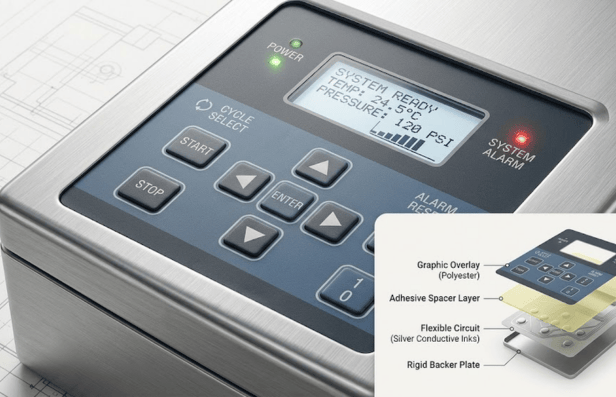
Industrial graphic overlays are more than printed labels. They are engineered interface surfaces that protect electronics, communicate information, and withstand harsh operating environments. Choosing the right material for an industrial graphic overlay directly affects durability, legibility, environmental resistance, and long-term Human Machine Interface performance.
Material selection must account for mechanical stress, chemical exposure, temperature extremes, and lifecycle expectations. A poorly selected substrate can lead to fading, cracking, delamination, or premature interface failure.
Understanding material properties is essential when designing industrial-grade graphic overlays.
What Is an Industrial Graphic Overlay?
An industrial graphic overlay is the top interface layer of a control system, typically integrated with membrane switches or rigid control panels.
It provides:
- Printed legends and symbols
- Surface protection
- Environmental sealing
- User interaction zones
- Display windows
Unlike consumer applications, industrial overlays must maintain structural and visual integrity under demanding conditions.
Key Environmental Factors That Influence Material Selection
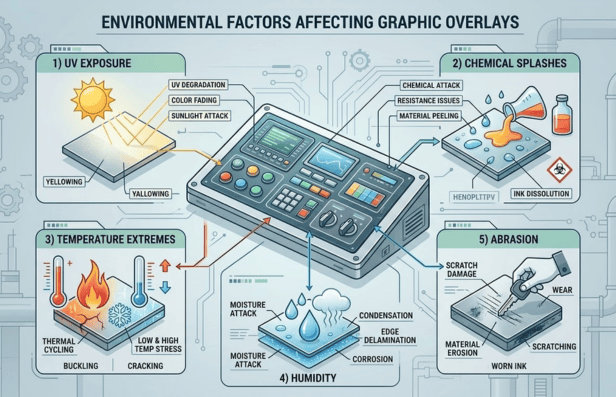
Industrial environments vary widely. Material selection must begin with environmental analysis.
Critical exposure considerations include:
- Temperature range and thermal cycling
- Humidity and condensation
- Chemical exposure, such as oils and solvents
- UV radiation exposure
- Abrasion and mechanical wear
- Cleaning procedures and disinfectants
Each of these factors affects substrate and coating performance.
Common Materials Used in Industrial Graphic Overlays
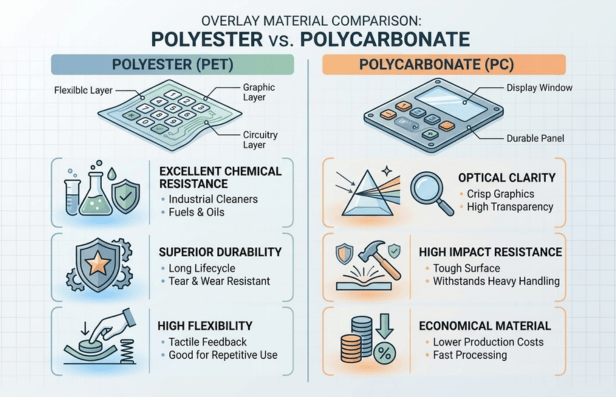
Two of the most widely used materials are polyester and polycarbonate. Each offers distinct performance characteristics.
Polyester
Polyester is frequently selected for high-durability applications.
Advantages include:
- Excellent chemical resistance
- Strong abrasion resistance
- High-dimensional stability
- Long lifecycle durability
- Good compatibility with embossing
Polyester is often preferred for membrane switch overlays because it withstands repeated flexing and actuation.
Polycarbonate
Polycarbonate is commonly used when clarity and cost efficiency are priorities.
Advantages include:
- High optical clarity
- Good impact resistance
- Easy to print and process
- Cost-effective for certain applications
However, polycarbonate typically has lower chemical resistance compared to polyester.
Material choice depends on environmental severity and performance expectations.
For a deeper technical breakdown of how these material choices influence durability and interface lifespan, you can explore this detailed guide on graphic overlay material choices that impact interface lifespan.
Surface Finishes and Protective Coatings
Material selection extends beyond the base substrate. Surface finish significantly impacts performance.
Common finish options include:
- Hard coat surfaces for scratch resistance
- Gloss finish for visual vibrancy
- Matte finish for glare reduction
- Textured finish for tactile feedback
Hard coats are often critical in industrial settings where frequent contact or cleaning occurs.
The correct finish prevents surface degradation and maintains legibility over time.
Chemical Resistance Considerations
In industrial facilities, graphic overlays may encounter:
- Hydraulic fluids
- Cleaning agents
- Alcohol-based disinfectants
- Industrial solvents
- Lubricants
Material testing under real-world chemical exposure conditions is essential.
Polyester typically provides superior resistance to aggressive chemicals, making it a common choice in manufacturing and medical environments.
Failure to account for chemical exposure can lead to ink degradation, surface cracking, or adhesive breakdown.
Temperature Performance and Dimensional Stability
Industrial systems may operate in environments with significant temperature variation.
Material selection should consider:
- Continuous operating temperature range
- Short-term heat exposure
- Cold temperature flexibility
- Expansion and contraction behavior
Polyester generally offers better dimensional stability during thermal cycling.
Dimensional instability can lead to misalignment with membrane switch circuits or control panel cutouts.
Adhesive Compatibility and Bond Strength
Graphic overlays must bond securely to their mounting surface.
Adhesive selection must account for:
- Surface energy of the substrate
- Environmental exposure
- Mechanical stress
- Temperature variation
- Long-term adhesion requirements
Pressure-sensitive adhesives must maintain bond strength under vibration and humidity conditions.
Improper adhesive selection can cause edge lifting or delamination.
Optical and Display Requirements
If the overlay includes display windows or LED backlighting, optical properties become critical.
Design considerations include:
- Light transmission levels
- Diffusion properties
- UV stability
- Clarity over time
Material haze, yellowing, or optical distortion can degrade interface readability.
Selecting materials with stable optical characteristics ensures long-term display clarity.
Mechanical Durability and Actuation Performance
For overlays integrated with membrane switches, flexibility matters.
Material selection must support:
- Repeated actuation cycles
- Embossed key areas
- Dome integration
- Consistent tactile feedback
Rigid materials may crack under repetitive flexing, while overly soft materials may reduce tactile definition.
Balancing flexibility and structural integrity is critical.
Engineering Process for Selecting Overlay Materials
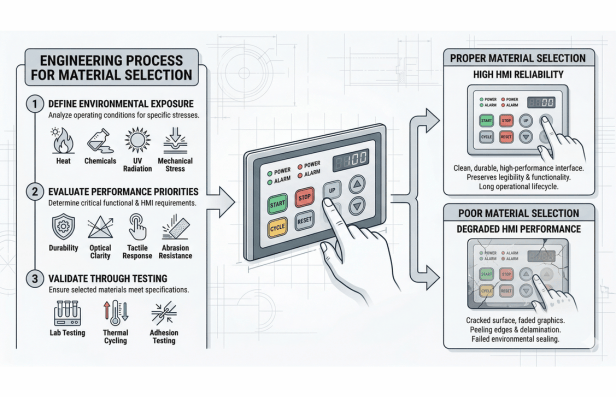
Choosing the right material requires a structured evaluation.
1. Define Environmental Exposure
Identify:
- Temperature extremes
- Chemical exposure
- UV conditions
- Mechanical stress levels
2. Evaluate Performance Priorities
Determine:
- Required lifecycle
- Optical clarity needs
- Tactile requirements
- Abrasion resistance targets
3. Validate Through Testing
Conduct:
- Chemical resistance testing
- Thermal cycling validation
- Adhesion testing
- Abrasion testing
Material selection should be validated under realistic operating conditions before scaling production.
Why Material Selection Directly Impacts HMI Reliability
Industrial graphic overlays serve as both communication tools and protective barriers.
Incorrect material selection can lead to:
- Surface cracking
- Ink fading
- Adhesive failure
- Reduced environmental sealing
- User interface degradation
Properly engineered material selection improves Human Machine Interface reliability, enhances durability, and reduces long-term maintenance costs.
Engineering Perspective on Long-Term Performance
Material selection is not simply about cost or printability. It is about lifecycle engineering.
The right material must:
- Maintain structural integrity
- Preserve legibility
- Resist environmental degradation
- Support scalable manufacturing
- Integrate with membrane switch assemblies
Industrial graphic overlays are functional components. Selecting the right material ensures consistent interface performance throughout the equipment lifecycle.
Frequently Asked Questions
Q. What material is best for industrial graphic overlays?
A. Polyester is often preferred for high durability and chemical resistance, while polycarbonate may be selected for optical clarity and cost efficiency.
Q. Are polyester overlays more durable than polycarbonate?
A. In most harsh industrial environments, polyester provides superior chemical and abrasion resistance.
Q. How important is adhesive selection?
A. Adhesive compatibility is critical for preventing delamination and ensuring long-term bond strength.
Q. Can graphic overlays withstand chemical cleaning?
A. Yes, if the correct substrate and protective coatings are selected based on expected chemical exposure.
Q. Do surface finishes affect performance?
A. Yes. Hard coats and matte finishes improve scratch resistance and glare control, directly affecting durability and readability.