
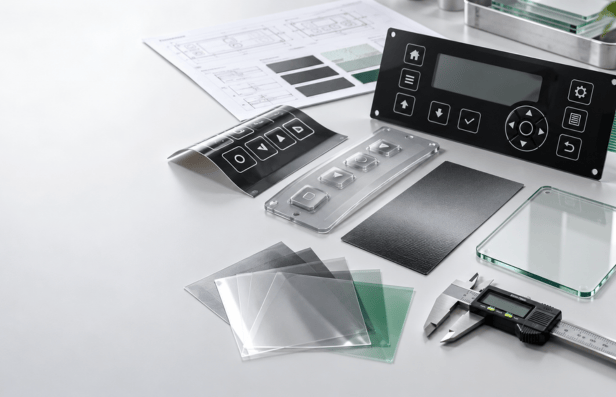
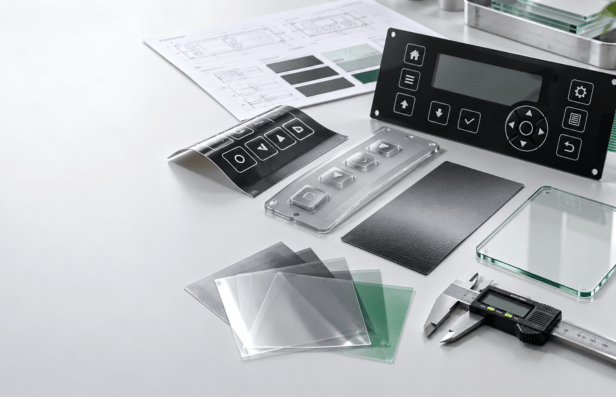
Most HMI material decisions start from the layer stack, but interfaces rarely fail by layer. They fail by mechanism. A polycarbonate key cracks where it was embossed and wiped with disinfectant, and a hardcoat hazes after a summer on a tractor.
An adhesive creeps at the edge of a panel near a washdown hose. These failures keep reaching the field because the film gets chosen before anyone writes down the environment. Starting from the environment catches them on paper instead.
Quick answer: Select high-performance HMI materials by listing the operating environment first: cleaning chemicals, UV, temperature and humidity, actuation count, flammability and optics. Then match each condition to its failure mechanism. Hard-coated polyester typically wins on flex life and chemical exposure, polycarbonate on formability and flame-rated grades, and glass on optical and chemical stability where no flex is needed.
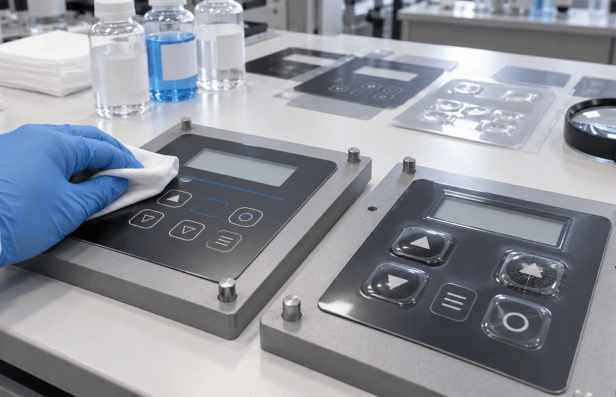
Disinfectant Exposure and Strain
Hard-coated polyester is generally the lower-risk choice for surfaces wiped with quaternary ammonium, bleach, hydrogen peroxide or alcohol products. Polycarbonate can work, but its chemical resistance depends on strain.
- A polycarbonate film that survives a flat coupon test may crack at an embossed key, where forming leaves residual stress under the wipe
- Covestro's guide, Makrolon: The Chemical Resistance, classes chemicals that cause damage below 1.0% outer fiber strain as incompatible
- Alkalis and amines attack polycarbonate, and pure isopropanol is rated resistant while methanol is not
- The CDC warns that hypochlorites corrode metals above 500 ppm, which matters for exposed bezels and fasteners
- Test the customer's actual disinfectants by product name on formed samples, since formulations differ
UV and Outdoor Exposure
Outdoor overlays are usually qualified with accelerated fluorescent UV and condensation testing, such as SAE J2020 or ASTM G154.
Measure color change, yellowing, gloss retention and adhesion against unexposed controls. ASTM G154-23 states that its exposures do not simulate pollution, biological attack or saltwater, so a marine console needs salt exposure testing on top of UV.
MacDermid Alpha designs its Autotex XE hard-coated polyester specifically for outdoor UV, moisture, and temperature variation. Manufacturers that state which UV standard a construction meets, such as Butler Technologies, Inc., whose graphic overlays and labels meet SAE J2020, give engineers a defined test to hold a grade against.
Heat and Humidity Limits
Humidity lowers the usable temperature ceiling of hard-coated films, so datasheets often state two limits. Washdown areas and humid climates fall under the stricter one.
- The Autotex datasheet lists a maximum use temperature of 85 °C below 10% relative humidity, but below 60 °C at 10 to 95%
- Minimum use temperature is -40 °C and maximum processing temperature is 120 °C
- Shrinkage at 120 °C is 0.08% transverse and 0.2% machine direction, so orientation affects long dimensions
- Glass, film, adhesive, and metal backers expand at different rates, so cycle between the real extremes and inspect for edge lift
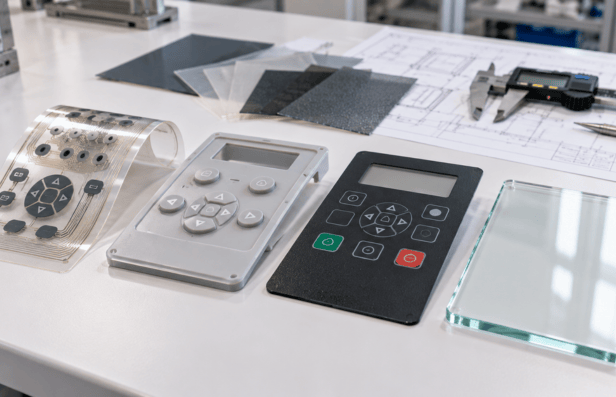
PET, PC, Hard-Coated Film and Glass
The right graphic overlay material choice depends on actuation, forming, and cleaning together.
- Polyester offers the longest flex life, over 100 million actuations non-embossed according to Tekra, dropping to about 10 million embossed
- Polycarbonate forms cold or hot and comes in UL 94 V-0 grades, but falls under 100,000 actuations when embossed
- Hard-coated polyester adds abrasion and chemical resistance, defined optical finishes and over 5 million actuations
- Glass gives the most stable optics and chemistry and does not yellow, but it cannot flex or be embossed
- Cover glass over touch sensors is offered from 0.55 to 3.0 mm, standard or chemically strengthened
Flammability and Optics on the Drawing
Put measurable values on the drawing: the UL 94 class at the film thickness used, gloss in gloss units, and haze and transmission as percentages. Words such as matte or flame retardant are not specifications.
Without numbers, a substitute film can pass inspection yet look or burn differently. UL assigns VTM-0, VTM-1 and VTM-2 to thin films that cannot support themselves horizontally, while V-0, V-1, V-2 and HB apply to enclosure and structural materials.
Textured Autotex grades run from 4.5 to 7 gloss units with haze between 58% and 71%, and total luminous transmission of 92% ± 2%. That haze suits a keypad but blurs a display, so specify display windows separately.
Environment Before Layer
Every failure above starts with a condition the material was never specified against. Stress cracking, yellowing, adhesive creep, and flex fatigue each trace back to a chemical, a climate or an actuation count nobody wrote down. A written environment specification, followed by tests on built parts rather than coupons, turns material selection into a repeatable engineering record.
Key Takeaways
- Polycarbonate's chemical resistance depends on strain, so embossed keys crack first
- Accelerated UV testing does not cover salt exposure, so marine consoles need both
- Humidity drops the Autotex maximum use temperature from 85 °C to below 60 °C
- UL 94 class, gloss, haze, and transmission belong on the drawing as numbers
Frequently Asked Questions (FAQs)
Is polycarbonate or polyester better for a medical device overlay?
Hard-coated polyester is usually safer for overlays wiped repeatedly, because polycarbonate's chemical resistance falls under strain, as at embossed keys. Polycarbonate still suits flat or deeply formed parts that need flame-rated grades. Either way, test the facility's actual disinfectants on formed samples.
Can a hard-coated overlay be used outdoors?
Yes, if the grade is designed for it and the construction is tested. Standard indoor films differ from outdoor grades such as Autotex XE. Qualify the finished overlay to SAE J2020 or ASTM G154, and add salt testing where relevant.
What UL 94 rating applies to thin overlay films?
Thin films that cannot support themselves horizontally are rated VTM-0, VTM-1 or VTM-2, with VTM-0 the most stringent. V-0, V-1, V-2, and HB apply to thicker structural materials. Confirm the rating was assigned at the thickness and grade you plan to use.
When should glass replace a film overlay?
Glass fits when the surface covers a display or touch sensor, needs the highest optical clarity, and must resist harsh chemicals without flexing. It cannot be embossed or used over tactile switches. Chemically strengthened glass improves impact and break resistance.