

Membrane keypads are used in environments where reliability is not optional. From industrial control panels to medical devices, these interfaces are expected to perform consistently over millions of actuations.
But long life in membrane keypads is not accidental. It is engineered.
Achieving durability requires precise control over materials, construction, electrical design, and manufacturing processes. Small design decisions at the early stage can significantly impact lifespan, performance, and failure rates.
What Defines a Long Life Membrane Keypad?
A long-life membrane keypad is designed to withstand repeated use without degradation in performance.
Key performance expectations:
- High actuation life, often exceeding millions of cycles
- Consistent tactile response over time
- Stable electrical performance
- Resistance to environmental stress
- Minimal wear or failure under repeated use
Longevity is a result of how well each layer and component works together.
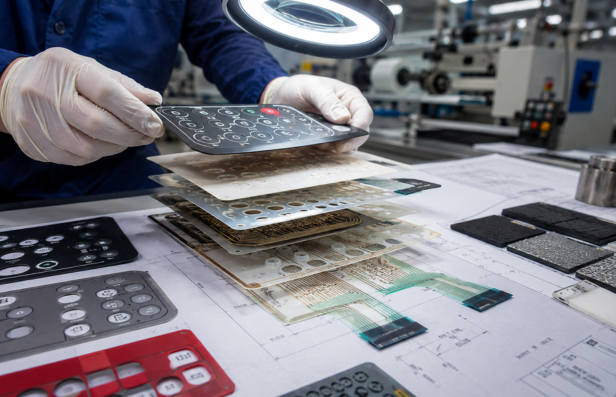
Layer Construction and Its Impact on Durability
Membrane keypads are built as multi-layer systems, and each layer plays a role in lifespan.
1. Graphic Overlay
- Acts as the user interface surface
- Protects internal layers from wear and environmental exposure
- The material choice of the graphic overlay impacts scratch resistance and flexibility
2. Spacer Layer
- Maintains separation between circuit layers
- Defines actuation travel
- Thickness and material consistency affect performance
3. Circuit Layer
- Contains printed conductive traces
- Must maintain electrical integrity over repeated flexing
- Ink selection and trace design are critical
4. Adhesive Layers
- Bond all components together
- Must maintain adhesion over time and environmental exposure
- Failure here leads to delamination
Material Selection for Long Life Performance
Material selection is one of the most critical factors in membrane keypad durability.
1. Overlay Materials
- Polyester is commonly used for its durability and flexibility
- Provides resistance to chemicals, abrasion, and repeated use
2. Conductive Inks
- Silver and carbon inks must maintain conductivity over time
- Ink formulation affects resistance stability and lifespan
3. Adhesives
- Must bond reliably across different materials
- Performance depends on surface compatibility and environment
4. Protective Coatings
- Enhance resistance to wear, UV exposure, and chemicals
- Extend operational life in harsh conditions

Switch Design and Actuation Life
Switch design directly impacts how long a keypad will last.
Key design considerations:
- Dome selection determines tactile feedback and cycle life
- Actuation force must balance usability and durability
- Contact design must ensure a consistent electrical connection
- Overtravel and return force affect long-term performance
Metal domes and polyester domes are commonly used, each with different lifecycle characteristics.
Beyond lifecycle performance, membrane switches remain valuable because they combine durability, low-profile construction, environmental resistance, and user-friendly operation in one interface.
This is why membrane switches remain essential in modern industrial design, especially for equipment that requires reliable actuation, sealed construction, and consistent long-term performance in demanding environments.
Environmental Factors That Affect Lifespan
Membrane keypads often operate in demanding environments.
Key environmental challenges:
- Temperature fluctuations affecting materials and adhesives
- Moisture and humidity lead to degradation
- Chemical exposure impacting overlays and adhesives
- Mechanical stress from repeated use
Design must account for these factors to ensure reliability.
Circuit Design and Electrical Reliability
Electrical performance must remain stable throughout the keypad’s life.
Critical factors:
- Proper trace width and spacing to avoid failure
- Consistent ink deposition during printing
- Protection against short circuits and wear
- Stable resistance over time
Poor circuit design can lead to intermittent failures even if the mechanical design is sound.
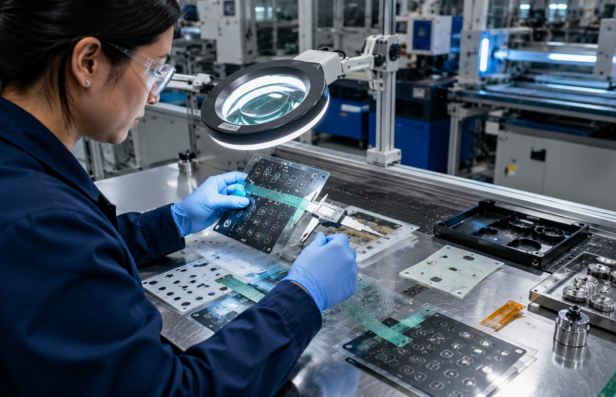
Manufacturing Precision and Process Control
Even the best design fails without proper manufacturing control.
Key process considerations:
- Accurate layer alignment during assembly
- Consistent printing of conductive inks
- Controlled curing processes
- Reliable bonding and lamination
Process variation is one of the most common causes of early failure.
Common Failure Modes in Membrane Keypads
Understanding failure helps improve design.
Typical issues include:
- Overlay wear or cracking
- Adhesive delamination
- Loss of tactile feedback
- Circuit degradation or open circuits
- Environmental damage
Most failures are preventable with proper engineering and validation.
Role of Testing and Validation
Testing ensures that designs perform under real conditions.
Key testing methods:
- Actuation lifecycle testing
- Environmental stress testing
- Electrical performance validation
- Adhesion and durability testing
Testing should simulate real-world usage, not just ideal conditions.
How Engineering Decisions Impact Lifecycle
The lifespan of a membrane keypad is determined long before production begins.
Critical decisions include:
- Material compatibility across layers
- Layer structure optimization for durability
- Switch design and actuation force balance
- Environmental protection strategies
From practical engineering experience, early alignment between design and manufacturing significantly improves reliability and reduces failure rates.
Companies specializing in printed electronics and interface solutions, such as Butler Technologies, Inc., approach membrane keypad development by integrating material expertise, precision manufacturing, and application-specific design. This ensures that keypads meet demanding lifecycle requirements across industrial, medical, and HMI applications.
Frequently Asked Questions (FAQs)
What determines the lifespan of a membrane keypad?
The lifespan is determined by material selection, switch design, circuit integrity, and environmental resistance.
How many cycles can a membrane keypad last?
High-quality membrane keypads can last millions of actuations depending on design and materials used.
What materials are used in membrane keypads?
Common materials include polyester overlays, conductive inks, adhesives, and protective coatings.
What causes membrane keypad failure?
Common causes include overlay wear, adhesive failure, circuit degradation, and environmental exposure.
How can the membrane keypad's life be improved?
Lifecycle can be improved through proper material selection, optimized design, controlled manufacturing, and thorough testing.