
The Generalized Curl Theorem isn't just an abstract identity; it is a robust physical principle. It tells us that in the study of scalar fields, complexity is often local, but balance is always global.
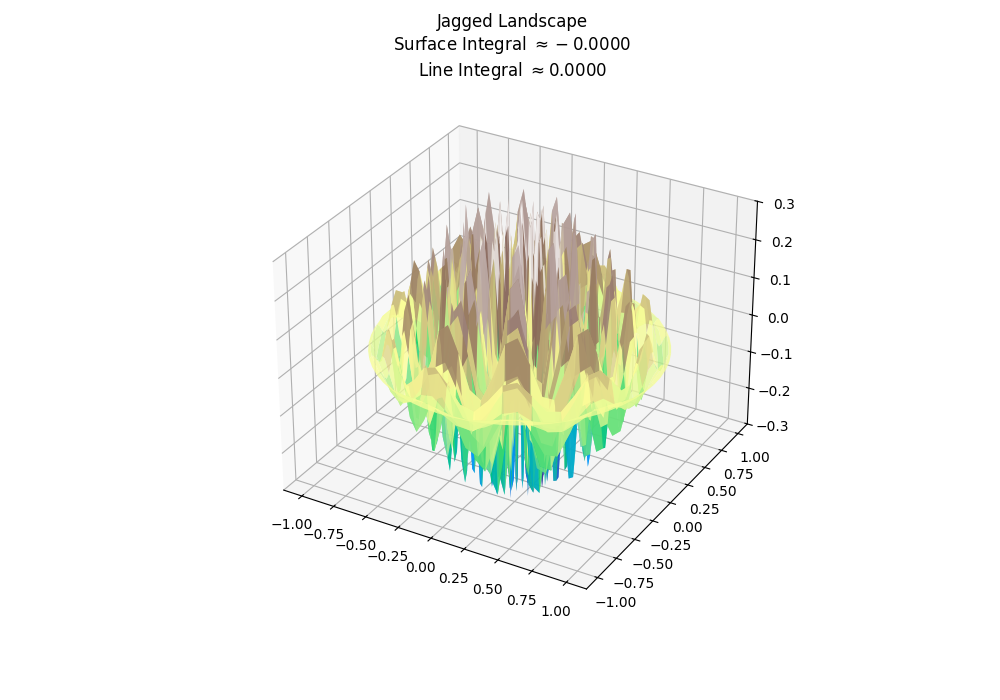
Imagine a sleek, darkened workspace where a solitary circular boundary glows in crimson, etched into the fabric of space. Within this ring, a surface rises—not as a simple, static dome, but as a dynamic, "rippled bowl," oscillating with the rhythmic complexity of a transcendental field. Scattered across this undulating surface are thousands of tiny, vibrant blue needles. Individually, they twist and tilt in chaotic, localized patterns, reacting to every jagged peak and hollow of the terrain. Yet, when you zoom out to witness the grand calculation, the "total twist" of those thousands of independent needles aligns perfectly into a singular, unwavering value that matches the crimson ring on the edge.
This is the Generalized Curl Theorem: a hidden, immutable symmetry linking the jagged complexity of a 3D surface to the simple, clean integrity of its boundary.
The Invisible Balance
The core narrative here is one of topological independence. At its heart, the theorem challenges the intuition that a complex, rugged interior requires a complex, rugged solution. Instead, it proves that the interior geometry—no matter how chaotic or "noisy" the scalar field becomes—is entirely subservient to the values living on the edge.
- The Bridge: The theorem acts as a mathematical bridge, converting a daunting surface-area-weighted gradient into a straightforward circulation integral. It essentially "projects" the 3D behavior of a field onto the 1D reality of a closed loop.
- The Stress Test: Through rigorous numerical demonstrations, we see the theorem hold firm under duress. Whether the capping surface is a perfect hemisphere or a "rippled bowl" pushed to the limits of transcendental functions, the math does not break.
- The "Gut" Realization: The feeling behind the proof is one of profound stability. It reveals that the "total twist" is a conserved, invariant property. If you anchor the boundary, you effectively lock the total behavior of the surface, rendering the intermediate geometry a mere detail.
Ultimately, the Generalized Curl Theorem isn't just an abstract identity; it is a robust physical principle. It tells us that in the study of scalar fields, complexity is often local, but balance is always global.