
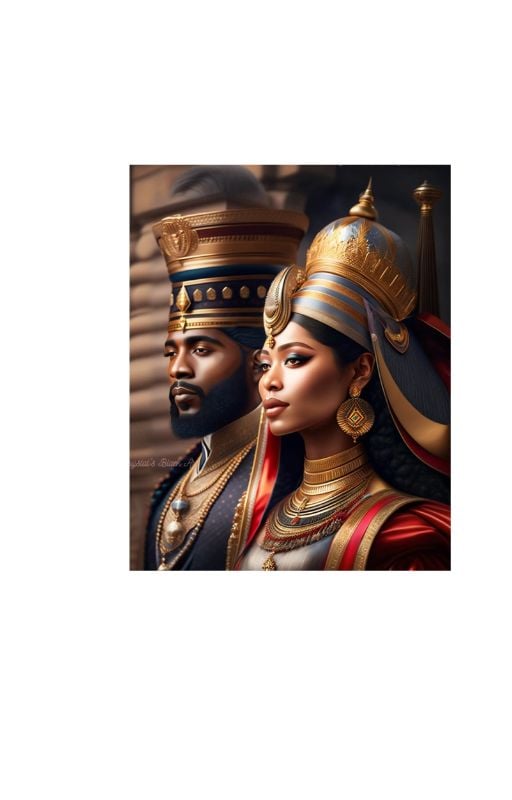
THE RESTORATION OF MEMORY
Christ Arise Books is built upon the sacred work of restoring the spiritual wellbeing of Black people by gathering, curating, and illuminating the most empowering historical, cultural, and theological knowledge available.
It exists as a healing house — a place where our scattered memory is gathered, our wounded identity is rebuilt, and our divine inheritance is restored. Through rigorous research and prophetic storytelling, it offers our people the tools to mend the generational trauma of colonization, cultural erasure, and historical tragedy.
In the same way the Jewish people reclaimed their identity across centuries of exile and catastrophe — from Babylon to the Holocaust — Christ Arise Books seeks to guide Black people into a similar restoration of memory, dignity, and collective strength, so that we may rise whole, healed, and historically anchored once again.
Prophet Dixon
BEFORE THE CHAINS — AFRICAN CHRISTIAN ROOTS
Theme: Reclaiming Your Identity Before Oppression
Before the ships, before the chains, before the lash and the auction block, before the world tried to rename, redefine, and reduce a people, there was identity. There was a continent where God walked with His children in the cool of the day, a land where kingdoms rose not only in power but in prayer, a people who knew the sound of the Spirit long before they heard the slave trader’s whip.
Africa was not a spiritual blank slate waiting for European missionaries; it was a cradle of Christian imagination, a land where the gospel took root early, deeply, and powerfully. Before the chains, there was church. Before the trauma, there was theology. Before dehumanization, there was dignity.
This is the story of who we were—so we can understand who we still are.
Africa has been misrepresented for centuries, but the truth is that Christianity reached the continent in the first century, while the apostles were still alive. Mark the Evangelist planted the church in Alexandria, and from there the gospel spread like wildfire across North Africa, into Nubia, Ethiopia, and beyond. African bishops shaped global doctrine.
African theologians wrote the texts that still anchor Christian belief. African believers prayed, fasted, discerned, cast out demons, interpreted dreams, and lived with a deep awareness of the Spirit’s presence. Africa did not receive Christianity as a foreign import; Africa recognized Christianity as the fulfillment of what the Spirit had already been whispering for generations.
The African worldview was inherently spiritual. God was not distant or abstract; He was the Creator who governed the seen and unseen worlds. Life was sacred. Community was covenant. Worship was woven into daily existence. When Africans encountered the gospel, they did not meet a strange God—they met a familiar One.
The Holy Spirit found a home among people who already understood dreams, visions, prophecy, healing, and spiritual warfare. Christianity did not erase African spirituality; it refined it, purified it, and revealed its true center in Christ.
Long before Europe became the face of Christianity, Africa was its beating heart. The Kingdom of Nubia stood as a Christian nation for nearly a thousand years. Ethiopia embraced the gospel so deeply that it remains one of the oldest Christian civilizations on earth.
The Kongo Kingdom adopted Christianity generations before the transatlantic slave trade intensified, meaning many Africans arrived in the Americas already baptized, already catechized, already singing Christian hymns in their own languages. And in the deserts of Egypt, African monks pioneered fasting, solitude, contemplative prayer, and spiritual warfare—disciplines that would later shape global Christianity.
The Black Church’s prayer culture, its emphasis on deliverance, its prophetic imagination, and its communal worship all have ancient African roots.
The tragedy of slavery is not only what was done to African peoples, but what was forgotten about them. They were not “heathens.” Many were Christians. Others held monotheistic worldviews that aligned naturally with Scripture.
They were not spiritually empty; they carried centuries of theological reflection and spiritual discipline. They were not powerless; they came from kingdoms, empires, and communities with structure, dignity, and spiritual authority.
They were not nameless; they had identities rooted in family, tribe, land, faith, and calling. Slavery tried to erase identity, but identity was older than slavery.
This matters because if you don’t know who you were before the chains, you will misinterpret who you are after them. The Black Church is not a reaction to oppression; it is a continuation of a Spirit-filled African legacy.
The Holy Spirit did not arrive in the Americas on a slave ship; He was already moving among African peoples. The resilience of the Black Church is not accidental; it is inherited. The prophetic voice of the Black Church is not new; it is ancient.
So, pause and reclaim what was always yours.
What lies have you believed about your spiritual origins?
Break agreement with them.
What truths about African Christian roots resonate with your spirit? Declare them.
What part of your identity feels older than your struggle? Name it.
What generational gifts do you carry that didn’t start with you? Claim them. Identity is not discovered; it is remembered.
You are not the descendant of slaves. You are the descendant of survivors, of scholars, of prophets, of kings and queens, of Spirit-filled believers who walked with God before the world tried to break them.
Before the chains, there was identity. Before the trauma, there was glory. Before the oppression, there was calling. And that identity still speaks. That glory still shines. That calling still stands. Rise in the memory of who you were so you can walk in the power of who you are.