
Some stories introduce danger with explosions.
Neonquiem Tokyo introduces it with a name passed across a bar.
Kumo.
Spider.
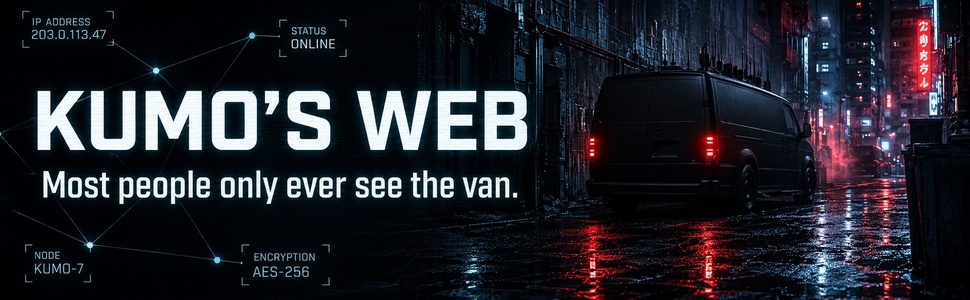
In the manuscript, Kumo does not arrive with a dramatic entrance or a clean explanation. He is given to Chase and Rika like a warning. A bartender with a mechanical eye points them toward a mobile shop hidden inside a blacked-out van in a delivery alley behind the Sega building on Chuo-dori. That detail matters because it says everything about the world of Neonquiem Tokyo without stopping to explain itself.
In this Tokyo, the truth is not sitting in a bright office waiting to be found. It is behind the main street. Behind the lights. Behind the crowds. Behind the kind of place most people walk past without realizing the real story is parked in the dark.
Kumo’s van represents one of the core feelings of the book: the city has another city underneath it.
There is the Tokyo tourists see, all neon and glass and speed. Then there is the Tokyo Chase and Rika are forced to move through, where information trades hands quietly, where a chip can matter more than a gun, and where the person you are looking for may be known mostly by the vehicle no one wants to get too close to.
That is what makes the van interesting.
It is not just a location.
It is a threshold.
The second Chase and Rika hear about it, the story shifts deeper into the hidden bloodstream of the city. The polished surface cracks. The mission becomes less official. Less clean. Less safe.
Kumo’s van is the kind of detail I love because it feels small at first, almost throwaway, but it carries weight. A blacked-out van in a delivery alley tells you this world has rules the official world does not control. It tells you there are people living between systems, surviving in the blind spots, doing business where surveillance and danger overlap.
And in Neonquiem Tokyo, that is where the real story begins to breathe.