
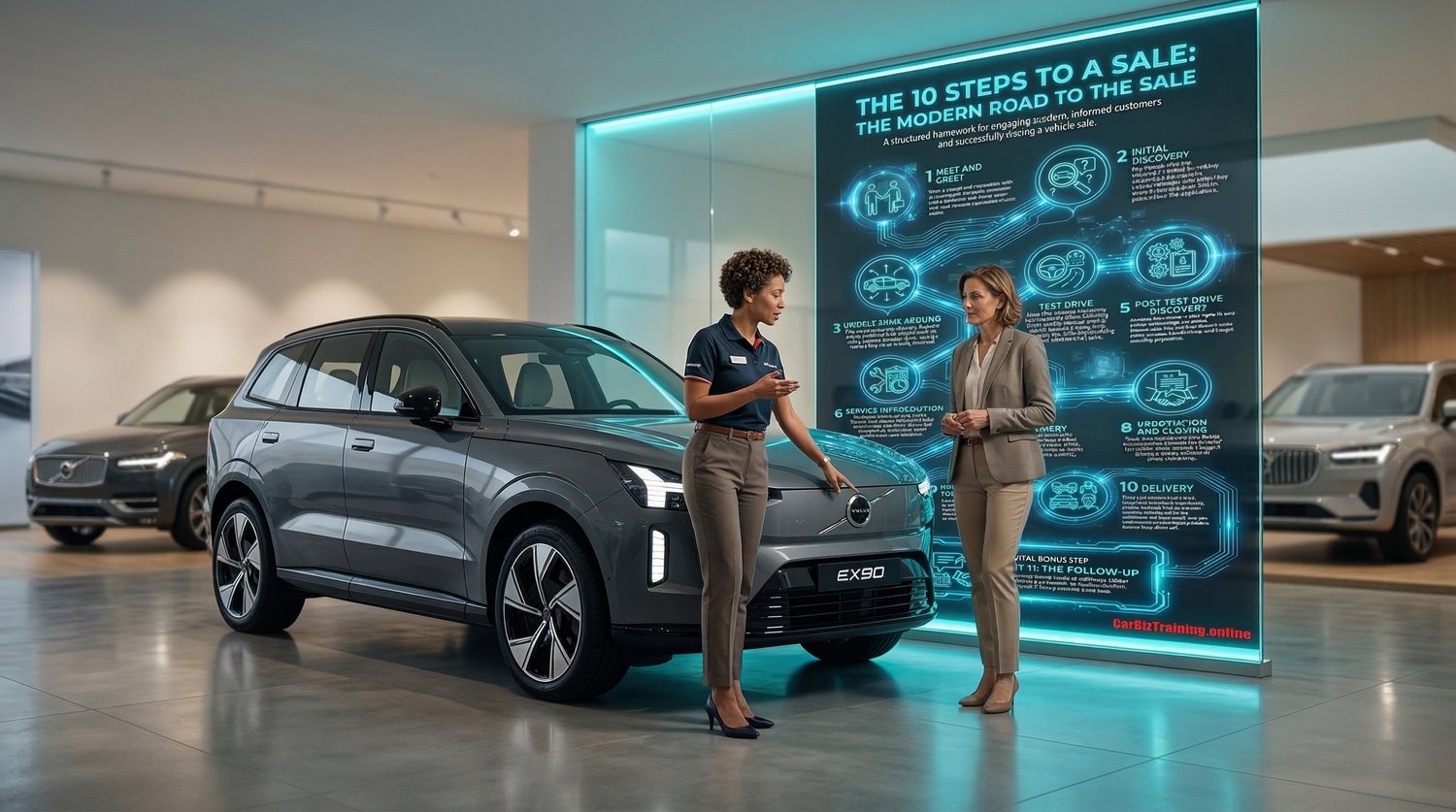
The Modern Road to the Sale:
The 10-Step System Top Automotive Sales Professionals Follow
For decades, the automotive industry has used a structured framework known as the Road to the Sale. While technology, consumer behavior, and dealership environments have evolved dramatically, one truth remains unchanged:
Great salespeople follow a process.
Customers today walk into dealerships more informed than ever before. They’ve researched pricing, features, incentives, and competitors long before stepping onto the lot. Because of this, the role of the salesperson has shifted from information provider to professional guide.
The most successful automotive sales professionals understand this shift and use a structured sales process that builds trust, maintains momentum, and guides the customer toward a confident buying decision.
This is where the Modern Road to the Sale comes in.
It is a 10-step framework that transforms a random conversation into a professional, repeatable sales experience.
Let’s break down each step.
Step 1: Meet and Greet
The first few seconds of an interaction often determine whether a customer relaxes or immediately becomes defensive.
Many salespeople still rely on outdated greetings such as:
“Can I help you?”
This approach unintentionally creates pressure because it signals that a sales interaction has already begun.
Instead, top performers focus on rapport and tone.
A professional greeting should feel natural, welcoming, and relaxed. The goal is to make the customer feel comfortable while subtly establishing yourself as a helpful professional.
When the greeting is done well, the customer becomes far more open to conversation.
Step 2: Discovery
Discovery is one of the most important steps in the entire process.
Unfortunately, it is also one of the most frequently skipped.
Many salespeople jump immediately into presenting vehicles or discussing features before they truly understand the customer’s needs.
Great discovery focuses on learning:
• How the customer uses their vehicle
• Driving habits and lifestyle
• Passenger needs
• Budget expectations
• Trade-in considerations
When discovery is done correctly, every vehicle recommendation feels tailored and relevant.
Instead of selling a car, you’re helping solve a problem.
Step 3: Vehicle Walk-Around
The vehicle walk-around is not simply a feature presentation.
It is an opportunity to create emotional ownership.
Customers rarely buy vehicles because of technical specifications alone. They buy because they begin to imagine themselves driving it every day.
Effective walk-arounds focus on translating features into benefits that matter to the customer.
For example:
Instead of saying:
“This vehicle has a remote start system.”
You might say:
“On cold mornings you can start the vehicle from inside your house and step into a warm car.”
This subtle shift makes the vehicle feel personal.
Step 4: Test Drive
The test drive is where logic and emotion begin to connect.
Many salespeople talk too much during the test drive, trying to sell continuously.
The best sales professionals understand that silence can be powerful.
The goal is to allow the customer to experience ownership.
Encourage the customer to imagine their daily routine with the vehicle:
• Commuting to work
• Weekend trips
• Family transportation
• Comfort and convenience
When customers visualize ownership, the buying decision becomes easier.
Step 5: Post-Test Drive Discovery
After the test drive, many salespeople immediately move toward pricing discussions.
This is often a mistake.
The post-test drive moment is the perfect time to confirm the customer’s feelings and uncover any concerns.
Simple questions such as:
“What stood out most about the drive?”
or
“Is there anything you would change about the vehicle?”
can reveal valuable insights.
These conversations strengthen the customer’s commitment while identifying potential objections early.
Step 6: Service Introduction
Introducing the service department reinforces long-term confidence in the dealership.
Customers want to know that support exists after the purchase.
Showing the service area and briefly explaining maintenance procedures helps establish trust.
It also introduces the idea that the dealership relationship extends beyond the initial sale.
Step 7: The Numbers
Presenting pricing information requires clarity and confidence.
Customers often feel overwhelmed by numbers, payments, trade-in values, and financing options.
Great sales professionals simplify this conversation.
They present options clearly while focusing on the overall value of the purchase.
Confusion creates hesitation. Clarity creates progress.
Step 8: Negotiation and Closing
Negotiation does not need to feel confrontational.
When rapport and discovery have been handled properly, negotiation becomes a collaborative conversation rather than a conflict.
Customers simply want reassurance that they are making a fair decision.
Professional communication and calm confidence are often more effective than aggressive closing tactics.
Step 9: Finance and Insurance
Finance and insurance discussions provide an opportunity to protect the customer’s investment.
Rather than framing products as add-ons, successful finance professionals position them as solutions to potential future problems.
When customers understand the value of protection, they often appreciate the opportunity to safeguard their purchase.
Step 10: Delivery
Delivery is one of the most overlooked steps in the entire sales process.
However, it is also one of the most powerful.
A thoughtful delivery experience reinforces the customer’s excitement and confirms that they made the right decision.
It is also the beginning of the next sale through referrals, reviews, and repeat business.
Why Process Matters
The difference between average salespeople and top performers often comes down to one factor:
Consistency.
When every customer interaction follows a structured process, the results become predictable.
Deals move forward smoothly.
Customers feel guided rather than pressured.
Confidence grows with each successful sale.
Turning Knowledge Into Action
Understanding the Modern Road to the Sale is one thing.
Applying it consistently every day is another.
That’s why many sales professionals benefit from having a visual reference they can quickly review throughout the day.
The 10 Steps to the Sale Blueprint was created specifically for that purpose.
It provides a clear, professional visual framework that keeps every stage of the process organized and easy to follow.
Whether you’re new to automotive sales or an experienced professional looking to sharpen your process, having a clear roadmap can make a significant difference.
Final Thoughts
The automotive industry continues to evolve, but the fundamentals of successful selling remain remarkably consistent.
Customers want to work with professionals who understand their needs, communicate clearly, and guide them through the buying process with confidence.
The Modern Road to the Sale provides that structure.
And when the process is followed consistently, sales results often follow.