
Walk into ten different car dealerships and you’ll find ten different ways of training new salespeople. In many stores, the process hasn’t changed in decades. A new hire is introduced to the team, handed a few product brochures, and told to shadow a top performer for a few days.
After that, they’re expected to learn by doing.
At first glance, this approach seems reasonable. Sales is a people business, and many managers believe the best way to learn is simply by observing experienced professionals in action. But in reality, this type of informal training creates one of the biggest problems in automotive retail today.
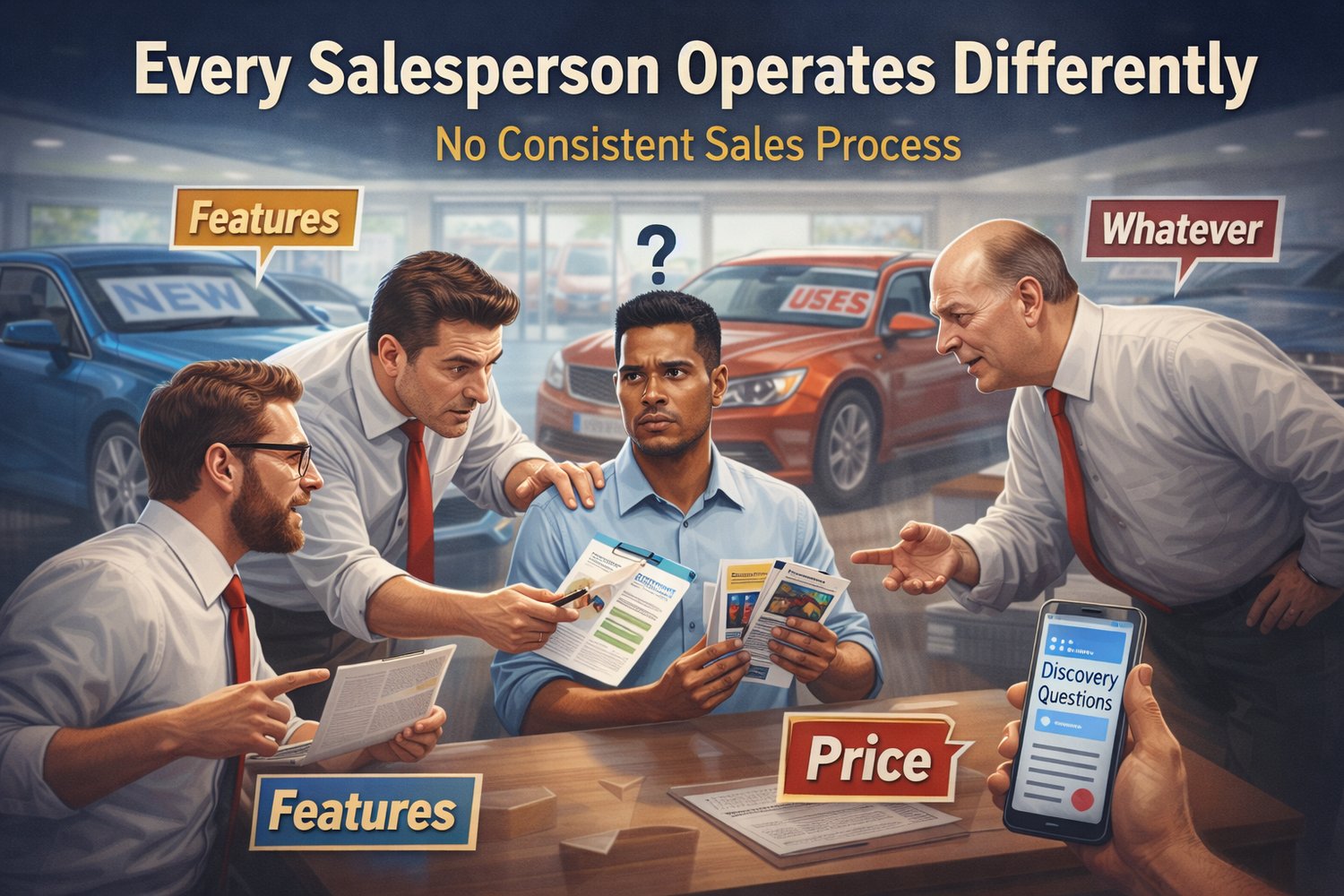
Instead of developing a consistent sales process, dealerships unintentionally create a showroom where every salesperson operates differently.
Some focus on features. Others jump quickly to price. Some rely heavily on personality, while others struggle to guide the conversation at all.
The result is inconsistency.
For dealership managers, this inconsistency creates daily frustration. It’s the moment when you watch a new salesperson greet a customer and within seconds you can tell the conversation is heading in the wrong direction. The customer asks a question the salesperson isn’t prepared for. The conversation stalls. Confidence disappears on both sides of the desk.
Now the manager has a choice to make: step in and rescue the deal or let the salesperson struggle and hope they figure it out.
This scenario plays out in dealerships across the country every day.
The problem isn’t that new salespeople lack motivation. In fact, most new hires are highly motivated when they start. They want to succeed. They want to make money. They want to prove themselves.
The real issue is much simpler.
Most dealerships never give them a clear process to follow.
The Hidden Cost of Unstructured Training
Training in automotive retail often happens reactively instead of proactively.
Managers coach salespeople in the middle of a deal instead of preparing them before the opportunity occurs. When a customer interaction goes poorly, the manager explains what should have happened afterward.
But by then, the opportunity is gone.
This reactive training style creates several hidden costs for dealerships.
First, it slows down the productivity of new hires. Without a defined process, salespeople spend weeks or months trying to figure out what experienced professionals already understand intuitively.
Second, it increases the burden on managers. Instead of focusing on strategy, forecasting, and leadership, managers spend a large portion of their day answering the same basic questions repeatedly.
Questions like:
“What should I ask next?”
“How do I handle this objection?”
“When should I present numbers?”
“How do I ask for the sale?”
When salespeople lack structure, managers become the process.
Finally, unstructured training creates inconsistent customer experiences. Two customers visiting the same dealership on the same day may receive completely different levels of service depending on which salesperson they encounter.
In today’s competitive automotive market, that inconsistency can cost dealerships both sales and long-term customer relationships.
What Successful Dealerships Do Differently
The most successful sales organizations, inside and outside the automotive industry, share one important characteristic.
They operate with a clearly defined sales process.
A sales process does not eliminate personality or flexibility. Instead, it provides a roadmap that guides both the salesperson and the customer through the buying experience.
This structure allows salespeople to focus their energy on building relationships instead of trying to figure out what step comes next.
In high-performing dealerships, every salesperson understands the general flow of the sales conversation.
- They know how to greet a customer professionally.
- They understand how to ask discovery questions.
- They know how to conduct a purposeful walk-around and test drive.
- They understand when and how to present numbers.
- And they know how to guide the customer through closing, finance, delivery, and follow-up.
Instead of guessing, they follow a process.
For managers, this structure makes coaching dramatically easier. When everyone operates within the same framework, it becomes much easier to identify where a deal is breaking down and how to improve performance.
The Importance of a Clear Sales Roadmap
Think of the sales process like a map.
Without a map, salespeople wander from one part of the conversation to another, sometimes skipping important steps entirely. They may jump directly into discussing price before establishing value, or they may attempt to close the deal before fully understanding the customer’s needs.
With a map, every step has a purpose.
The greeting establishes professionalism and rapport.
Discovery questions reveal what matters most to the customer. Instead of guessing which features to highlight, the salesperson learns about driving habits, lifestyle needs, budget considerations, and previous vehicle ownership.
The vehicle walk-around becomes focused and relevant because it highlights the features that matter most to that particular buyer.
The test drive allows the customer to experience the vehicle rather than simply hearing about it.
By the time numbers are presented, the customer has already built confidence in both the vehicle and the salesperson.
At that point, the conversation becomes far more natural.
The Role of Closing Techniques
Many sales training programs focus heavily on closing techniques. While closing skills are important, they are often misunderstood.
Closing is not a single moment in the sales process. It is the natural outcome of a series of well-executed steps.
When discovery is thorough, when value is clearly demonstrated during the walk-around and test drive, and when the customer understands the vehicle’s benefits, the final close becomes much easier.
In contrast, when earlier steps are rushed or skipped entirely, closing techniques become a desperate attempt to salvage a conversation that never developed properly.
This is why strong sales systems emphasize the entire journey rather than focusing exclusively on the final step.
Building Confidence in New Salespeople
One of the biggest benefits of a structured sales process is confidence.
New salespeople often struggle not because they lack ability, but because they lack clarity. When they are unsure what question to ask next or what step comes after the test drive, hesitation becomes visible to the customer.
Customers quickly sense uncertainty.
On the other hand, when salespeople understand the structure of the conversation, they appear more confident and professional. They know what questions to ask, what information to gather, and how to guide the buyer through the decision process.
Confidence builds trust.
Trust builds sales.
The Manager’s Perspective
For dealership managers, implementing a clear sales process can dramatically reduce stress and improve team performance.
Instead of constantly stepping into deals, managers can focus on coaching specific steps within the process. If a salesperson struggles during discovery, the manager can focus training there. If the walk-around lacks impact, that step can be improved.
The process creates a shared language for coaching and development.
It also makes onboarding new hires much faster. Rather than relying on observation and guesswork, new employees learn the structured framework used throughout the dealership.
This shortens the learning curve and helps new hires become productive more quickly.
A Modern Approach to Sales Training
The automotive industry has changed dramatically over the past decade. Customers now arrive at the dealership with more information than ever before. Many have already researched pricing, features, and vehicle comparisons online before stepping onto the showroom floor.
Because of this, the role of the salesperson has evolved.
Today’s sales professionals are not simply information providers. They are guides who help customers navigate choices, confirm decisions, and move confidently toward ownership.
This role requires structure.
A clear, modern sales process ensures that salespeople remain focused on the customer’s needs while maintaining momentum throughout the buying experience.
Moving Toward a More Structured Future
Dealerships that embrace structured sales training create stronger teams and better customer experiences.
Salespeople gain confidence faster. Managers spend less time rescuing deals. Customers receive a more professional and consistent buying experience.
Over time, this consistency leads to higher closing ratios, stronger customer satisfaction scores, and improved retention within the sales team.
In a competitive marketplace where margins are tighter and customer expectations are higher, a clearly defined sales process is no longer optional.
It is essential.
If you're a dealership manager looking for a clear framework to onboard new salespeople faster, explore the CarBizTraining 10-Step Sales System at CarBizTraining.online