
Most people would rather accept a lower salary than write the email asking for more.
I know this because I have been on the other side of that email for seven years.
As an HR Consultant I have processed hundreds of job offers.
I have watched candidates accept salaries $5,000, $10,000, even $15,000 below what we were prepared to pay — simply because they never sent one email.
ONE EMAIL.
That is the difference between what you are offered and what you actually deserve.
Today, I am giving you that email.
A complete salary negotiation letter template, written from the HR side of the table, structured to get results, and ready to personalize in under ten minutes.
Why Most Candidates Never Negotiate in Writing
Before I shared the template, you need to understand something that will change how you approach this forever.
Hiring managers expect negotiation.
Not hope for it. Not tolerate it. Expect it.
When a candidate accepts the first offer without question, experienced hiring managers often think one of two things.
- Either this person does not know their market value.
- Or they are so desperate they will take anything.
Neither impression serves you well as you begin a new role.
A professional, well-written salary negotiation letter does the opposite.
- It signals that you know your worth.
- That you have done your research.
- That you are the kind of professional who advocates for themselves which is exactly the kind of professional most organizations want to hire.
The letter is not confrontational. It is not aggressive. It is not an ultimatum.
It is a professional conversation. In writing.
And it works far more often than candidates realize.
What a Salary Negotiation Letter Must Achieve
Before I give you the template — here is what it needs to do at every stage.
- Open with genuine enthusiasm: You must make it clear you want the role. Negotiation should never read and dissatisfaction or threat. It reads as professional due diligence.
- Anchor to market value, not personal need: The moment you say "I need more because of my rent" you have lost the negotiation. The moment you say "based on my research into current market rates for this role" you have grounded your request in data which is infinitely harder to dismiss.
- Be specific: Vague requests get vague responses. "I was hoping for something a bit higher" gets "we'll see what we can do." A specific number gets a specific counter. Always give a specific number.
- Leave room for conversation: A salary negotiation letter is the opening of a dialogue — not a take-it-or-leave-it ultimatum. The tone should always invite a response.
- Close with confidence: Reaffirm your enthusiasm for the role. Make it easy for them to say yes.
The Free Salary Negotiation Letter Template
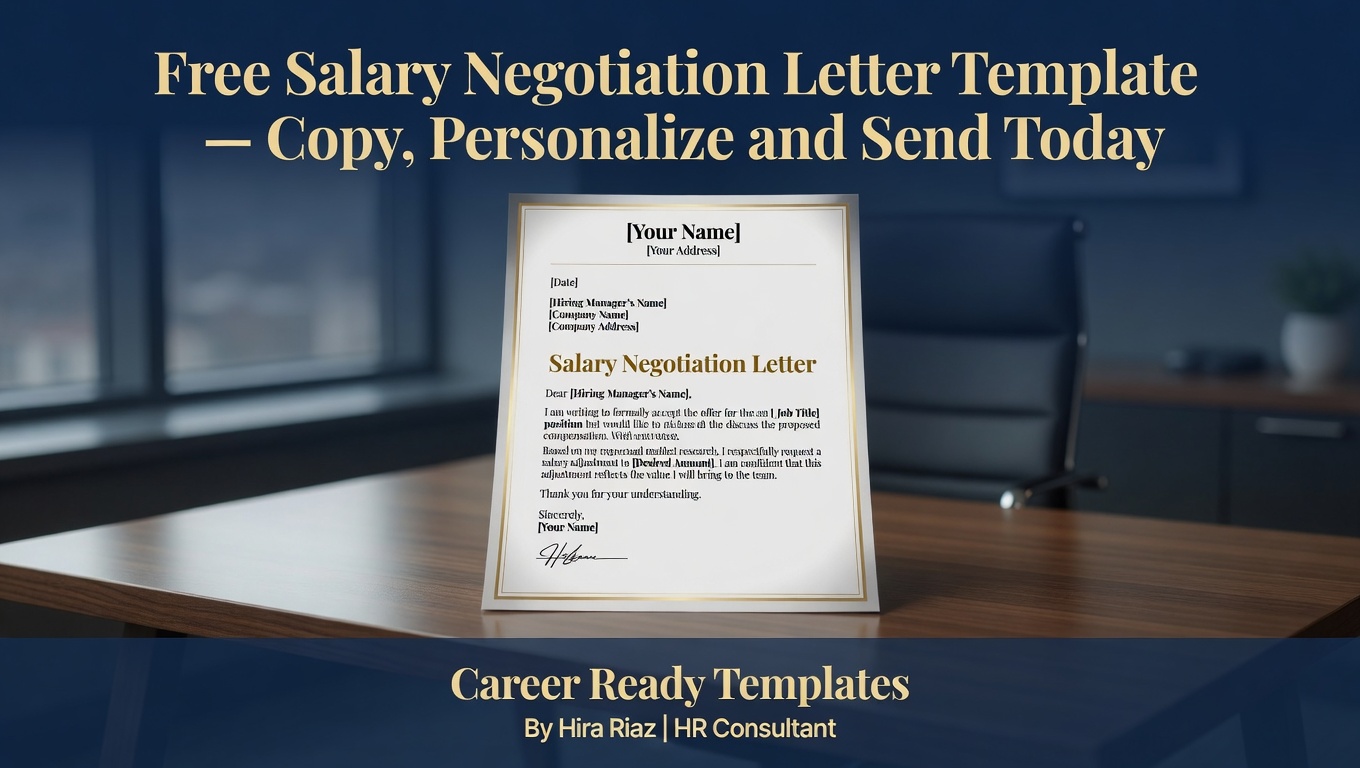
Copy this template. Replace every section in brackets with your specific details. Send it within 24-48 hours of receiving your offer.
Subject line: [Your Name] — [Job Title] Offer — Salary Discussion
Dear (Hiring Manager Name),
Thank you so much for offering me the (Job Title) position at (Company Name). I am genuinely excited about this opportunity and I am very much looking forward to contributing to (specific team, project or company goal you discussed in the interview).
After careful consideration of the offer, I would like to discuss the base salary. Based on my research into current market rates for (Job Title) roles in (location/industry), as well as my (X years) of experience in [specific relevant area], I was expecting a base salary in the range of (your target salary figure).
I bring [mention 2-3 specific, relevant strengths (e.g., proven experience in X, track record of Y, expertise in Z) that I believe position me strongly to deliver results in this role from day one.
With this in mind I would like to respectfully propose a base salary of (specific figure). I believe this reflects both the market rate for this position and the value I would bring to (Company Name).
I remain very enthusiastic about joining the team and I am confident we can reach an agreement that works for both of us. I am happy to discuss this further at your convenience.
Thank you again for this opportunity. I look forward to hearing from you.
Warm regards
(Your Full Name) (Phone Number) (LinkedIn Profile URL)
How to Fill In the Template — Section by Section
Subject line:
Keep it professional and clear. Include your name and the role title so it is immediately identifiable in a busy inbox. Never use a vague subject line like "Regarding the offer" it gets deprioritized.
Opening paragraph:
This is your enthusiasm anchor. Before you say anything about money, make it crystal clear you want the job. Hiring managers need to know they are not about to lose you before they even consider your request. Reference something specific from your interview (a project, a team goal) something that signals you were genuinely paying attention.
The market research paragraph:
This is the most important sentence in the letter. "Based on my research into current market rates" transforms your request from a personal ask into a professional data point.
Research your target salary on LinkedIn Salary, Glassdoor, Levels.fyi, or industry salary surveys before you write this letter. Know your number and know why it is justified.
Your value statement:
Two or three specific strengths, not generic ones.
Not "strong communication skills." Specific ones.
"Seven years managing enterprise ATS implementations across Fortune 500 companies." Specific value is hard to argue with. Generic value is easy to dismiss.
The specific figure:
Always higher than your actual target. If you want $75,000, ask for $78,000 or $80,000. This gives the hiring manager room to negotiate down while you still land where you need to be.
The closing:
Reaffirm enthusiasm. Signal flexibility.
Make it easy to say yes. You are not demanding, you are inviting a conversation.
What Happens After You Send It
Most candidates send the letter and then spend three days catastrophizing about whether they have ruined everything.
You have not ruined anything.
Here is what actually happens on the other side of that email.
The hiring manager reads it.
They check with HR or finance about whether there is flexibility in the budget.
They come back with one of three responses.
- Response one — they meet your number. This happens more often than you think. Especially when your request is backed by market research and delivered professionally.
- Response two — they counter somewhere in the middle. This is the most common outcome. You asked for $80,000. They offered $72,000. They come back at $75,000 or $76,000. You have still gained significantly more than if you had never asked.
- Response three — they say the offer is firm. This is the least common outcome. And even when it happens, you have not lost the job. Offers are almost never rescinded because a candidate negotiated professionally.
What you have lost is nothing. The offer is exactly where it was before you sent the letter. The risk of sending this letter is near zero. The potential gain is thousands of dollars annually, compounded across your entire career at this organization.
Send the letter.
The Salary Negotiation Mistakes to Avoid
- Mistake one — negotiating verbally without following up in writing. Verbal negotiations get forgotten, misremembered or conveniently reinterpreted. Always put your negotiation in writing. It creates a clear record and signals professionalism.
- Mistake two — Apologizing for negotiating. Never open with "I'm sorry to ask but..." You have nothing to apologize for. Negotiation is a professional norm and not an imposition.
- Mistake three — giving a range. "I was thinking somewhere between $70,000 and $80,000." The hiring manager hears $70,000. Always give a specific figure.
- Mistake four — waiting too long. Send your negotiation letter within 24-48 hours of receiving the offer. Waiting longer signals uncertainty or indecision. Acting promptly signals confidence.
- Mistake five — making it personal. Your mortgage, your student loans, your cost of living, none of this is relevant to the hiring manager. Your market value and your professional contribution are. Ground your request in data not circumstance.
One More Thing Before You Send
Read the letter out loud before you send it.
- If any sentence sounds apologetic, rewrite it.
- If any sentence sounds aggressive, soften it.
- If any sentence sounds vague, make it specific.
The tone you are aiming for is calm, confident and collaborative. A professional conversation between two people who both want to reach an agreement.
That tone wins negotiations more often than any specific script or tactic.
Your Next Step
Use this template for your next offer negotiation. Personalize every section with your specific details, your specific research, and your specific value.
And remember, the worst they can say is no. The offer stays exactly where it is. You have lost nothing.
But if they say yes or even if they meet you halfway, you have gained something that compounds for the rest of your career at that organization.
Grab our complete Salary Negotiation Scripts and Conversation Templates — 25 ready-to-use scripts covering every salary negotiation scenario including counter offers, raise requests, promotion conversations and difficult pushback responses.
If you want to have a step by step guide towards the complete salary negotiation (including how to do market research), get your Salary Negotiation Guide.
And if you are still working on getting to the offer stage — free ATS Resume Checklist makes sure your resume actually reaches the recruiter's desk.
Written by Hira Riaz | HR Consultant