

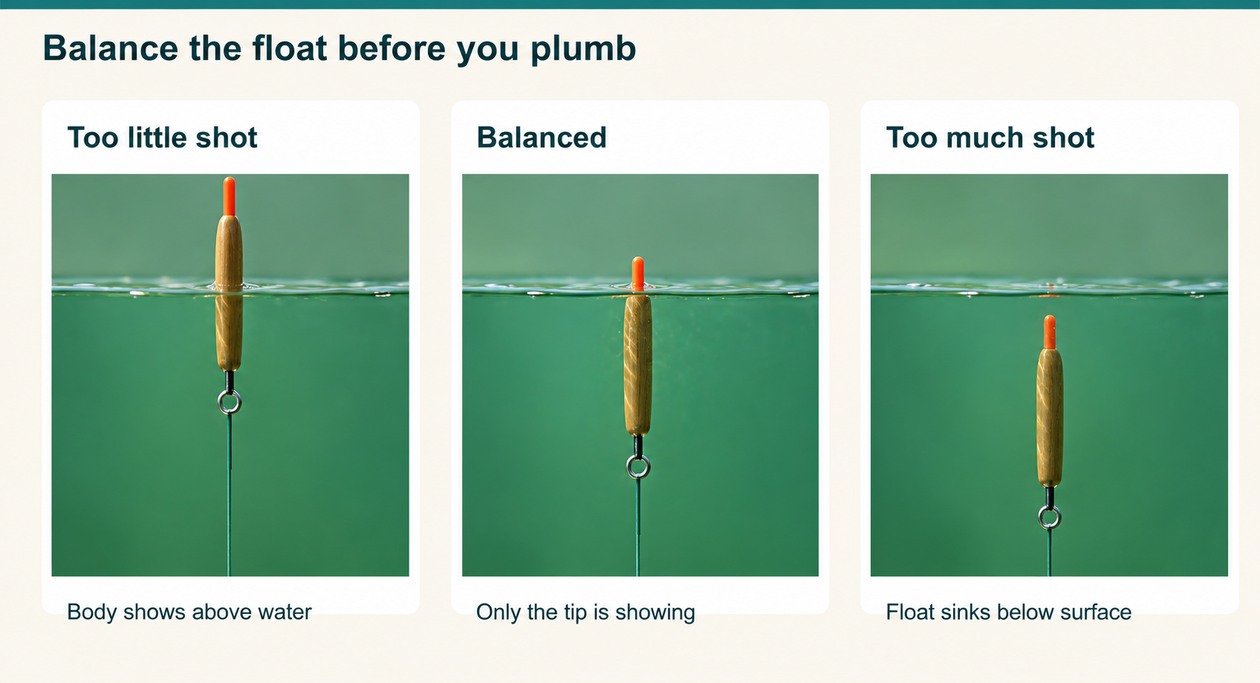
A float tells you much more when it is set up properly. If half the body is waving about above the surface, you may struggle to spot a delicate bite. If it disappears before a fish gets anywhere near it, something needs adjusting.
There are two separate jobs: balance the float with weight, then measure the depth. Keep them separate and the whole process becomes easier to understand.
First, balance the float
A waggler attaches to the line at its bottom eye. With your rig assembled, set a shallow depth and check it close in where the hook and all the shot can hang freely, clear of the bottom.
Add small amounts of non-toxic shot until the float’s body sits under the water and enough coloured tip remains visible to watch comfortably. Let it settle after each adjustment. If it sinks, remove a little weight. The marking on a float is a starting point; the water test is what matters.
A loaded float already carries some weight, so it will not need the same shot as an otherwise similar unloaded float. Follow the instructions for the model you have, and use a shot tool rather than your teeth.
Next, fit a plummet
A plummet is a temporary depth-finding weight. Choose one suitable for your tackle. With a top-eye, soft-base design, pass the tied hook through the eye and secure its point in the soft base. Clip-on models work differently, so check their instructions.
Lower it or make a gentle short cast to a clear, nearby spot. Leave enough slack that your rod is not holding the float up. The plummet needs to overcome the float’s buoyancy when the hook cannot reach the bottom.
Read the float, then adjust
• If it sinks, move the float towards the rod to increase the float-to-hook distance.
• If it lies over or sits much higher than it did when balanced, shorten that distance a little.
• Repeat until the plummet rests on the bottom and the float tip sits at the surface.
Check the same spot, then a little either side, so a slope does not fool you. Remove the plummet before fishing. Begin with the bait just touching the bottom and check how a change of hookbait affects the float.
Want to see the steps?
The free eight-page sample includes balancing, plummet attachment and depth-setting illustrations. The complete Ultimate Beginner’s Guide to Coarse Fishing covers the earlier setup, knots, casting and fish-care skills too. Read the complete lessons before your first trip.