
Think about the last wireless job you finished. Access points mounted where the building allowed rather than where the plan wanted them, controllers configured late on a Friday, a client device that refused to roam cleanly, and a handover meeting where someone asked why coverage stops at the stairwell. That work — the mounting, the configuration, the arguing with physics, the explaining — is what GB0-342 is about.
The exam is called Building an H3C WLAN, and the name is unusually honest. It is not a theory paper with a vendor logo on it, and it is not a sales overview of a product family. It leads to the H3C Certified Senior Engineer For WLAN (H3CSE-WLAN) credential, and it is aimed at the person who actually puts wireless networks into buildings and keeps them running afterwards.
That makes it an unusual exam to prepare for, because much of the material will already be familiar. The risk is not that it is too hard; it is that it feels easy enough to skip the preparation, and then asks about the parts of the job you have always had someone else handle. This article is written for that position: what the exam is, what its numbers mean in practice, how to read the syllabus against your own experience, how to prepare without relearning what you already know, and what the credential changes.
Every exam fact here comes from its published information. Where that information is silent — prerequisites, retake policy — the article says so and points you to H3C's official pages rather than guessing.
What Is the H3C GB0-342 Building an H3C WLAN Exam?
GB0-342 is the exam code for Building an H3C WLAN, and passing it leads to the H3C Certified Senior Engineer For WLAN credential, written as H3CSE-WLAN. It sits in the Wireless category of H3C's certification programme and is scheduled through Prometric.
Two parts of that description matter to a working engineer. The first is the word "Building". The exam is organised around the act of putting a WLAN into service: planning it, configuring the equipment, making it secure, and confirming it works. That framing is why practical experience is worth so much here. Someone who has deployed wireless has already met most of the situations the syllabus describes, even if they have never seen them written down as topics.
The second is "Senior Engineer". This is not an introductory credential. A senior-level exam assumes you can reason about a deployment as a whole rather than recite what a setting does. In practice that means questions are more likely to describe a situation and ask what you would do than to ask for a definition.
Who the exam is for
The natural candidate works with H3C wireless already: engineers at integrators and partners who deploy it for customers, in-house staff who run campus or branch wireless, and support engineers who inherit networks built by somebody else. It also suits engineers from other wireless ecosystems moving into an H3C estate, who know the fundamentals and need the vendor-specific layer.
The published exam information does not list prerequisites, so check the official H3C WLAN certification pages before assuming anything about eligibility or about how this exam fits into the wider programme.
What "practitioner-level" really means here
There is a difference between knowing a product and knowing a deployment. Plenty of engineers can configure an access point correctly and still produce a network that performs badly, because the decisions that matter were made earlier: where devices went, how channels were planned, what the client population actually is, and what the building does to radio. An exam about building a WLAN has to care about both halves. Expect to be asked about configuration, and expect that configuration to sit inside a situation.
GB0-342 Exam Overview and Details
These are the published exam details, and the only numbers this article relies on.
- Exam code: GB0-342
- Exam name: Building an H3C WLAN
- Certification: H3C Certified Senior Engineer For WLAN (H3CSE-WLAN)
- Duration: 60 minutes
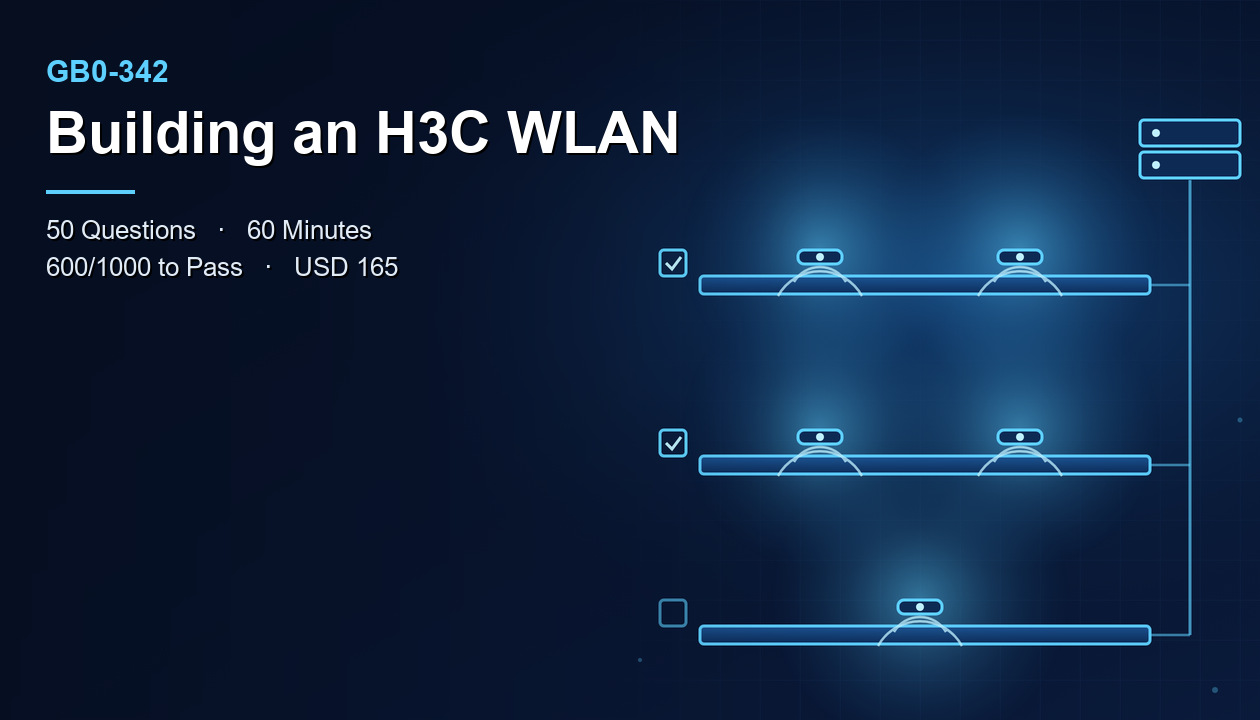
- Number of questions: 50
- Passing score: 600 / 1000
- Exam price: USD 165
- Scheduling: Prometric
Seventy-two seconds per question
Sixty minutes for 50 questions works out to 72 seconds each. That is a brisk pace. It is enough to read a short scenario and answer from knowledge you already have, but not enough to reason anything out from first principles more than a handful of times.
For a working engineer this has a specific implication. On the job, you look things up. Nobody minds if you check a command reference or a datasheet before making a change, and most of us have built careers on knowing where to look rather than holding everything in memory. The exam removes that option. The preparation task, therefore, is not to learn the material — much of it you have used — but to move it from "I know where to find this" to "I know this". Those are different states, and only the second one survives 72 seconds per question.
A practical pacing plan: aim to be at question 25 by the 30-minute mark, and flag anything that passes two minutes rather than fight it. On a 50-question paper, two or three questions consuming ten minutes between them is how good candidates run out of time.
A scaled score of 600 out of 1000
The published passing score is 600 out of 1000. That is a scaled score, not a percentage, so it does not translate neatly into "30 of 50 questions correct". Questions on a scaled exam need not be weighted identically, and the relationship between raw answers and the reported number is not something you can calculate in the exam room.
The practical consequence is the same as for any scaled exam: do not plan a narrow pass. Aim to be comfortable across the whole syllabus rather than working out how many questions you can afford to lose, because the arithmetic that would justify that plan is not available to you.
USD 165, and the cost of the resit you did not plan
At USD 165 the exam is mid-priced. For most engineers the fee is not the main cost of failing; the lost evenings and the delay to whatever the credential was meant to support usually matter more. The published information does not describe retake rules or waiting periods, so check the official pages rather than assuming you can rebook quickly.
Booking is through Prometric. If your previous exams were with a different test provider, look at available centres and formats early — availability can shape your date more than your readiness does.
Key Topics and Syllabus for GB0-342
The authority on what this exam covers is the GB0-342 Building an H3C WLAN exam syllabus, which lists the official topic areas and any weighting H3C publishes. This article does not reproduce domain names or percentages; invented ones would send your study in the wrong direction. What follows is a way of reading that syllabus as a practitioner: the competences a "build a WLAN" exam is concerned with, and the question to ask yourself about each.
Wireless fundamentals behind the product
Every vendor's wireless equipment implements the same underlying behaviour: radio energy that weakens with distance and obstruction, a shared medium where devices take turns, and standards that define how they do it. A senior-level exam assumes this layer even when it asks about a product feature. Read the syllabus for the fundamentals it lists, and ask yourself whether you could explain each one to an apprentice without reaching for a vendor term. If you cannot, that is where to start, because the product-specific material makes far more sense on top of it.
WLAN architecture and the roles equipment plays
A deployment is a set of components with defined jobs: the devices that serve clients, whatever controls or coordinates them, and the wired network behind both. The competence being tested is understanding which component does what, and what changes when you choose one arrangement over another. Ask yourself: could I sketch the architecture of the last network I worked on, including what happens if one part of it is unavailable? Practitioners often know this implicitly and have never had to state it.
Planning and designing the deployment
This covers everything that decides whether the finished network works: coverage planning, where devices go, channel and capacity decisions, and the constraints a building imposes. Look for syllabus topics about planning and design. The practitioner's question here is uncomfortable but useful: how much of the design on my last project did I actually make, and how much did I inherit? The parts you inherited are your gaps, regardless of how many deployments you have completed.
Configuring and commissioning the network
This is the heart of a "building" exam and the area most candidates feel safest in. Expect the syllabus to cover the configuration needed to bring a WLAN into service. The trap is familiarity: engineers often know one path through the configuration — the one their employer's standard build uses — and have never touched the alternatives. Ask yourself which options you always set the same way without considering the others. Those settings are where exam questions find people out.
Wireless security
Security on an invisible, shared medium has its own logic: how users and devices are authenticated, how traffic is protected, and how access is controlled. Read the syllabus for the security topics it lists, and make sure you can explain what each approach protects against and what it costs in complexity. Many practitioners have deployed exactly one security model many times; the exam may ask about the one you have not.
Verification, monitoring, and troubleshooting
Finally, building a WLAN includes proving it works and fixing it when it does not. Expect topics on verification and troubleshooting, and treat them as the most practitioner-friendly part of the syllabus: this is where your field experience is worth the most. The one habit worth examining is whether you troubleshoot by evidence or by pattern. Experienced engineers often jump to a fix that has worked before, which is efficient at work and risky on an exam that describes a scenario designed to resemble a familiar problem without being one.
A worked example makes the difference clear. A user reports that their laptop drops the network when they walk from one end of a floor to the other. The pattern-matching answer is immediate: coverage is weak in the middle, add an access point. That answer is often correct in the field, which is exactly why it is dangerous. A scenario question will usually include a detail that rules it out — signal strength is strong the whole way, say, or only one type of device is affected, or the problem started after a configuration change rather than after the floor was reorganised.
Reading from evidence instead means asking what each detail eliminates. Strong signal throughout points away from coverage and toward how the client decides to move between access points, or how it is authenticated when it does. A single device type points toward client behaviour rather than infrastructure. A problem that began after a change points at the change. None of this is more difficult than what you do on site; it is simply more deliberate, and deliberate is what an exam rewards when it has deliberately included a distractor.
Practise by taking faults you have fixed and listing the evidence that would have distinguished your eventual answer from the two most plausible alternatives. That exercise is quick, it uses material you already own, and it directly trains the reading habit these questions assume.
Once you have the official syllabus in front of you, mark each area as "I have done this", "I have seen this done", or "new to me". That split, not a generic study plan, is what should decide where your weeks go.
GB0-342 Preparation Guide
The route below is written for someone who deploys wireless for a living and has limited evenings to spare. It is designed to convert experience into exam-ready knowledge rather than to teach the subject from scratch.
Step 1: Audit your experience honestly
Work through the syllabus with the three-way split above. Be strict about the difference between "I have done this" and "I have seen this done". Watching a colleague configure something, or following a runbook written by someone else, leaves you able to recognise the steps and unable to reason about them under time pressure.
Expect an uneven result. Most practising engineers are strong on configuration and commissioning, reasonable on troubleshooting, and thinner on planning and on the fundamentals underneath the product — because the job lets you succeed without articulating them. That pattern is normal and it is the whole point of doing the audit.
Step 2: Study the official material against your gaps
The published exam information lists an official Building an H3C WLAN course document from H3C. Work through it in the order your audit suggests rather than front to back: start with the areas you marked "new to me", then "I have seen this done", and treat the areas you have genuinely done as revision to confirm rather than relearn.
As you read, keep a list of anything you could not have explained before reading it. That list is both your revision sheet and your honest progress measure, which is more useful than counting pages.
Step 3: Use your own deployments as a lab
You have an advantage most candidates for other exams do not: real networks you already have access to. Use them deliberately. Take a site you support and reconstruct its design decisions — why the access points are where they are, how channels were allocated, which security model is in use and why. Where the answer is "because that is our standard build", go and find out what the alternatives were.
Then look at the parts of the configuration you never touch. Most engineers maintain a narrow working path through any product, and the unexplored branches are exactly what a senior-level exam samples. If you have access to a test environment, change one of those settings deliberately and observe what happens; if you do not, at minimum read what the option does and where it would be the right choice.
One more exercise is worth the hour it takes. Pick a site you did not build and work out, from the configuration alone, what the engineer before you was trying to achieve. Why that channel plan, that security model, those device placements? Some answers will be sound, some will be habit, and a few will be mistakes you now have to live with. Reading someone else's deployment is the closest thing to the exam's own framing, which presents you with a situation you did not create and asks what should happen next.
Step 4: Practise at exam pace and sort your mistakes
When the syllabus is covered, practise with questions under time pressure at around 70 seconds each. Afterwards, review every wrong answer and every lucky guess, and sort each into one of three causes: I did not know it, I knew it but was too slow, or I answered from my own environment rather than from the general case.
That third category deserves particular attention for practitioners. Years of doing things one way produce confident answers that are right in your building and wrong in the question's. When you catch one, write down the assumption behind it — those notes are the most valuable thing you will read the night before.
Step 5: Decide when to book
Book when three things hold. Your audit has no "new to me" items left. You can explain each syllabus area aloud without notes, including the fundamentals under the product. And your timed practice is consistently comfortable across every area, on questions you have not seen before, with no cluster of environment-specific mistakes left.
For an engineer deploying this equipment regularly, that is usually a few weeks of focused evenings. For someone whose wireless experience is with other vendors, allow longer for the product-specific material, and more again if the fundamentals were learned on the job rather than studied.
Benefits and Career Scope of H3CSE-WLAN
The published exam information contains no salary data, and none is invented here. What the credential changes is what you are trusted to do and how your experience is read by people who have not worked with you.
Your field experience becomes legible
Practitioners often have more capability than their CV can demonstrate. Years of deployments look, on paper, like a list of job titles. A senior-level wireless credential makes that experience legible to employers, customers, and procurement departments who need a reason to believe you can do what you say.
You move earlier in the project
Engineers known for installation get called at installation time. Engineers known for design get called when the project is being planned, which is when the interesting decisions are made and when it is still possible to prevent the problems you would otherwise be asked to fix later. Studying planning properly, not just configuration, is what moves you up that timeline.
Partner and tender work
For engineers at integrators and resellers, vendor certifications are often a practical requirement rather than a nice addition: they affect partner standing and can be named in customer requirements. A senior-level WLAN credential is the kind that gets counted when a bid is assembled.
You stop being the person who only knows the local build
Perhaps the quietest benefit. Preparing properly forces you out of the single configuration path your employer standardised on years ago, and into the alternatives. That makes you more useful on unfamiliar sites, better at judging whether the standard build still suits a new situation, and harder to strand when you change jobs.
Practice Test and Preparation Resources for GB0-342
The published exam information lists a small set of resources. Use each for what it does best.
Official certification pages. The H3C WLAN certification pages, linked earlier, are where to confirm current exam details, requirements, and policies. Check them when you start and again before booking.
Official course material. The Building an H3C WLAN document, linked in the preparation guide, is the study material listed for this exam. It is written against the product the exam tests, which makes it the most reliable route through your gaps.
Sample questions. Before buying anything else, work through the free GB0-342 sample questions and answers. For a practitioner these are especially useful early rather than late: they show quickly whether your working knowledge is stated the way the exam states it, which is a different thing from whether you can do the job.
Scheduling. The exam is booked through Prometric. Check available formats and dates early so your study plan has a realistic target.
If you add a full practice exam, treat it as a diagnostic instrument. The score matters less than the pattern of errors and the study that follows it.
Conclusion
GB0-342 is a 60-minute, 50-question exam with a scaled passing score of 600 out of 1000 and a USD 165 fee, booked through Prometric. It certifies the work of building an H3C WLAN: planning it, configuring it, securing it, and proving that it does what the people using it need.
If that is already your job, the preparation is not about learning the subject. It is about three things: stating what you know rather than looking it up, exploring the parts of the product your standard build has let you ignore, and separating what is true everywhere from what is merely true in your buildings. Do that, and H3CSE-WLAN records what you can already do — in a form that other people can read.
FAQs
What is the GB0-342 exam?
It is H3C's Building an H3C WLAN exam. Passing it leads to the H3C Certified Senior Engineer For WLAN (H3CSE-WLAN) certification.
How long is the exam, and how many questions does it have?
The exam lasts 60 minutes and has 50 questions, which works out to about 72 seconds per question.
What is the passing score for GB0-342?
The passing score is 600 out of 1000. It is a scaled score rather than a percentage, so it does not convert directly into a number of correct answers.
How much does the GB0-342 exam cost?
The exam price is USD 165. Check the current fee for your region when you book.
Where do I book the exam?
GB0-342 is scheduled through Prometric. Check centre availability and formats early, especially if your previous exams used a different test provider.
What official study material is available?
The published exam information lists the Building an H3C WLAN course document from H3C, alongside the official certification pages.
Are there prerequisites or retake rules?
The published exam information does not list them. Check H3C's official certification pages for current requirements and policies.
I deploy wireless every week. Do I still need to prepare?
Yes. Field experience covers much of the syllabus, but the exam asks you to state things from memory in about 72 seconds, and it samples parts of the product your standard build may never use.