
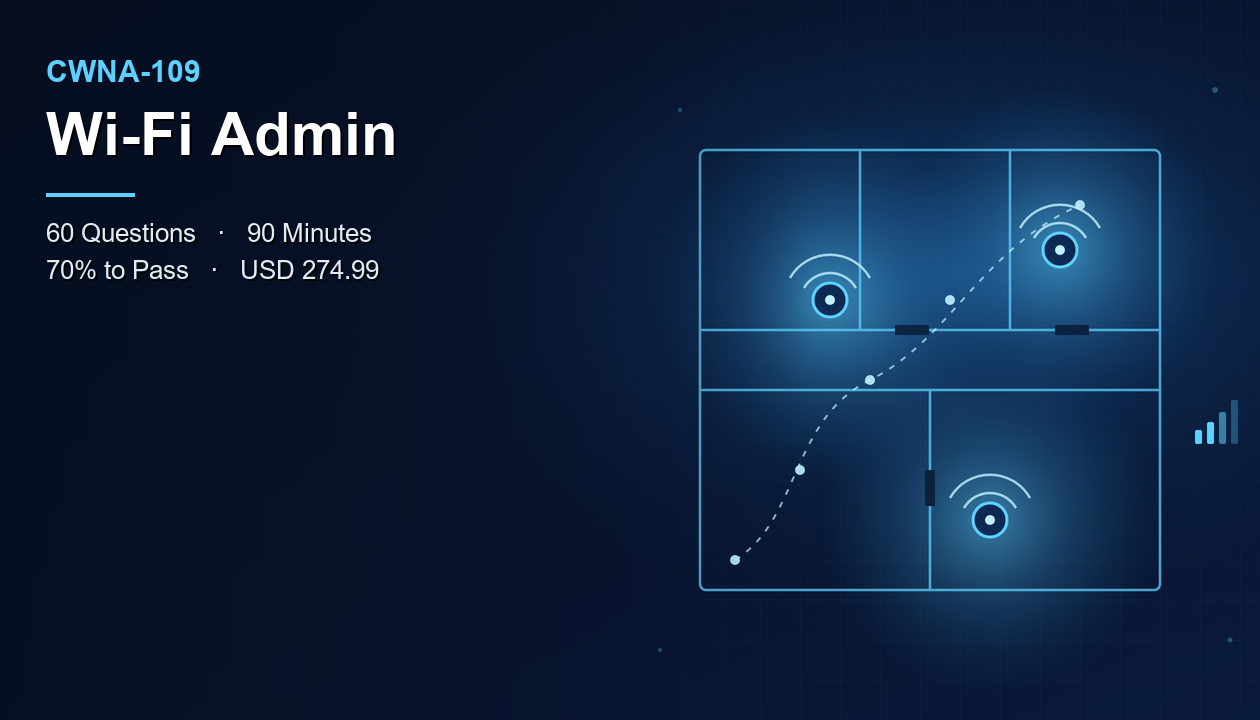
There is a particular moment in a network career when Wi-Fi stops being somebody else's problem. A user reports that video calls break up in one corner of the building. A warehouse deployment works perfectly during testing and falls apart once the shelves are full. A vendor's dashboard says every access point is healthy while the people who work there say the opposite. At that point, the engineer who can explain what radio waves are actually doing becomes the most useful person in the room.
CWNA-109 is the exam that certifies that person. It leads to the CWNP Certified Wireless Network Administrator credential, and it is vendor-neutral: it is about how Wi-Fi works rather than how one manufacturer's product exposes it. That distinction is what makes it a career credential rather than a product one. Learn a vendor's interface and you can operate that vendor's equipment. Learn what CWNA-109 covers and you can walk into any wireless environment and reason about it.
This article looks at the exam through that lens: where it sits in a career, what it changes about the work you get asked to do, and how to prepare for it properly. It covers what the exam is, what its numbers mean in practice, how to read the syllabus without guessing at its contents, a preparation route you can follow while working, and the resources the exam data lists.
Every exam fact here comes from the published exam information. Where that information is silent, such as on prerequisites or retake policy, the article says so and sends you to CWNP's official pages rather than filling the gap.
What Is the CWNA-109 Certified Wireless Network Administrator Exam?
CWNA-109 is the exam code for CWNP's Wi-Fi administrator certification. The credential it leads to is the CWNP Certified Wireless Network Administrator, usually written as CWNA, and the exam sits in the Wireless Network category. It is scheduled through Prometric rather than through Pearson VUE, which catches out candidates used to booking other vendors' exams.
CWNP is a certification body rather than an equipment manufacturer, and that shapes what the exam asks. There is no product to learn the menus of. What remains is the behaviour that every wireless network shares, whichever badge is on the access points: how radio frequency energy travels and weakens, how antennas shape coverage, how the 802.11 standards arrange access to a shared medium, how clients and infrastructure interact, how security is applied, and how to measure and validate what you have built.
That is why the credential travels well. Organisations change vendors; the physics does not. An engineer whose wireless knowledge is entirely expressed in one manufacturer's terminology has to relearn a vocabulary each time the estate is refreshed. An engineer with CWNA-level fundamentals translates between vendors instead, because they already understand what the vendor-specific feature is doing underneath.
Where it sits in a career
CWNA is typically the point where wireless stops being a sideline and becomes a recognised part of what you do. Before it, most engineers pick up Wi-Fi in fragments: a controller upgrade here, a coverage complaint there, a site survey someone else validated. The knowledge is real but patchy, and it tends to fail exactly when a problem is unusual.
After it, you have a complete model rather than fragments. That changes the questions people bring you. Instead of "can you add this SSID?", it becomes "why does this area perform badly, and what should we do about it?" Instead of implementing a design, you are asked to review one. For engineers whose next step is wireless design, analysis, or security specialisation, CWNA is the base those paths are built on. The published exam information does not list prerequisites, so check the official CWNA certification page for current requirements before assuming any.
Who should sit it
The natural candidate is a network engineer or administrator who already supports wireless in some form and wants to stop guessing. It also suits systems and support staff who inherit Wi-Fi complaints, engineers at partners and integrators who deploy wireless for customers, and anyone whose employer is about to run a refresh where the design decisions matter more than the installation.
CWNA-109 Exam Overview and Details
These are the published exam details, and the only numbers this article relies on.
- Exam code: CWNA-109
- Exam name: CWNP Wireless Network Administrator
- Certification: CWNP Certified Wireless Network Administrator
- Duration: 90 minutes
- Number of questions: 60
- Passing score: 70%
- Exam price: USD 274.99
- Scheduling: Prometric
Ninety seconds per question, and what that buys you
Ninety minutes for 60 questions is exactly 90 seconds per question. That is a comfortable pace by certification standards, and it is enough time to read a scenario, picture the environment it describes, and choose between two answers that both look plausible at first glance.
It is not, however, enough time to derive things you have not internalised. Wireless has a handful of relationships that come up repeatedly, and if you have to reconstruct each one from scratch during the exam, the clock will catch you. Aim to reach question 30 by the 45-minute mark, and treat any question that passes two minutes as one to flag and revisit rather than fight.
A published passing score, and the arithmetic it allows
Unlike many exams, this one publishes a real percentage: 70%. With 60 questions, that is 42 correct answers, which means you can afford 18 wrong ones. Knowing the number is useful, but it can also mislead you if you plan around it.
Eighteen sounds generous until you consider how errors cluster. Candidates rarely miss questions at random; they miss them in the areas they avoided while studying. If one topic area accounts for a sixth of the exam and you are weak in it, a large share of your allowance is gone before you answer anything else. The safer way to read the 70% figure is as a floor that balanced preparation clears comfortably, not as a budget to spend.
The cost, and the resit question
The exam costs USD 274.99, which puts it in the range where most individuals think carefully before booking and most employers want a reason. The published exam information does not describe retake rules or waiting periods, so check CWNP's official pages rather than assuming you can rebook immediately.
Worth noting for planning: because the exam is delivered through Prometric, the booking process, available dates, and test-centre or online-proctoring options may differ from what you are used to with other vendors. Look at that early rather than on the day you decide you are ready.
Key Topics and Syllabus for CWNA-109
The authority on what this exam covers is the CWNA-109 exam syllabus, which lists the official topic areas and any weighting CWNP publishes. This article does not reproduce domain names or percentages, because invented ones would misdirect your study. What follows is a set of lenses for reading the official syllabus: the competences a vendor-neutral Wi-Fi administrator exam is concerned with, and what each one changes about the work you can do.
Radio frequency behaviour
Everything in wireless rests on how radio energy travels, weakens, reflects, and interferes. This is the part most engineers have absorbed only in fragments, and it is the part that makes the difference between describing a problem and explaining it. When you read the syllabus, treat anything about RF characteristics, signal strength, and propagation as foundational rather than introductory. If you can explain why signal strength falls the way it does, why a measurement in one place says little about a spot ten metres away, and why two adjacent networks affect each other, the rest of the material has something to attach to.
Antennas and coverage
Antennas turn radio theory into a shape on a floor plan. The competence being tested is understanding how different antenna types distribute energy, how mounting and orientation change coverage, and why the same access point performs differently in an office, a warehouse, and an atrium. This is also where careers change: an engineer who can look at a building and anticipate where coverage will struggle becomes part of design conversations rather than being handed the result.
802.11 standards and how the medium is shared
Wi-Fi is a shared medium, and the standards define how devices take turns on it. Look for syllabus content on the 802.11 standards, frames, and channel access. The underlying competence is understanding why throughput is not simply a matter of speed ratings: why more clients on one channel slow each other down, why a distant slow client affects everyone, and why a network that looks fine on paper can feel slow in use. This is the reasoning that lets you answer the question every organisation eventually asks, which is why the Wi-Fi feels slow when the dashboard says it is healthy.
It is worth working that example through, because it is the clearest illustration of why this material matters. Picture a meeting room where people complain about video calls, served by an access point that reports no faults, no errors, and a strong signal for every connected device. On the wired network, "no errors and plenty of link speed" would genuinely mean the problem lies elsewhere. On a shared radio medium it does not, because only one device can transmit on a channel at a time, and time is the resource being shared rather than bandwidth.
Once you think in terms of airtime, the explanations appear. Devices that are far away or negotiating slower rates occupy the channel for longer to send the same data, which leaves less time for everyone else. A neighbouring network on the same channel consumes airtime that never appears in your own device's statistics. Traffic that is retransmitted because frames were not acknowledged consumes the channel twice. None of these show up as a fault on an access point, and all of them make a room feel slow.
An engineer who has internalised that will ask a different first question. Not "is the access point healthy?" but "what else is using this channel's time, and how efficiently is it being used?" That habit is worth more than any single fact in the syllabus, and it is exactly the kind of reasoning a 90-second scenario question is built to reward.
Network architecture and devices
An administrator has to understand the components: access points and the various ways they can be managed, clients of very different capability, and how wireless connects into the wired network behind it. Read the syllabus for architecture and hardware topics, and pay attention to the ways deployments are organised, because those choices determine what you can change centrally and what has to be handled per device.
Wireless security fundamentals
Security on a shared, invisible medium has its own logic. Expect the syllabus to cover authentication and encryption for wireless networks and the differences between the approaches an organisation might choose. The competence is being able to explain what each approach protects against and what it costs in complexity, so that you can advise rather than simply implement whatever was configured last time.
Site survey, validation, and troubleshooting
Finally, an administrator has to be able to measure. This covers surveying a site before and after deployment, validating that what was designed is what exists, and troubleshooting when it is not. The habit worth building here is evidence first: measure, then conclude. Many wireless problems are diagnosed confidently and wrongly because someone reasoned from the dashboard rather than from what the radio environment is doing where the users are.
Once you have the official syllabus in front of you, map its areas onto these six lenses and rate yourself on each. Where your rating is low, note whether the gap is knowledge or experience, because those need different fixes.
CWNA-109 Preparation Guide
The route below assumes you work full time and support wireless in some capacity, but have never studied it systematically. It is designed to convert scattered experience into the complete model the exam expects.
Step 1: Map your fragments against the syllabus
Print the syllabus and go through it honestly, marking each topic as "I could teach this", "I have seen it", or "new to me". Most experienced engineers find a striking pattern: strong on devices and configuration, thin on RF behaviour and measurement. That pattern is the whole reason CWNA exists, and finding it early tells you where the USD 274.99 is genuinely at risk.
Keep this map as your tracker for the whole preparation. Progress on this exam means moving items leftward on it, not finishing chapters.
Step 2: Build the physics first
Study RF behaviour before anything else, even though it is the least immediately practical material. Everything later in the syllabus makes more sense once it is in place: antenna choice, channel planning, security overhead, and survey results all become consequences rather than isolated facts.
The published exam information lists the CWNA All-In Digital Bundle as study material for this exam. Official material is written against the current exam version, which matters for a certification that revises as the standards evolve. Work through it in the order your map suggests rather than front to back.
Step 3: Attach every concept to something you can observe
Wireless rewards observation more than almost any other networking subject, because the medium is invisible until you measure it. Wherever you can, pair each concept with something you look at directly: walk a floor and watch how signal strength changes as you move, compare an area with obstructions to an open one, look at what your own client devices report, and examine how a busy channel behaves compared with a quiet one.
If your employer runs wireless, ask to be shown survey or validation data for a site you know, and try to predict what it will say before you see it. Predicting and then checking is the fastest way to turn read knowledge into the intuition that answers scenario questions inside 90 seconds. CWNP also lists live Wi-Fi design training classes, which are worth considering if you learn better with an instructor and hands-on exercises.
Be deliberate about what you measure with. A phone app that reports signal strength is enough to watch coverage change as you walk, and that alone teaches more about propagation than a chapter does. What it will not show you is how busy a channel is or what else is competing for it, so do not mistake a strong signal reading for a healthy environment. Knowing the limits of your own measurement is part of the competence being tested: the exam expects an administrator who can say what a given observation does and does not prove.
Step 4: Practise with questions and track where you lose marks
Once the syllabus is covered, work through practice questions under time pressure at 90 seconds each. Afterwards, review every wrong answer and every correct guess, and record which syllabus area each belongs to. After a few sessions the clusters will be obvious, and clusters are what the 70% threshold punishes.
Watch for a specific failure mode in this subject: answering from your own environment rather than from the principle. If your estate is one vendor, in one kind of building, with one client mix, some of your instincts are local rather than general. A vendor-neutral exam will find those. When you miss a question that way, write down the assumption that caused it.
Step 5: Decide when to book
Book when your map has no "new to me" items left, your practice scores are consistently and comfortably above the threshold across every area rather than on average, and you can explain each of the six competence lenses aloud without notes. Then check Prometric's scheduling options for your area, since availability may shape your date more than your readiness does.
For most working engineers this is a matter of a couple of months of steady evening study rather than a fortnight of cramming. The RF material in particular needs time to settle, because it is understanding rather than recall, and understanding is what 90 seconds per question is designed to reward.
Benefits and Career Scope of the CWNA Certification
The published exam information contains no salary data, and none is invented here. What the credential changes is the work you are given and the conversations you are invited into.
You become the person who explains, not just fixes
Wireless problems are unusually visible: they affect people directly, and everyone has an opinion. An engineer who can explain why an area performs badly, in terms a manager can follow, becomes the person consulted when the organisation decides what to do about it. That is a different role from the one that closes tickets, and it is the most immediate change CWNA tends to bring.
Your knowledge outlives your current employer's vendor
Because the certification is vendor-neutral, it does not expire when the estate is refreshed or when you move to an organisation that buys different equipment. Vendor certifications are valuable, but they are valuable in one ecosystem. CWNA's fundamentals apply everywhere, which makes it unusually portable as a career asset.
It opens the design and analysis path
For engineers who want to specialise, wireless design, analysis, and security are natural next steps, and all of them assume the fundamentals this exam covers. Holding CWNA makes it credible to ask for that work: surveys, design reviews, validation, and the analysis of problems that have defeated everyone else.
It makes you better at judging vendor claims
A quieter benefit, but a real one. Every wireless vendor markets features that promise to solve coverage and capacity problems. An administrator with CWNA-level knowledge can ask what a feature is actually doing to the radio environment and whether the problem in front of them is one it can address. That judgement protects budgets, and people notice who has it.
It travels into adjacent work
Wireless fundamentals increasingly matter outside the wireless team. Cloud-managed networking, secure access projects, and IoT deployments all depend on radio environments behaving predictably. Being the person who understands that layer makes you useful on projects that are not, on paper, about Wi-Fi at all.
Practice Test and Preparation Resources for CWNA-109
The published exam information lists a focused set of resources. Use each for what it does best.
Official certification page. The CWNA certification page, linked earlier, is where to confirm current exam details, requirements, and policies. Check it when you start studying and again before you book, since certification bodies revise exam versions periodically.
Official study material. The CWNA All-In Digital Bundle, linked in the preparation guide, is the study package listed for this exam. It is the most direct route through the syllabus.
Instructor-led training. CWNP's live class listing, also linked above, covers Wi-Fi design training. Worth considering if your gaps are in the practical, measurement-heavy parts of the syllabus, which are the hardest to close from reading alone.
Sample questions. Before buying anything extra, work through the free CWNA-109 sample questions and answers. They show how questions are framed and how deep the reasoning goes. Use them diagnostically: record the syllabus area of every miss and feed it back into your study map.
Scheduling. The exam is booked through Prometric's CWNP exam page. Check formats and availability early, because the options may differ from the vendor exams you have taken before.
If you add a full practice exam, treat it as a measuring instrument rather than a score to celebrate. The value is in the errors it exposes and the study that follows.
Conclusion
CWNA-109 is a 90-minute, 60-question exam with a 70% passing score and a USD 274.99 fee, booked through Prometric. Those numbers describe a fair, moderately paced exam. What they do not convey is what the credential does to a career: it turns scattered wireless experience into a model you can reason with, and it does so in terms that survive any change of vendor.
If wireless keeps landing on your desk and you keep solving it by pattern-matching, this is the exam that changes that. Map your gaps against the syllabus, build the RF fundamentals before anything else, attach every concept to something you can observe, and practise until your answers come from principles rather than from your own building. The result is not just the CWNA credential, but the ability to walk into an unfamiliar wireless environment and explain what is happening in it.
FAQs
What is the CWNA-109 exam?
It is CWNP's Wireless Network Administrator exam. Passing it leads to the CWNP Certified Wireless Network Administrator (CWNA) certification.
How long is the exam, and how many questions does it have?
The exam lasts 90 minutes and has 60 questions, which works out to exactly 90 seconds per question.
What is the passing score for CWNA-109?
The passing score is 70%. With 60 questions, that means 42 correct answers.
How much does the CWNA-109 exam cost?
The exam price is USD 274.99. Check the current fee for your region when you book.
Where do I book the exam?
CWNA-109 is scheduled through Prometric, not Pearson VUE. Its booking options may differ from other vendors' exams, so check availability early.
What official study material is available?
The published exam information lists the CWNA All-In Digital Bundle, and CWNP also lists live Wi-Fi design training classes.
Are there prerequisites or retake rules?
The published exam information does not list them. Check the official CWNA certification page for current requirements and policies.
Is a vendor-neutral certification worth it if my employer uses one vendor?
The fundamentals it covers apply to any wireless network, so the knowledge transfers when equipment or employers change, and it helps you understand what vendor-specific features are doing underneath.