
Most people in a Cisco partner organisation reach the 700-550 exam sideways. You were hired to sell, pre-sell, or manage accounts, and at some point your company decided to pursue work with United States federal agencies. Suddenly the conversations change. The customer is no longer a single IT director with a budget and a deadline; it is an agency with a mission, a contracting officer, rules about how technology can be bought, and a long memory for vendors who did not understand those rules. The Cisco US Federal Authorized Partner exam, code 700-550, sits exactly at that turning point in a career.
This is not a certification that proves you can configure a router or troubleshoot a wireless network. It belongs to the "Channel Partner and Other" category of Cisco exams: credentials aimed at the people who represent Cisco solutions to customers. What it changes is less about your technical depth and more about the kind of work you get trusted with. Before it, you might be the person who helps on a federal opportunity. After it, you are more likely to be the person who is expected to know how that opportunity should be handled.
That shift is worth taking seriously, because it is where the value of the credential really lives. A sixty-minute exam that costs USD 80 is a small investment in money. The larger investment is the attention you give to understanding a market that behaves differently from commercial selling. This article walks through what the exam is, what its numbers mean in practice, how to think about the syllabus without guessing at it, how to prepare in a way that actually sticks, and what the credential changes about your day-to-day role.
Throughout, the facts come from the published exam information itself. Where that information is silent, the article says so and points you to the official Cisco page or the syllabus rather than filling the gap with assumptions. For a federal-facing role, that habit is worth practising anyway.
What Is the Cisco US Federal Authorized Partner (USFAP) Exam?
The 700-550 exam is the test behind the Cisco US Federal Authorized Partner credential, usually shortened to USFAP. Its full product name is "700-550: Cisco US Federal Authorized Partner (USFAP)", and the certification it leads to carries the same name. It is a Cisco exam, scheduled through Pearson VUE, and it belongs to the family of 700-series exams that Cisco uses for partner-facing knowledge rather than for engineering tracks such as CCNA or CCNP.
The name tells you most of what you need to know about its purpose. "US Federal" sets the market: agencies and organisations of the United States federal government. "Authorized Partner" sets the audience: people working for companies that sell and deliver Cisco solutions through Cisco's partner channel. Put together, the exam is about being a Cisco partner who can be trusted to engage with federal customers properly.
It helps to be clear about what the exam is not. It is not a replacement for an engineering certification, and it will not teach you to design a secure network for an agency. It is also not a general sales course. It is narrower than both, and more specific: it concerns the knowledge a partner representative needs when the customer is the federal government. That narrowness is part of why it is short and relatively inexpensive, and it is also why people who treat it as a formality sometimes find it harder than expected. The exam assumes you are being prepared for a particular kind of responsibility.
Who tends to sit it? Based on its category and name, the natural audience is account managers, partner sales representatives, pre-sales staff, and practice leads inside partner organisations that work, or want to work, with federal customers. Technical staff who spend a lot of time on federal pursuits may also find it useful, because it gives them the vocabulary the commercial side of the deal is using. The published exam information does not list prerequisites or eligibility rules, so check the official Cisco USFAP exam page before you assume anything about who may take it or what it is required for.
Where it sits in a career
The credential is best understood as a marker of a transition. Early in a partner career, you learn Cisco's portfolio and how to position it. Later, you specialise: in a technology area, in a vertical, or in a type of customer. The federal market is one of the most distinctive of those specialisations, because it has its own purchasing behaviour, its own expectations about conduct, and its own consequences for getting things wrong. USFAP is the point where your organisation, and Cisco, can see that you have studied that specialisation deliberately rather than picking it up piecemeal on the job.
700-550 Exam Overview and Details
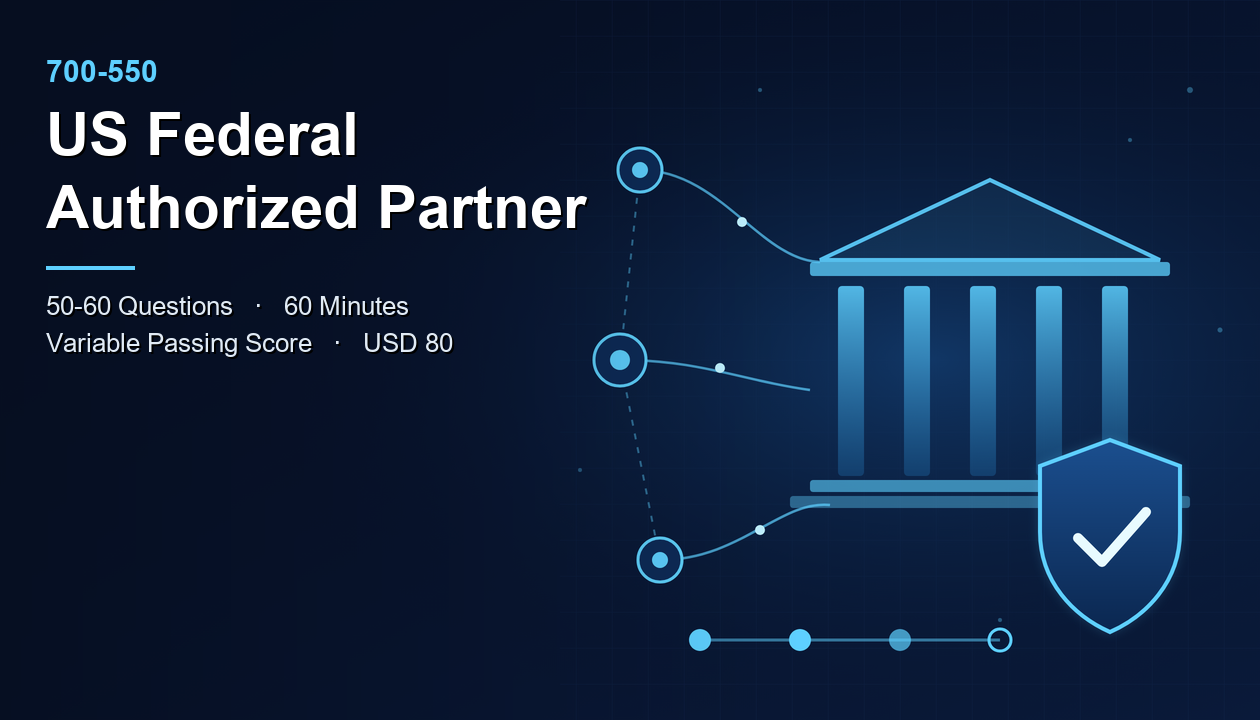
The published exam information gives the following details. These are the only numbers this article relies on.
- Exam code: 700-550
- Exam name: Cisco US Federal Authorized Partner (USFAP)
- Duration: 60 minutes
- Number of questions: 50-60
- Passing score: Variable (750-850 / 1000 Approx.)
- Exam price: USD 80
- Scheduling: Pearson VUE
- Category: Channel Partner and Other
What the time limit means per question
Sixty minutes for 50 to 60 questions works out to somewhere between 60 and 72 seconds per question. That is enough time to read a question carefully and think once, but not enough to deliberate at length on every item. If your exam lands at the upper end of the range, sixty questions in sixty minutes, you have exactly one minute each with nothing left over for review.
In practice this changes how you should prepare. An exam with this pace rewards recognition and understanding over reconstruction. If you have to reason your way from first principles to the answer on every question, you will run short of time. If you already understand the concepts well enough that most questions feel familiar, you can move through them quickly and bank time for the few that genuinely require thought. A sensible pacing plan is to aim to be around the halfway mark of the questions by the thirty-minute point, and to flag rather than wrestle with any item that is taking more than about ninety seconds.
What a variable passing score means
The passing score is listed as variable, approximately 750 to 850 out of 1000. That is not a percentage, and you should not read it as "you need 75 to 85 percent correct." Cisco reports scores on a scale, and the threshold on that scale can differ between versions of an exam. The practical takeaway is simple: you cannot plan to scrape through by counting how many questions you can afford to miss. Preparation that aims for comfortable mastery of the whole syllabus is the only reliable plan, because the precise cut-off for the form you sit is not something you will know in advance.
This also explains why candidates who feel they "mostly knew it" sometimes fail. On a scaled exam with a threshold that may sit toward the top of that range, "mostly" is not always enough. If your practice results hover near the lower end of comfortable, treat that as a signal to keep studying rather than a sign you are ready.
What the price means
At USD 80, the exam is inexpensive by certification standards. That can work against candidates, because a low price encourages a casual first attempt. The real cost of failing is not the fee. It is the time you spent preparing, the time until you can schedule again, and, if your role or your employer's plans depend on the credential, the delay to that work. The published exam information says nothing about retake rules, so check the official Cisco page for current policy rather than assuming you can simply try again next week.
Key Topics and Syllabus for the 700-550 Exam
The authority on what the 700-550 exam covers is the syllabus. Read the Cisco 700-550 USFAP exam syllabus before you plan anything else: it lists the official topic areas, and any weighting Cisco publishes for them. This article deliberately does not reproduce domain names or percentages, because inventing them would do you a disservice. Instead, the sections below describe the kinds of competence an exam with this name and audience is built to check. Use them as a lens for reading the official syllabus, not as a substitute for it.
Understanding the federal customer
Any exam aimed at partners who serve the US federal government has to test whether you understand who that customer is. A federal agency is not a company. Its priorities are shaped by its mission, by legislation, and by the public accountability that comes with spending public money. When you read the syllabus, look for the topics that describe how federal customers are organised and what drives their technology decisions. Those are the topics that change how you open a conversation, because the question is rarely "what will improve your margins?" and far more often "what will help you deliver your mission within the rules you operate under?"
How federal buying works
Federal purchasing follows formal processes that commercial sellers seldom encounter in the same form. A partner who does not understand how an agency is allowed to buy can waste months on an opportunity that could never close the way they imagined. As you work through the syllabus, pay attention to anything describing how purchases are made, who is involved, and in what order. The underlying competence is the ability to look at an opportunity and understand the path it must take, rather than assuming the path you would take with a commercial customer.
Conduct, compliance, and trust
Working with government customers brings expectations about conduct that are stricter and more consequential than in most commercial settings. A partner's behaviour reflects on Cisco as well as on the partner itself. Expect the syllabus to include material relating to the rules and responsibilities that apply when you represent Cisco to federal customers. This is the area where "roughly right" is not good enough, because the consequences of a mistake are not just a lost deal. Study it until you can explain it to a colleague without notes.
The Cisco partner relationship in the federal market
The word "Authorized" in the exam's name matters. The credential concerns partners working within Cisco's channel, which means understanding how Cisco and its partners work together on federal opportunities: who does what, how responsibilities divide, and how you coordinate with Cisco rather than working around it. Look for syllabus topics describing that relationship. The competence being tested is the ability to act as a reliable part of a joint effort, not as an independent reseller who happens to carry Cisco products.
Positioning Cisco solutions for federal missions
Finally, a partner exam naturally checks whether you can connect the portfolio to the customer's needs. In the federal market, those needs are often framed in terms of mission outcomes, security expectations, and long-term operational requirements. Read the syllabus for any topics describing how Cisco solutions are presented or aligned to federal customers. The skill here is translation: taking what a solution does and expressing it in the terms a federal stakeholder uses to judge whether it is worth buying.
Once you have read the official syllabus, map each of its topic areas onto one of these five lenses. Anything that does not fit cleanly deserves extra attention, because it is probably the part of the exam where your existing experience helps you least.
700-550 Preparation Guide
Preparation for a short, non-technical partner exam can look deceptively simple. The risk is not that the material is enormous; it is that it is easy to read once, feel familiar with it, and walk into the exam without the depth that a variable, scaled passing score demands. The route below is designed for someone who is working full time and wants to pass on the first attempt.
Step 1: Start from the official sources
Open two pages before anything else: the official Cisco USFAP exam page and the syllabus linked above. From the official page, confirm the current exam details, any prerequisites, and any recommended training Cisco lists. From the syllabus, copy every topic area into a working document. That document becomes your study tracker. Next to each topic, write one line on how confident you feel today: "comfortable", "partly", or "new to me". Be honest; this is for you.
The reason for starting here is practical. Many people prepare for partner exams by searching for summaries and notes. Those can help, but they can also be out of date or simply wrong, and in a compliance-heavy area, a wrong summary is worse than none. Anchor your preparation to the official material and use everything else as a supplement.
Step 2: Study by topic, and explain each one aloud
Work through the syllabus one topic area at a time, starting with the ones you marked "new to me". For each topic, find the relevant official material, read it, and then close it and explain the topic out loud in two or three minutes as if briefing a new colleague who has just joined your federal team. If you cannot do that without hesitating, you do not yet know it well enough for an exam that gives you about a minute per question.
This "explain it aloud" test is especially useful for material about processes and responsibilities. It is easy to recognise a correct statement when you see it; it is much harder to produce one. The exam will not ask you to produce a paragraph, but the ability to do so is a good sign that you will recognise the right answer quickly and avoid being tempted by one that is almost right.
Step 3: Connect every topic to a real scenario
Because the credential is about how you behave in a particular market, the best way to make the material stick is to attach each topic to a situation. For every syllabus area, write a short scenario from your own work or an invented but realistic one. For example: a federal customer asks you to move quickly on a purchase before a deadline. What do you need to understand about how that purchase can be made? Who else needs to be involved? What would be inappropriate for you to do or promise?
Scenarios turn abstract rules into judgement, and judgement is what exam questions in this area tend to test. If you work in a team that already sells to federal customers, ask a colleague who has done it for a while to review a few of your scenarios. Their corrections will be some of the most valuable study material you get.
Step 4: Practise under exam conditions
Once you have covered the syllabus, start practising with questions under time pressure. Set a timer for a block of questions at roughly one minute each. The goal is not only to check whether you know the answers but to practise the rhythm the real exam requires: read, decide, move on, and flag the few that need a second look. After each session, review every question you got wrong and every question you got right but guessed. Guessed-right answers are hidden weak spots, and they are exactly what a scaled passing score will expose.
Keep a simple log: date, number of questions, score, and the topic areas of the questions you missed. After three or four sessions, a pattern will emerge. Put your remaining study time into the topics that appear in that pattern, not into the ones you already find easy.
Step 5: Decide when you are ready
Book the exam when your practice results are consistently comfortable across all topic areas, not just on average. An average can hide one weak area, and on a short exam, a weak area that happens to be well represented on your form can cost you the pass. A reasonable test of readiness is being able to explain every syllabus area aloud and hitting your practice target on two separate sessions, a few days apart, without studying in between.
For most working candidates, this route fits into a few weeks of steady effort rather than a single weekend. The exact time depends on how much federal experience you already have. Someone who has supported federal deals for years will move quickly through much of it; someone new to the market should expect to spend more time on the early steps.
Benefits and Career Scope of the USFAP Credential
The benefits of USFAP are best described in terms of work rather than titles. The published exam information includes no salary data, and this article will not guess at any. What the credential changes is what you are trusted to do.
You become a credible owner of federal opportunities
In partner organisations that serve federal customers, there is a meaningful difference between being "on" a federal deal and "owning" one. Owners are expected to understand how the opportunity must be handled from the first conversation to the final order. A credential that specifically addresses the federal market is a visible signal that you have prepared for that responsibility. It gives your manager, and Cisco's teams, a concrete reason to put you in front of federal customers rather than keeping you in a supporting role.
Your commercial experience becomes transferable
Many strong sellers and pre-sales professionals hesitate to move into federal work because it feels like starting over. It is not starting over, but it does require new knowledge. USFAP gives that transition a clear structure. Your existing understanding of the Cisco portfolio and your ability to run a sales conversation remain valuable; the credential adds the market-specific layer that makes those skills usable in a federal context.
You reduce risk for your organisation
Federal work carries consequences that commercial work often does not. A partner representative who understands the rules protects the company from mistakes that can damage relationships with an agency and with Cisco. That makes a USFAP-credentialed person more valuable internally, in ways that go beyond individual revenue numbers. People who reduce risk tend to be given more responsibility, because leaders can delegate to them with confidence.
You speak the language of mixed teams
Federal pursuits often involve a mix of people: account managers, engineers, contract and compliance specialists, and Cisco's own federal teams. The credential gives you a common vocabulary with all of them. For technical professionals, this is a subtle but real benefit. An engineer who understands the constraints the commercial side is working under can design proposals that are realistic from the start, and becomes much easier to work with.
A foundation, not a finish line
USFAP does not replace technical depth. If your work involves designing or deploying Cisco solutions for federal customers, you will still want the engineering credentials that match that work. What USFAP adds is a clear demonstration that you understand the market you are working in. For many people, it is the credential that turns "I can do the technical work" into "I can be trusted with the customer."
Practice Test and Preparation Resources for 700-550
The published exam information lists a small set of resources, and it is worth using each of them for what it does best rather than looking for more.
The first is the official Cisco USFAP exam page, linked earlier in this article. It is the place to confirm the current exam details, any prerequisites, recommended training, and exam policies. Check it before you begin studying and again shortly before you book, because official details can change and the page is the source of truth.
The second is the syllabus, also linked above. It defines what you are studying. Treat it as the table of contents for your preparation and your tracker for progress.
The third is Pearson VUE, which is how the exam is scheduled. You can book through Pearson VUE's Cisco exam page. Look at scheduling options early, even if you are not ready to book, so that you can plan your study timeline around a realistic date.
The fourth is practice questions. Before investing in anything else, work through the free Cisco 700-550 sample questions and answers. They give you a feel for how questions in this exam are framed, which matters a lot on a test that allows about a minute per item. Use them diagnostically: note which topic areas the questions you miss belong to, and feed that back into your study tracker.
If you decide to add a full practice test, use it the same way. The value of a practice test is not the score but the pattern of errors it reveals. A practice exam taken under timed conditions, followed by a careful review of every mistake, is worth far more than several taken quickly without review.
The published exam information does not list any official book or course for this exam. If Cisco recommends training, you will find it on the official page. Be wary of third-party materials that claim to reproduce the exam's exact content or domain weightings; the syllabus is the authority on those.
Conclusion
The Cisco 700-550 US Federal Authorized Partner exam is small in its numbers and larger in what it represents. Sixty minutes, 50 to 60 questions, a variable scaled passing score, and a USD 80 fee make it one of the more accessible Cisco exams to sit. What it certifies, though, is a readiness to work in a market that asks more of the people who serve it: understanding the federal customer, respecting how that customer is allowed to buy, behaving in ways that protect trust, and working as a reliable part of Cisco's partner effort.
If you are at the point in your career where federal work is becoming part of your role, this credential is the natural way to show that you have prepared for it. Start from the official page and the syllabus, study each topic until you can explain it aloud, tie every rule to a scenario, and practise at the pace the exam demands. Pass it on the first attempt, and it changes the work you are trusted with, which is the only measure of a credential that really matters.
FAQs
What is the 700-550 exam?
It is the Cisco exam for the US Federal Authorized Partner (USFAP) credential. It belongs to the "Channel Partner and Other" category of Cisco exams and is aimed at people in Cisco partner organisations who work with US federal customers.
How long is the 700-550 exam, and how many questions does it have?
The exam lasts 60 minutes and contains 50-60 questions, which works out to roughly one minute per question.
What is the passing score for 700-550?
The passing score is variable, approximately 750-850 out of 1000. It is a scaled score, not a percentage, so aim for comfortable mastery of the whole syllabus rather than a target number of correct answers.
How much does the 700-550 exam cost?
The exam price is USD 80. Confirm the current fee in your region when you book.
How do I schedule the 700-550 exam?
The exam is scheduled through Pearson VUE, using its Cisco exam page.
Are there prerequisites for the USFAP exam?
The published exam information does not list any. Check the official Cisco USFAP exam page for current eligibility requirements before you book.
Where can I find the official exam topics?
The syllabus linked in this article lists the official topic areas and any weightings Cisco publishes. Use it as the authority rather than third-party summaries.