
Affiliate Disclosure: This post contains affiliate links. As an Amazon Associate, I earn from qualifying purchases. If you purchase through one of these links, I may earn a small commission at no additional cost to you.
There is a version of career change that nobody glamorizes.
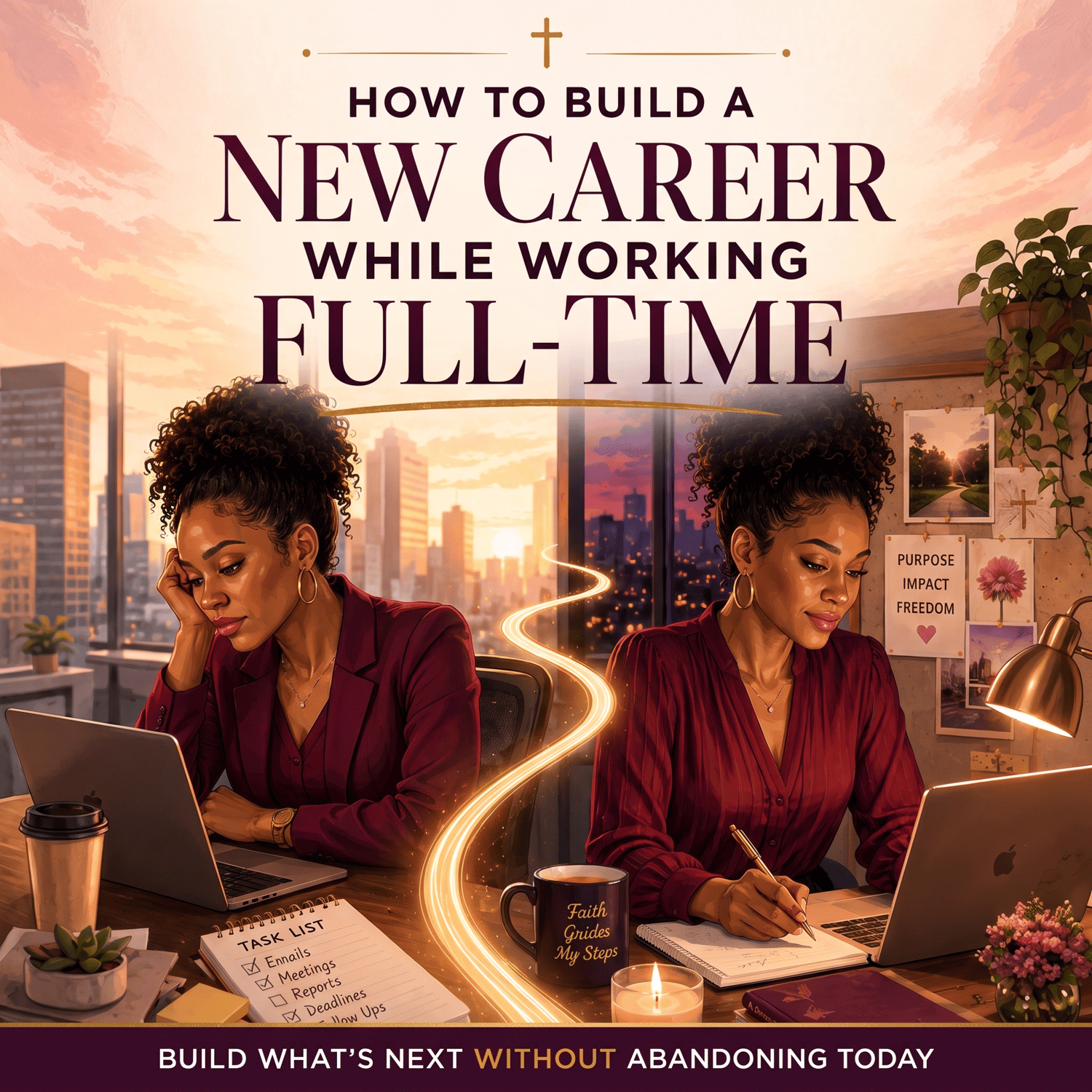
It is waking up early for a job you have outgrown, completing a full day of responsibilities, coming home exhausted, and still trying to build a different future with whatever energy you have left.
You may be learning a new skill after work, creating a portfolio on weekends, growing a business from your bedroom, or applying for opportunities during your lunch break.
You know you want something different, but you also need your current income.
That does not mean you lack faith. It means you are trying to balance purpose with responsibility.
Your current job can fund your transition without defining your identity.
Building a new career while working full-time will require patience, structure, and faith. But you do not have to quit your job tomorrow, or have your entire future figured out, to begin moving forward.
1. Stop Treating Your Current Job Like Your Final Destination
A job and a career are not the same.
Your job is the position that supports your life right now. Your career is the long-term professional direction you are intentionally building through your gifts, experience, education, and choices.
Your current job may provide:
- A dependable paycheck
- Health insurance and benefits
- Professional experience
- Transferable skills
- Financial stability while you prepare
You can appreciate those benefits without deciding to remain in the same role forever.
Your job may simply be a bridge between your present responsibilities and your future career.
Provision for this season does not automatically mean permanence.
Colossians 3:23 says:
“And whatsoever ye do, do it heartily, as to the Lord, and not unto men.”
Continue working with integrity, but stop allowing your position to determine what you believe is possible for your future.
2. Get Clear About What You Are Building
Wanting to escape a job is not the same as knowing which career you want to pursue.
When work becomes stressful, almost any alternative can appear attractive. But changing careers requires more clarity than frustration.
Before applying for random positions or enrolling in another degree program, ask yourself:
- Which parts of my current work do I enjoy?
- Which responsibilities consistently drain me?
- What problems do I feel naturally drawn to solve?
- Which subjects do I research without being asked?
- What skills do people frequently ask me to use?
- What type of environment helps me perform at my best?
- What does meaningful work look like to me now?
Write down the patterns you notice. Your next career direction may already be leaving clues throughout your life.
Habakkuk 2:2 says:
“Write the vision, and make it plain upon tables, that he may run that readeth it.”
You do not need a perfect ten-year plan. You need enough clarity to identify the direction of your next step.
A helpful resource for exploring possible career and life paths is Designing Your Life by Bill Burnett and Dave Evans. It encourages readers to approach life changes through curiosity and small experiments instead of believing there is only one correct path.
3. Choose One Career Goal for the Next 12 Weeks
Trying to change your entire life at once will leave you overwhelmed.
You do not need to update your résumé, complete three certifications, start a business, build a website, grow every social media platform, and apply for 50 jobs in the same month.
Choose one primary goal for the next 12 weeks.
Your goal might be:
- Complete one relevant certification
- Build three strong portfolio projects
- Apply for five targeted positions each week
- Schedule eight informational interviews
- Launch one simple service
- Publish one piece of content each week
- Save a specific amount for your career transition
Once you select your goal, break it into weekly actions.
The 12 Week Year by Brian P. Moran and Michael Lennington offers a practical framework for focusing on a shorter execution period instead of postponing important goals throughout an entire year.
Clarity tells you where to go. Structure helps you keep moving when motivation disappears.
4. Create a Schedule That Works With Your Energy
Building a new career after work requires more than finding time. You must also manage your energy.
You may technically have three hours available in the evening, but that does not mean you have three hours of focused mental energy.
Create a realistic weekly schedule based on your actual life.
For example:
- Tuesday: 45 minutes of skill development
- Thursday: 45 minutes for résumé, portfolio, or networking
- Saturday: Two-hour focused career-building session
- Sunday: 20-minute weekly review and planning session
Three intentional sessions can create more progress than seven evenings spent feeling guilty because you did not do enough.
Establish a “minimum version” of your routine for difficult weeks. If you cannot work for an hour, commit to 15 minutes. If you cannot complete an entire project, finish one small section.
Atomic Habits by James Clear is a useful resource for learning how small, repeatable actions can support larger goals.
Consistency does not mean doing the same amount every day. It means returning to the vision after life interrupts you.
5. Protect Your Focus
Your available career-building time is valuable. Protect it.
Turn off unnecessary notifications. Place your phone in another room. Close unrelated browser tabs. Decide what you will work on before the session begins.
Do not spend your entire career-building block watching videos about how to change careers. At some point, research must become action.
If you have 45 minutes, spend:
- 5 minutes reviewing your goal
- 35 minutes completing focused work
- 5 minutes recording your progress and next step
Deep Work by Cal Newport explores strategies for developing focused concentration in a world filled with constant distractions.
Protecting your attention can help you accomplish meaningful work without sacrificing every evening.
6. Turn Your Current Job Into Career Capital
Even if you no longer want to remain in your field, your experience is not wasted.
Your current job may be helping you develop:
- Communication skills
- Leadership experience
- Project management abilities
- Problem-solving skills
- Customer or employee insights
- Technical knowledge
- Conflict-resolution skills
- Industry relationships
- Evidence of reliability and results
Instead of describing yourself only by your job title, learn to communicate the value behind your responsibilities.
For example:
Instead of saying, “I schedule interviews,” you might say:
“I coordinate multiple stakeholders, manage competing priorities, and guide candidates through a time-sensitive process.”
The second statement identifies transferable skills that can apply to project coordination, operations, customer experience, marketing, or other career paths.
You are not starting over. You are repositioning the experience you already earned.
7. Build Evidence Before Waiting for Confidence
Many women believe they must feel confident before pursuing a new career.
But confidence often arrives after you begin, not before.
If you want to move into marketing, create a sample campaign.
If you want to enter UX research, complete a case study.
If you want to become a consultant, help one person solve a specific problem and document the outcome.
If you want to build a business, create a simple offer and test it with a small audience.
Every completed project becomes evidence that you are capable of doing more than your current title suggests.
Your portfolio, testimonials, certifications, and measurable results will help other people see what you are learning to recognize within yourself.
Stop waiting to feel completely ready. Build the evidence that reminds you why you are qualified.
8. Make Networking Part of Your Transition
Do not wait until you desperately need a job to begin building professional relationships.
Connect with people who are already working in your desired field. Ask thoughtful questions about their responsibilities, challenges, skills, and career path.
You can begin with a simple message:
“Hi, I’m currently exploring a transition into your field, and I appreciate the work you’re doing. If you’re open to it, I would love to ask you a few questions about your experience and any advice you would offer someone preparing to enter the industry.”
Networking is not asking strangers to give you a job. It is building genuine relationships, learning from other people’s experiences, and allowing others to become familiar with your interests and abilities.
One conversation can give you information that months of online research cannot.
9. Prepare Financially Before Making Your Move
You do not have to destroy your stability to prove that you believe in your future.
Before leaving your job, consider:
- Building an emergency fund
- Reducing unnecessary expenses
- Paying down high-interest debt
- Estimating the costs of training or certifications
- Researching realistic salaries in your desired field
- Testing a side-business offer before depending on it
- Understanding your health insurance options
- Creating a transition timeline
Sometimes faith looks like taking a leap. Sometimes it looks like saving, learning, and building a secure bridge before you move.
Proverbs 16:3 says:
“Commit thy works unto the Lord, and thy thoughts shall be established.”
Bring both your vision and your practical concerns to God. Ask Him for wisdom concerning your timing, responsibilities, and next steps.
Planning is not evidence that you lack faith. Wise preparation can be an expression of stewardship.
10. Give Yourself Permission to Build Slowly
It can be frustrating to watch other women announce new businesses, promotions, and career changes while you are still working behind the scenes.
But you do not know how long they prepared before making the announcement.
Do not compare your private construction season to someone else’s public celebration.
Zechariah 4:10 asks:
“For who hath despised the day of small things?”
One application matters.
One completed lesson matters.
One professional connection matters.
One hour spent building your portfolio matters.
Small actions may not immediately change your circumstances, but they are changing your direction.
Do not mistake slow movement for no movement. You are building something your current circumstances cannot reveal yet.
How Do You Know When It Is Time to Move?
There may never be a moment when you feel completely fearless. However, you may be approaching a healthy transition when:
- You can clearly explain the direction you are pursuing.
- You have developed relevant skills or evidence of your work.
- You understand the financial impact of the change.
- You have a practical transition plan.
- You are moving from purpose rather than reacting to one difficult day.
- You have prayed, prepared, and sought wise counsel.
- Remaining in the position is costing more than the stability is providing.
Do not make a permanent decision from temporary frustration. At the same time, do not allow temporary comfort to keep you permanently disconnected from growth.
A Prayer for the Woman Building After Work
Lord, thank You for the job that is providing for me during this season. Help me remain grateful without becoming afraid to grow.
Give me clarity concerning the career I am building and wisdom about the steps I should take. Strengthen me when I am tired, protect me from comparison, and help me remain consistent when progress feels slow.
Show me how to use my current experience, gifts, and resources wisely. Keep me from making decisions based on panic, pressure, or desperation.
Establish the work of my hands and prepare me for the opportunities that align with Your direction for my life.
In Jesus’ name, amen.
Your Full-Time Job Is Not the End of Your Story
Building a new career while working full-time is not easy. You are carrying the responsibilities of your current life while creating space for a different future.
Give yourself credit for the courage that requires.
You do not need to quit tomorrow. You do not need to build everything tonight. You do not need to know every step before taking the first one.
Start with clarity. Choose one goal. Create a realistic schedule. Protect your focus. Build evidence. Prepare financially. Trust God with the timing.
Your job may be supporting your present, but it does not get to place limits on your future.
You are not behind. You are building, and the work you complete in this hidden season will become the foundation of your next chapter.
If you need help identifying your gifts, understanding your career dissatisfaction, and choosing your next right move, The Clarity Blueprint was created to guide you through that process with faith, reflection, and practical action.
You do not have to figure out your entire future today. You only need enough clarity to take the next faithful step.