
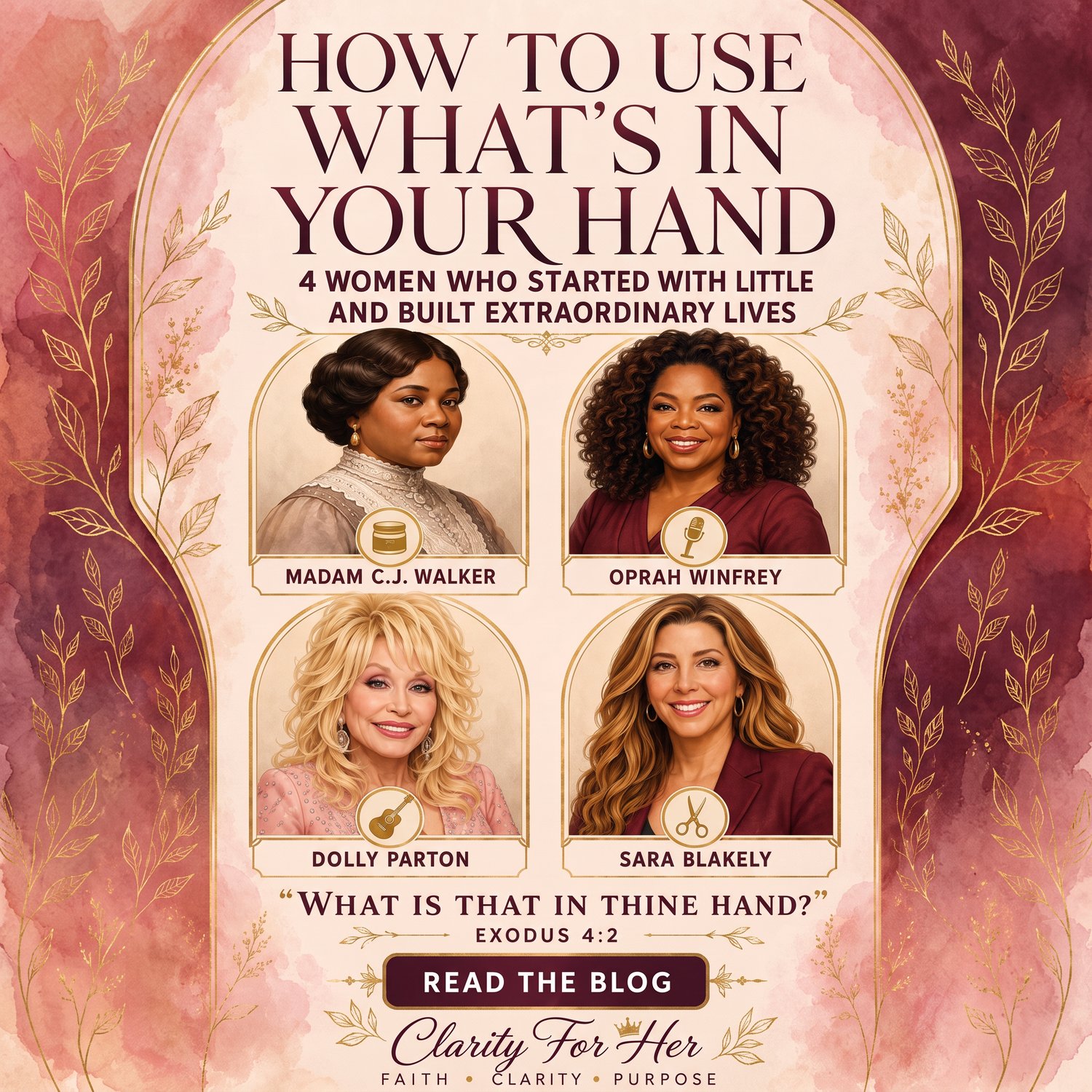
We often say a successful woman “came from nothing.”
But the truth is, she did not come from nothing.
She may have started with little money, limited education, no powerful connections, and no clear blueprint. But somewhere within her story, she possessed something—a voice, a skill, an idea, a painful experience, a pair of scissors, a guitar, or hands willing to work.
What appeared insignificant became the beginning of something extraordinary.
She may have started with little money, but she did not start empty-handed.
If you are waiting for more resources, more confidence, a larger audience, or the perfect opportunity before beginning, God may be asking you a different question:
What is already in your hand?
“What Is That in Your Hand?”
In Exodus 4, Moses questioned whether he was capable of doing what God had called him to do. He focused on what he lacked—confidence, eloquence, and credibility.
God redirected his attention.
Exodus 4:2 says:
“And the Lord said unto him, What is that in thine hand? And he said, A rod.”
It was an ordinary shepherd’s staff. Moses had probably carried it for years without seeing anything remarkable about it.
But when it was surrendered to God, that ordinary staff became part of an extraordinary assignment.
God did not begin by asking Moses what he wished he had. He asked him to recognize what he was already holding.
We see the same principle in the story of the widow in 2 Kings 4. She was grieving, overwhelmed by debt, and afraid that her sons would be taken from her.
The prophet Elisha asked:
“What hast thou in the house?”
At first, she focused on her lack:
“Thine handmaid hath not any thing in the house, save a pot of oil.”
She saw “only” a small amount of oil. But the oil was the beginning of her provision.
The miracle did not begin with something falling out of the sky. It began with something already inside her home.
God often begins with an inventory before He brings an increase.
Do Not Dismiss What Looks Ordinary
You may not have a large savings account, thousands of followers, expensive equipment, or an influential network.
But what do you have?
Perhaps you have:
- A story that could encourage another woman
- A skill people continually ask you to use
- Knowledge gained through a difficult experience
- A laptop, phone, notebook, or small workspace
- A solution to a problem you repeatedly encounter
- One free hour after work
- A gift for speaking, organizing, designing, teaching, writing, or listening
- A community that trusts your perspective
- A desire to serve a particular group of people
You may be overlooking what is in your hand because it does not look impressive enough yet.
Your hand may look empty because you are measuring it by money instead of by gifts.
Throughout history, women from different racial and economic backgrounds have built extraordinary lives by using the resources, skills, and opportunities available to them.
Their struggles were not identical. Black women often had to confront racism, segregation, and barriers that white women did not experience in the same way. Recognizing a shared principle should never erase those differences.
Still, their stories reveal something powerful: they did not wait until everything was perfect to begin.
Madam C.J. Walker Used Her Hands, Experience, and a Personal Problem
Madam C.J. Walker was born Sarah Breedlove in 1867. Her parents had been enslaved and later worked as sharecroppers. She was orphaned as a child, worked as a washerwoman, and spent years supporting herself and her daughter through physically demanding labor.
When she arrived in Denver in 1905, she reportedly had only $1.50 in savings. She continued working while mixing hair-care formulas and selling her products door to door.
Walker had experienced hair loss herself. Instead of viewing that struggle only as a source of embarrassment, she recognized that other Black women were facing the same problem.
She used what was already in her hands:
- Her personal experience with hair loss
- Her understanding of Black women’s needs
- Her willingness to experiment
- Her sales experience
- Her ability to connect with women
- Her hands, which mixed and demonstrated the products
What began with homemade formulas became a business that also created economic opportunities for thousands of Black women. The National Park Service documents Walker’s journey from poverty and washerwoman to entrepreneur and philanthropist.
Walker did not begin with a factory. She began with a problem she understood and a solution she could place in another woman’s hands.
Sometimes the problem that frustrated you is pointing toward the person you are equipped to serve.
Oprah Winfrey Used Her Voice
Oprah Winfrey’s story began in rural Mississippi. She spent part of her childhood living with her grandmother in a home without indoor plumbing.
Long before she owned a production company or became an internationally recognized media leader, she was a little girl reciting poems and Bible verses in church.
Her voice was already present.
According to the Academy of Motion Picture Arts and Sciences, public speaking competitions and pageants helped Oprah enter local broadcasting. At 19, she became the first Black news anchor on Nashville television. Her ability to communicate, listen, and connect with people eventually shaped her media career.
Oprah used what was in her hand:
- Her voice
- Her ability to communicate
- Her emotional intelligence
- Her curiosity about people
- Her difficult experiences
- Her ability to make others feel heard
The very sensitivity that may have made life more painful also helped her connect deeply with millions of people.
The part of you that once felt too sensitive may be the part God uses to help others feel seen.
Dolly Parton Used a Guitar, Her Stories, and Her Roots
Dolly Parton grew up in a poor Appalachian family as the fourth of 12 children. Her father worked as a sharecropper, and her family struggled financially.
But music surrounded her.
When Dolly was seven, her uncle gave her a guitar. By 10, she was performing on local radio and television.
She did not hide the poverty, faith, family stories, or mountain culture that shaped her. She turned those experiences into songs.
The National Endowment for the Arts describes how Parton transformed her working-class Appalachian upbringing into meaningful music, including “Coat of Many Colors.” Her distinctive voice and storytelling became the foundation of her career.
Dolly used what was in her hand:
- A guitar
- A distinctive voice
- Stories from her childhood
- The faith and music she heard in church
- The values her family taught her
- A willingness to write consistently
What others might have considered an ordinary or embarrassing upbringing became the material from which she created.
Do not be ashamed of the place where your story began. Your roots may contain the message only you can deliver.
Sara Blakely Used a Pair of Scissors and a Frustrating Problem
Sara Blakely’s beginning was different from the poverty and racial barriers faced by Madam C.J. Walker and Oprah Winfrey. However, she did enter an unfamiliar industry with limited business resources.
Blakely was preparing to wear white pants when she cut the feet out of a pair of pantyhose because she wanted the smoothing effect without visible feet.
She paid attention to a small, everyday frustration.
That simple experiment became the starting point for Spanx. The company says it began with $5,000 of Blakely’s savings and no outside funding. SPANX also identifies the footless-pantyhose experiment as the idea behind its original product.
Sara used what was in her hand:
- A pair of scissors
- Pantyhose
- A personal frustration
- Her savings
- Sales experience
- Persistence after rejection
She did not begin as a fashion-industry expert. She began as a woman trying to solve a problem she personally understood.
You do not always need a completely original idea. Sometimes you need to improve an experience that continually frustrates people.
What These Women Had in Common
These women came from different backgrounds, lived in different eras, and faced different obstacles.
But each one paid attention to something already present:
- Madam C.J. Walker recognized a problem affecting women like her.
- Oprah recognized the power of her voice and ability to connect.
- Dolly Parton used her guitar, stories, faith, and upbringing.
- Sara Blakely noticed an everyday problem and tested a simple solution.
None of them began with the full version of what they eventually built.
They began with a clue.
God may not be waiting to place something new in your hand. He may be waiting for you to recognize what is already there.
Ask Yourself: What Is in My Hand?
Take a moment to examine your own life.
What do people consistently ask you to help them with?
The requests you receive may reveal a skill you have normalized because it comes naturally to you.
What problem have you learned to solve?
Your career disappointment, financial setback, health journey, rejection, or season of rebuilding may have taught you something another woman needs.
What can you do with the resources available today?
Perhaps you cannot launch the entire business, but you can test one service.
You may not be able to publish the complete book, but you can write one page.
You may not have professional equipment, but you can record one helpful video with your phone.
You may not be ready to leave your job, but you can spend one hour each week developing your next career.
What have you been calling “just” a hobby?
You “just” enjoy organizing.
You “just” like helping people improve their résumés.
You “just” create beautiful graphics.
You “just” research subjects for hours.
You “just” enjoy teaching women what you have learned.
Be careful with the word just. It can cause you to minimize the very clue God is trying to highlight.
What feels ordinary to you may be valuable to someone who does not know how to do it.
How to Begin Using What You Have
1. Create an inventory
Write down your skills, experiences, tools, relationships, interests, and available resources.
Do not judge them yet. Simply identify them.
2. Select one problem you can help solve
Your gift becomes useful when it meets a real need.
Ask yourself: “Who can I help, and what can I help her do?”
3. Start with the smallest useful version
Do not wait until you can build everything.
Create one worksheet. Offer one service. Record one video. Teach one lesson. Help one person.
4. Pay attention to the response
Notice which questions people ask, what they find valuable, and which parts of the process energize you.
The response will help you refine the gift.
5. Remain consistent
Small beginnings require consistency before they produce visible results.
Zechariah 4:10 asks:
“For who hath despised the day of small things?”
Do not despise the stage where you are learning, testing, and building quietly.
6. Surrender the outcome to God
Moses had a staff, but the power did not come from the staff alone. The widow had oil, but the provision required faith and obedience.
Bring your gift before God and ask Him how it should be used.
Proverbs 18:16 says:
“A man’s gift maketh room for him, and bringeth him before great men.”
You do not have to force every opportunity. Develop the gift, use it faithfully, and allow God to determine where it makes room for you.
A Prayer for the Woman Who Feels She Has Nothing
Lord, open my eyes to what You have already placed within my life.
Forgive me for dismissing my gifts because they appear small, ordinary, or unfinished. Help me recognize the value inside my experiences, interests, skills, and story.
Show me who I am equipped to serve and which problem I can help solve. Give me the courage to begin before I feel completely ready.
Teach me to stop comparing my beginning to another woman’s harvest. Help me use what is in my hand with wisdom, excellence, humility, and faith.
Establish the work of my hands and allow it to become a blessing to others.
In Jesus’ name, amen.
You Are Not Starting With Nothing
You may not have everything you want, but you have something you can begin with.
A staff.
A small jar of oil.
A voice.
A guitar.
A pair of scissors.
A lesson learned through pain.
A skill developed at work.
A story that could help another woman feel less alone.
Do not insult the seed because it does not look like the harvest.
Ecclesiastes 9:10 says:
“Whatsoever thy hand findeth to do, do it with thy might.”
Start with what you have. Use it faithfully. Allow it to grow.
You are not empty-handed. You may simply need clarity to recognize what you are carrying.
If you need help identifying the gifts and patterns hidden throughout your story, begin with the Gift Clue Finderr. For a deeper journey toward understanding your experiences, strengths, and next career direction, explore The Clarity Blueprint.
Before asking God for something new, take another look at what He has already placed in your hand.