

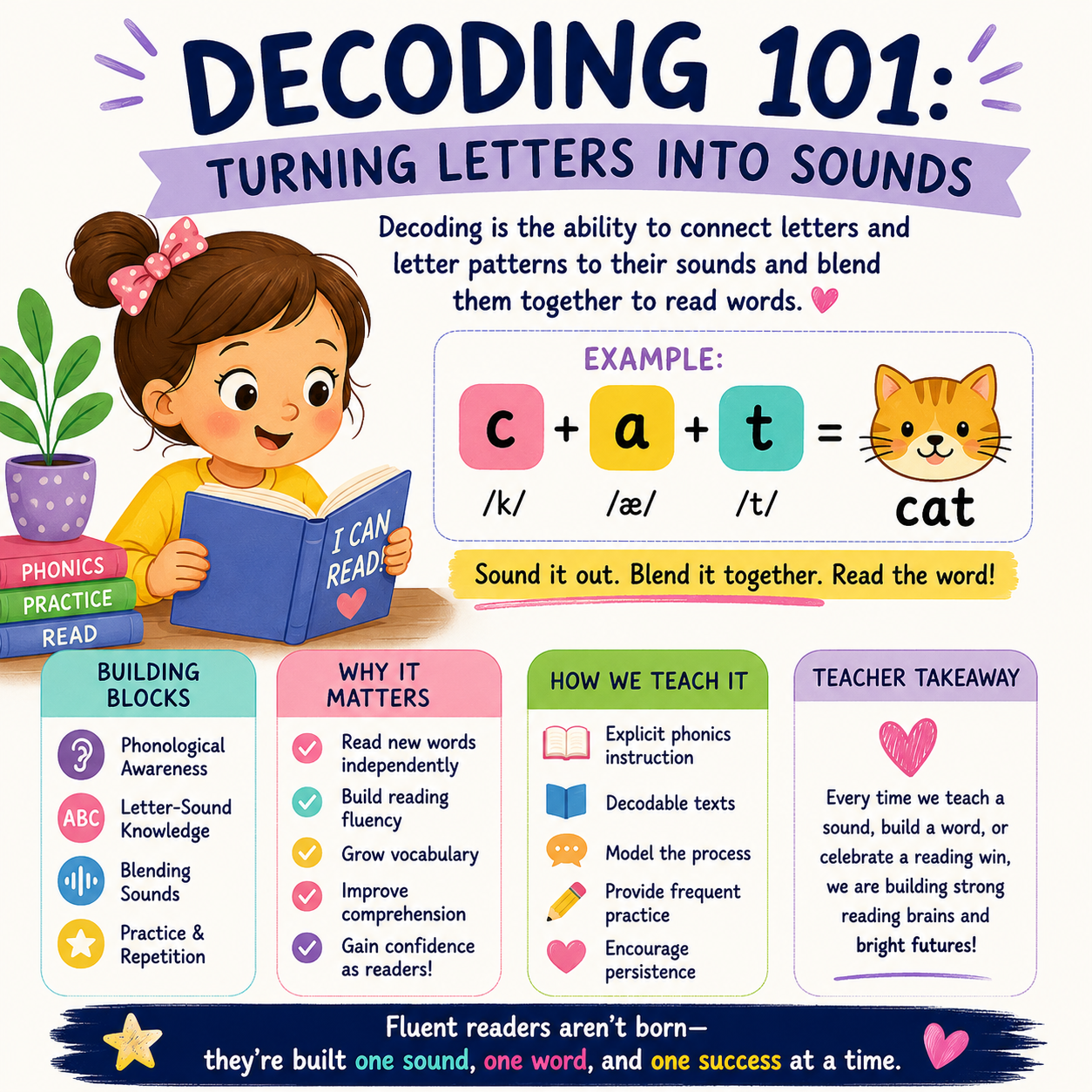
Decoding 101: Turning Letters into Sounds
One of the most exciting moments in a child's reading journey is when they realize they can read a word independently. What may seem like a simple accomplishment is actually the result of a complex process called decoding—the ability to translate written letters into spoken sounds.
Decoding is one of the foundational skills that transforms beginning readers into confident, independent learners. Understanding how decoding works can help teachers provide effective instruction and support students as they build strong reading skills.
What Is Decoding?
Decoding is the process of using knowledge of letter-sound relationships to read written words. When students look at a word and identify the sounds represented by each letter or letter combination, they can blend those sounds together to determine the word.
For example:
s – a – t → sat
The reader recognizes each letter, recalls its corresponding sound, and blends the sounds to read the word.
While skilled readers perform this process almost automatically, beginning readers must consciously practice decoding until it becomes fluent and effortless.
Why Is Decoding Important?
Decoding serves as the bridge between printed text and spoken language. Without strong decoding skills, students may struggle to read unfamiliar words, limiting both fluency and comprehension.
When students can decode efficiently, they are able to:
- Read new words independently
- Build reading fluency
- Expand vocabulary
- Focus more attention on understanding text
- Develop confidence as readers
Simply put, decoding opens the door to reading success.
The Building Blocks of Decoding
Successful decoding relies on several foundational skills:
1. Phonological Awareness
Before students can connect letters to sounds, they must understand that spoken words are made up of individual sounds.
Activities such as rhyming, syllable counting, sound isolation, and phoneme blending help strengthen phonological awareness and prepare students for decoding.
2. Letter-Sound Knowledge
Students need explicit instruction in how letters and letter combinations represent sounds.
Examples include:
- m = /m/
- sh = /sh/
- ai = /ā/
The stronger a student's knowledge of these relationships, the easier decoding becomes.
3. Blending Sounds
Once students know individual sounds, they must learn to blend them smoothly together.
For example:
c – a – t → cat
This skill often requires significant practice but becomes more automatic over time.
4. Practice and Repetition
Like any new skill, decoding improves through consistent practice. Repeated exposure to letter patterns and decodable words helps strengthen neural pathways and increase reading accuracy.
Common Challenges Students Face
Many students encounter obstacles while learning to decode. Some common difficulties include:
- Confusing similar-looking letters (b/d, p/q)
- Forgetting letter-sound correspondences
- Difficulty blending sounds smoothly
- Guessing words based on pictures or context
- Struggling with irregular spelling patterns
Recognizing these challenges early allows teachers to provide targeted support and intervention.
Effective Classroom Strategies for Teaching Decoding
Research-based instruction can significantly improve decoding skills. Consider incorporating the following strategies:
Explicit Phonics Instruction
Teach letter-sound relationships systematically and directly. Introduce skills in a logical sequence and provide opportunities for guided practice.
Use Decodable Texts
Decodable books allow students to apply the phonics skills they have learned. This helps reinforce decoding strategies and build confidence.
Model the Process
Think aloud while decoding unfamiliar words. Demonstrate how skilled readers break apart words and blend sounds.
Provide Frequent Practice
Short, daily opportunities to decode words, sentences, and connected text are more effective than occasional lengthy sessions.
Encourage Persistence
Remind students that struggling with a word is part of learning. Celebrate effort and growth as much as accuracy.
From Decoding to Fluent Reading
Decoding is not the final destination—it is the pathway to fluent reading. As students repeatedly decode words, many become stored in long-term memory through a process known as orthographic mapping.
Eventually, readers no longer need to sound out every word. They recognize many words instantly, allowing them to focus on meaning, comprehension, and enjoyment.
Final Thoughts
Decoding may seem like a small step in the reading process, but it is one of the most powerful skills we teach. Every time students connect letters to sounds and successfully read a word, they strengthen the foundation for future literacy success.
As educators, our role is to provide explicit instruction, meaningful practice, and encouragement along the way. With strong decoding skills, students gain the tools they need to unlock the world of written language—one sound, one word, and one book at a time.