

Phonemic Awareness vs. Phonics: What's the Difference?
If you've spent any time in elementary education, you've likely heard the terms phonemic awareness and phonics used interchangeably. While they are closely related and both play critical roles in learning to read, they are not the same thing.
Understanding the difference can help teachers provide more effective literacy instruction and better support struggling readers.
What Is Phonemic Awareness?
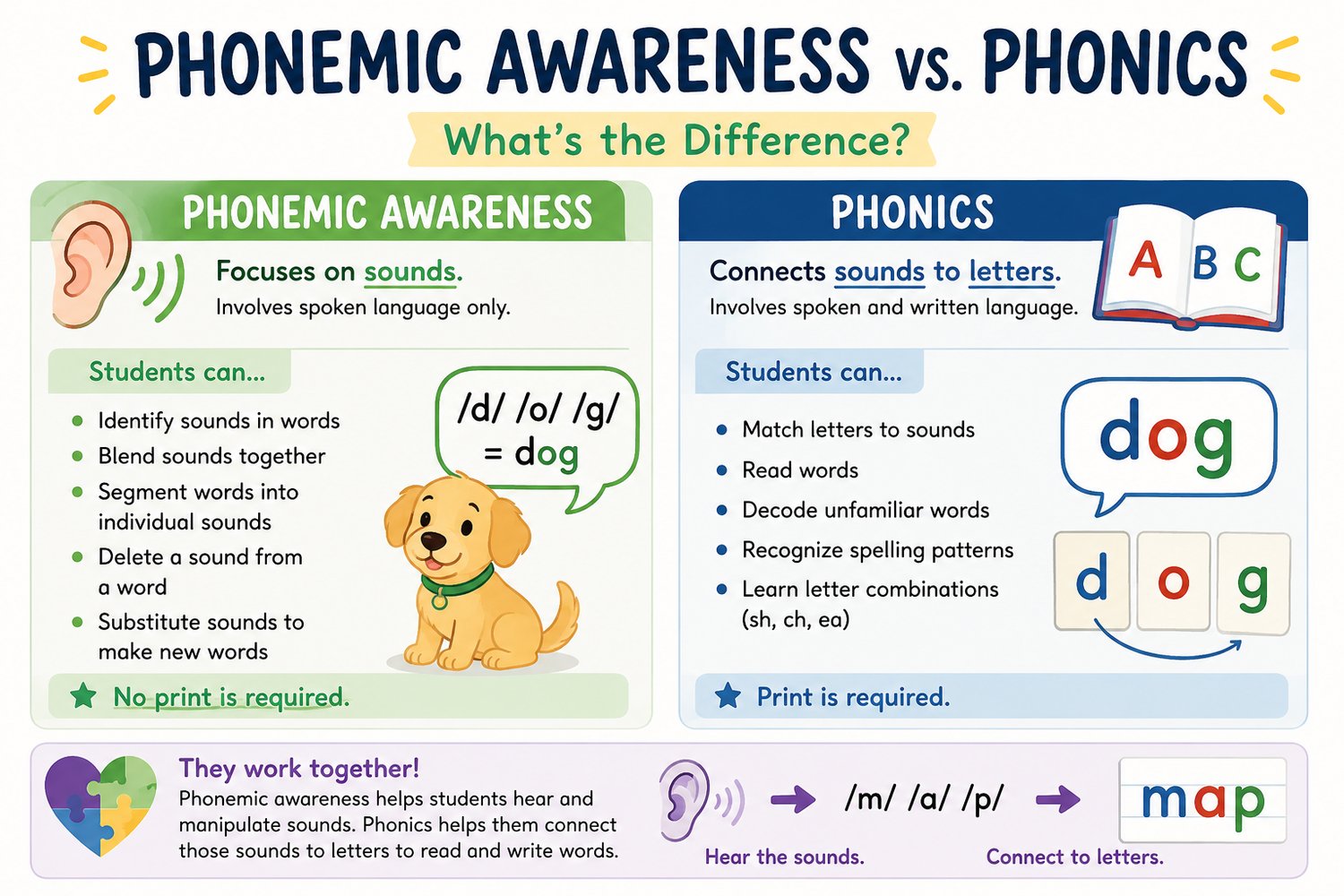
Phonemic awareness is the ability to hear, identify, and manipulate individual sounds (phonemes) in spoken words.
Importantly, phonemic awareness is an auditory skill. It focuses entirely on sounds and does not involve printed letters or words.
For example, students demonstrating phonemic awareness can:
- Identify the first sound in cat (/k/)
- Blend sounds together to form a word (/d/ /o/ /g/ = dog)
- Segment a word into its individual sounds (ship = /sh/ /i/ /p/)
- Delete a sound from a word (smile without /s/ becomes mile)
- Substitute sounds to create new words (hat becomes hot)
Because phonemic awareness happens "in the air," students can practice these skills without ever looking at text.
Why Is Phonemic Awareness Important?
Research consistently shows that phonemic awareness is one of the strongest predictors of future reading success. Before children can connect letters to sounds, they must first recognize that spoken words are made up of individual sounds.
Think of phonemic awareness as the foundation upon which phonics instruction is built.
What Is Phonics?
Phonics is the relationship between sounds and the letters or letter combinations that represent those sounds in print.
Unlike phonemic awareness, phonics involves both sounds and written language.
Examples of phonics skills include:
- Matching the letter m to the sound /m/
- Reading words with short vowel patterns
- Decoding unfamiliar words
- Recognizing common spelling patterns
- Learning letter combinations such as sh, ch, and ea
When students use phonics, they are applying their understanding of sound-symbol relationships to read and spell words.
Why Is Phonics Important?
Phonics gives students the tools they need to decode words independently. Strong phonics instruction helps readers move beyond memorizing words and empowers them to tackle new words with confidence.
Systematic phonics instruction has been shown to improve reading accuracy, fluency, and comprehension, particularly for beginning readers.
The Key Difference
The simplest way to remember the difference is this:
Phonemic awareness focuses on sounds. Phonics connects sounds to letters.
Phonemic Awareness Phonics
Involves spoken language only Involves spoken and written language
Focuses on hearing and manipulating sounds Focuses on connecting sounds to letters
No print is required Print is required
Develops before and alongside phonics Builds on phonemic awareness skills
How They Work Together
Phonemic awareness and phonics are partners in reading development.
For example, before a student can read the word map, they need to be able to hear the three sounds /m/, /a/, and /p/. That's phonemic awareness.
Once they can identify those sounds, they learn that the letters m, a, and p represent them in print. That's phonics.
Without phonemic awareness, phonics instruction can feel confusing. Without phonics, students cannot effectively apply their understanding of sounds to reading and writing.
Classroom Strategies
Building Phonemic Awareness
Try activities such as:
- Rhyming games
- Sound matching activities
- Oral blending and segmenting
- Sound deletion and substitution exercises
- Interactive songs and chants
Teaching Phonics
Support phonics development through:
- Explicit instruction in letter-sound relationships
- Decodable texts
- Word-building activities
- Sound-spelling mapping
- Guided reading and writing practice
Final Thoughts
While phonemic awareness and phonics are distinct skills, both are essential components of effective literacy instruction. Phonemic awareness helps students understand that words are made up of sounds, while phonics teaches them how those sounds connect to print.
When educators intentionally develop both skills, they give students a stronger foundation for reading success and help create confident, capable readers for years to come.